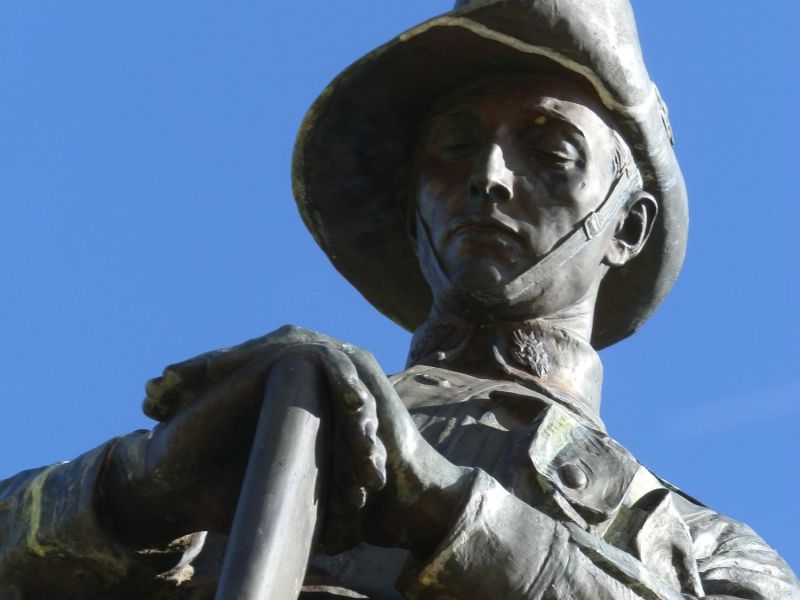
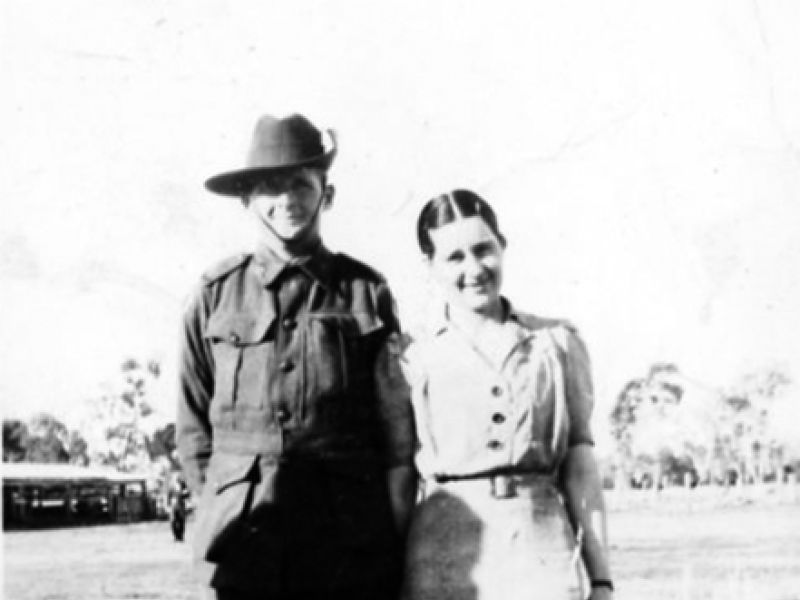
Private Neal Mortimer Bidstrup, 2/26th Australian Infantry Battalion
 Australian War Memorial
Neal Bidstrup was born on 6 July 1914 in Warra, a farming area in Queensland on the Darling Downs. The son of Alfred and Jane Bidstrup, he grew up in Queensland alongside his sister, Anna, and attended Dalby State High School.
He went on to work as a farmer, inheriting the family farm after the death of his father in August 1929. Having won a scholarship to attend Gatton Agricultural College in July 1929, he developed the farm into a successful Illawarra Shorthorn stud, and showed cattle with some success at country agricultural shows.
With the start of the Second World War, Bidstrup became engaged to his sweetheart, Eileen Anderson, before enlisting in the Second Australian Imperial Force on 23 April 1941.
Private Bidstrop entered Redbank Camp and began training. Following pre-embarkation leave, he was allocated to the 2/26th Infantry Battalion. He joined his unit at Bathurst in July before embarking from Melbourne for active overseas service.
Arriving in Singapore in mid-August, Bidstrup was admitted to a convalescent depot to recover from a case of mumps. The 2/26th was camped near Changi village on the north-eastern tip of the island. With war against Japan increasingly likely, at the start of October the battalion began deploying to Malaya where it continued its training and prepared defences. In early December 1941 the Japanese launched surprise attacks on Pearl Harbor in Hawaii, and invaded Malaya.
By the beginning of January 1942, Japanese forces had advanced through Thailand and most of Malaya. In preparation for the fighting ahead, the 2/26th moved on 10 January to Johore, on the western side of the peninsula, where it fought alongside British and Indian troops.
Less than a week later, the battalion began a fighting withdrawal towards Singapore Island. Towards the end of January, the battalion held the Simpang Rengam crossroads, where it was shelled by Japanese artillery and strafed by Japanese aircraft. The battalion inflicted heavy casualties on the Japanese and proved to be particularly successful in fighting rearguard actions; morale was high.
With Indian troops protecting the final withdrawal, the men crossed into fortress Singapore. The Japanese attack on Singapore began at 10.30 pm on 8February, when two Japanese divisions crossed the Johore Strait. Bidstrup and his comrades defended the Causeway sector, but there was no stopping the Japanese advance. By 13 February the battle for Singapore was all but over; the British commander surrendered two days later.
After the surrender, prisoners of war were concentrated in Changi goal, where they were used as labour for work parties. The first parties were dispatched around Singapore and southern Malaya, but Bidstrup was to become part of F Force, one of the last labour forces to leave Changi in on 21 April 1943.
Many of the men of F Force were unwell even before they left Singapore. F Force’s hardships began when the men were packed into suffocating metal railway trucks with little food and water. On reaching Ban Pong in Thailand, they were forced to march over 300 kilometres to camps near the border with Burma. Arriving up country in early May, F Force was spread across half a dozen camps progressing toward the Burma border. From here, the men would work on the infamous Burma–Thailand Railway.
Isolated, remote from food and medical supplies, and drenched by monsoonal rains, almost a third of the Australians and two-thirds of the British prisoners would die.
Private Bidstrup died on 27 May 1943 at Lower Sonkuri No. 1 Camp. His cause of death was listed as cholera.
He was 28 years old.
Today, his remains lie buried in Thanbyuzayat War Cemetery under the inscription chosen by his grieving family:
“Duty nobly done … ever remembered.”
- AWM Roll of Honour https://www.awm.gov.au/collection/R1683449
- Virtual war memorial https://vwma.org.au/explore/people/620005