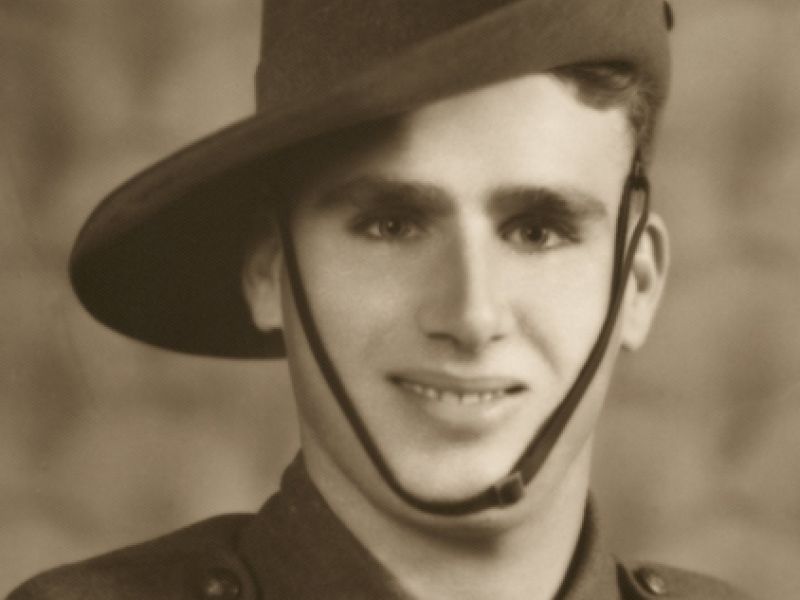
Trooper Francis Herbert Whitehouse, 2/7th Australian Cavalry Regiment
 Australian War Memorial
Francis Whitehouse was born on 20 April 1917, in Laidley, Queensland. Known as Frank, he was one of 11 children born to farmer Charles Whitehouse and his wife Sarah. Francis joined his father working on the family property: Tupcott Farm. When he was 23, he married Florence Crosby, with the wedding taking place on 5 February 1940 at St Saviours Church in Laidley. The young couple later had a daughter.
Francis and his brother Benjamin enlisted in the Australian Imperial Force on 27 May 1940. They were followed by their brother Ivor, who enlisted in June, and Charles, who enlisted in July. Francis and his brothers were assigned to the 7th Division Cavalry Regiment.
Francis trained at Enoggera in Queensland before moving Cowra in New South Wales, where he trained to operate Vickers light tanks and machine-gun carriers. In November 1940, he and his comrades were granted leave before being sent to the front. On Boxing Day, Frank and his brothers embarked for active service on board Queen Mary.
Private Francis Whitehouse arrived in Egypt in early February 1941. His unit moved to Palestine shortly after, and continued training. Whitehouse then became ill and was sent to the 5th Australian General Hospital, suffering from inflammation of the optic nerves. He re-joined his unit in early March, and moved to the Suez Canal where his unit assisted with defences.
In May 1941, Whitehouse’s unit was sent to Cyprus in support of British troops preparing to defend the island from German invasion. They moved to Syria in early August, serving as part of the garrison force after heavy fighting against Vichy forces a month earlier.
Whitehouse and his brothers returned to Australia in early 1942, shortly after Japan’s entry into the war. They arrived in Adelaide in early March, after which they moved to Landsborough on Queensland’s Sunshine Coast, to continue training. Whitehouse was granted a month’s leave without pay, probably to spend time with his wife and daughter. He re-joined his unit in June during a period of restructuring in which his regiment was designated the 2/7th Cavalry Regiment.
In September, the regiment was sent to Papua to help defend Port Moresby against the Japanese advance. Deployed without tanks or armoured cars because of the unsuitable conditions on the island, the 2/7th Cavalry served as infantrymen. In December, it was flown to Poppondetta to reinforce Australian units.
On 18 December, the 2/7th Cavalry was moving to Huggins roadblock, when Whitehouse’s squadron encountered a Japanese patrol. After heavy fighting ensued, the enemy had suffered eight killed, while the 2/7th had lost two men, including Trooper Francis Whitehouse, who was killed during the fighting. His brothers arranged to have his personal effects sent to his widow, Florence, before burying their brother where he fell. The following day, Francis’s brother Ivor was killed during the push to capture Sanananda Point.
His wife later posted an in memoriam notice in the local newspaper which read:
“To live in the hearts we leave behind is not to die.”
Frank Whitehouse was 25 years old.
- AWM Roll of Honour https://www.awm.gov.au/collection/R1691803