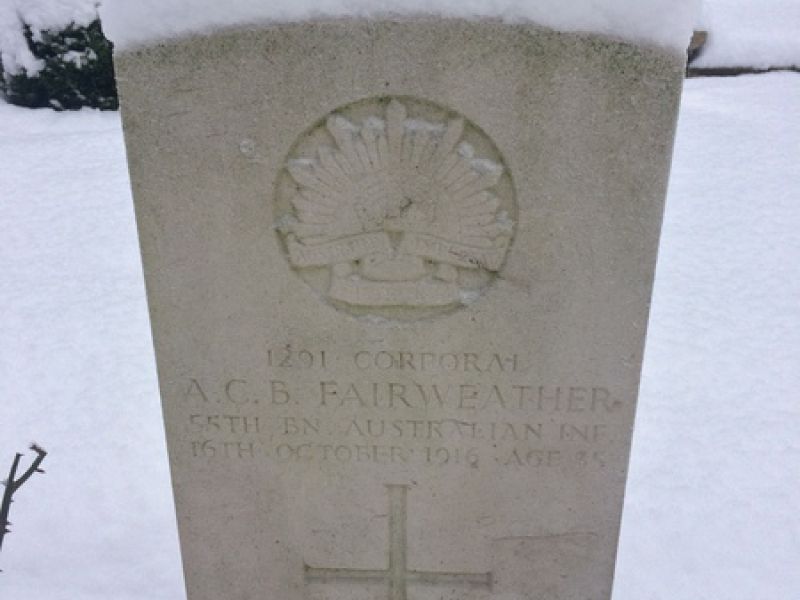
Lance Corporal Andrew Carnegie Booth Fairweather, 55th Australian Infantry Battalion
 Australian War Memorial
Andrew Fairweather was born in Arbroath, Scotland around 1881, one of 12 children born to Alexander and Emma Fairweather.
When Andrew was seven, his family immigrated from Scotland to Australia. They settled in Brisbane before moving south to Wellington in New South Wales, where Andrew’s father began farming a block of land. Andrew attended the local Wellington South Public School, before finding work as a carpenter. In 1908, Andrew joined the permanent full-time strength of the Royal Australian Garrison Artillery.
>He remained as a full time soldier until 10 October 1914, when he enlisted for service in the Australian Imperial Force. Andrew Fairweather was assigned to the 3rd Battalion, and ten days later departed from Sydney in the troopship Euripides to join the first convoy leaving Albany in early November 1914.
Although intended to sail directly to England and the Western Front, the convoy was rerouted to Egypt. Fairweather and the 3rd Battalion arrived at Mena Camp outside Cairo on 4 December 1914, and spent the next few months training.
Fairweather remained in Egypt when the bulk of the 3rd Battalion landed on Gallipoli on 25 April 1915, but joined his battalion on the peninsula on 7 May. He was wounded, sustaining a gunshot wound to the eye in early June, and spending six weeks recovering in Egypt and Cyprus before returning to his unit in late July, both eyes still intact.
Fairweather was wounded again during the fighting at Lone Pine in early August, and was evacuated to Mudros for medical treatment, and then England to recover fully.
Fairweather returned to Egypt in mid-1916, to find that the 3rd Battalion had been split to provide numbers for the newly-formed 55th Battalion. He joined B Company of the 55th Battalion on 21 April 1916, and was promoted to lance corporal.
The battalion left Egypt two months later, sailing from Alexandria to Marseilles in late June. From southern France, the battalion travelled north by train. By mid-July they were in the frontline trenches just south of Armentieres. This area was known as the nursery sector by the men, due to the relatively quiet introduction to trench warfare it offered.
A week after entering the trenches on the Western Front for the first time, the battalion prepared for its first major battle at Fromelles on 19 July. The battle was a disaster. Initially held in reserve, the 55th Battalion was quickly committed to the attack, and eventually played a critical role in supporting the 14th Brigade’s withdrawal.
Between the evening of 19 July and the following morning, the battalion sustained heavy losses: 339 casualties, including 143 men missing in action.
Among the missing was Lance Corporal Andrew Fairweather. It was later discovered that he had been captured, and became a prisoner of war. He was transported from outside Fromelles to Dülmen Prisoner of War camp in western Germany. While international laws required that prisoners of war be kept in specific conditions and treated well, food shortages and tensions between the different sides often impacted prisoners. By the time Andrew left Dülmen for the prisoner of war camp at Minden, he was described as looking “very ill”, possibly as a result of “very bad” food.
Not long after arriving at Minden, Fairweather was admitted to hospital suffering from pneumonia. Lance Corporal Andrew Fairweather died of heart issues in hospital at 2 am on 16 October 1916.
He was 35 years old.
His remains were initially buried in the French Prisoner of War Cemetery at Minderheide. A small funeral was held in his honour, attended by other members of the 55th Battalion and presided over by the Canadian padre at the camp.
In 1924, as part of the effort to concentrate allied prisoner of war graves across Germany, Andrew’s remains were exhumed and reinterred in Hamburg Cemetery beneath an Imperial War Graves headstone.
- AWM Roll of Honour https://www.awm.gov.au/collection/R1723860