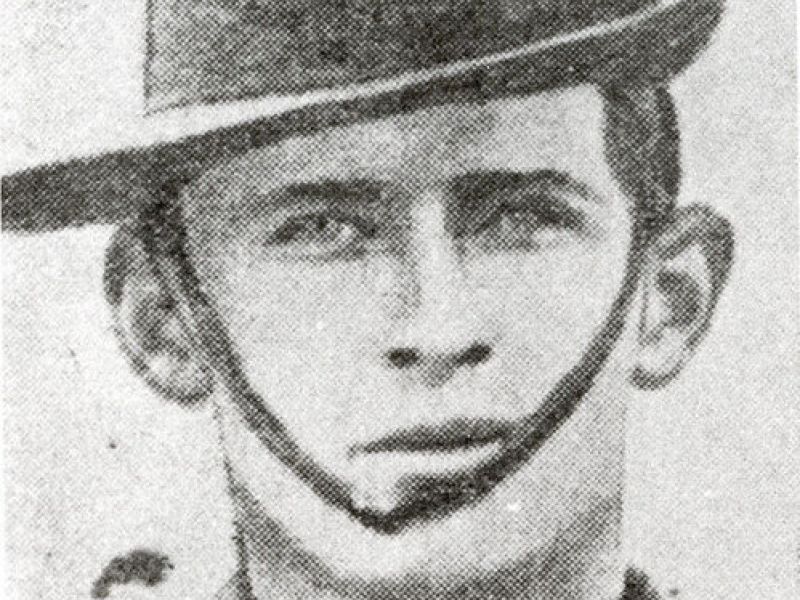
Private William Frederick Field Hehr, 1st Australian Pioneer Battalion
 Australian War Memorial
William Hehr was born on 9 May 1896 in the Melbourne suburb of Brunswick. He was the elder of two sons born to German immigrant Christian Hehr and his wife Amelia. Christian and Amelia separated soon after the birth of their second son, Thomas Edward, in 1898.
William and his brother Thomas attended Devenish West and Campbellfield State Schools, before William enrolled in the Melbourne Working Men’s College as a sheet metal worker. After finishing his schooling, he moved with his mother to Glenroy, where he found work as a farmer and a labourer.
William enlisted in the Australian Imperial Force for the first time on 27 October 1914 in Melbourne. He was allotted to the 1st reinforcements of the 8th Light Horse Regiment, and began initial training. In early January 1915, the officer in charge of the 8th Light Horse recommended that William be discharged because of his frequent misbehaviour. At the end of his letter, the officer in charge asserted, “I do not desire this type of man in the Light Horse.”
Undeterred, William re-enlisted in the AIF a few weeks after his discharge, signing his new attestation papers on 21 January 1915. This time, he used a false name: James Anderson. His mother later recalled that William “said that he wasn’t going to be called after the old Kaiser … he was a high spirited boy and very enthusiastic to go to war.”
After training with B Squadron of the 13th Light Horse Regiment, William left Melbourne in the troopship Persic on 28 May 1915, bound for Egypt.
In Egypt in late June, William continued to train with the 13th Light Horse. On 1 August, he was hospitalised with venereal disease. A decision was made to return him to Australia, and he departed Egypt on 3 August.
Back in Australia in early September, William returned to duty at Broadmeadows camp on 14 October 1915, still using his assumed name of Anderson. He was allotted to the 7th reinforcements of the 24th Australian Infantry Battalion with the rank of private.
Following a month of training, William again left Melbourne, this time aboard the troopship Commonwealth on 20 November 1915. It would be the last time he saw Australia.
William arrived in Egypt in early 1916 and joined the 6th Training Battalion at Zeitoun. On 24 February, he was taken on strength of the 8th Battalion at Serapeum, before being transferred to the 1st Pioneer Battalion on 13 March.
William departed Egypt in late March 1916 in the troopship Ballarat, arriving in southern France on 2 April. Throughout April and May, the battalion was involved in maintenance and repair work around Sailly, just north-west of Fromelles.
On the night of 30 May, the battalion was undertaking its usual program of night-time work in the trenches when the enemy began an intense bombardment of the front-line trenches at 7:30 pm. After two hours of constant heavy bombardment, a German raiding party entered the allied trenches.
During the raid, William rushed to help a machine-gunner who had been knocked from his position by a bomb. William helped to save the gun from being captured by the enemy, “and though inexperienced in the use of machine guns” began to use it against the German raiders. William was knocked down by a second bomb, but managed to assist the machine-gunner to remove the gun into a more forward position.
Following the raid, William was recommended for a Distinguished Conduct Medal for his actions. In his recommendation, the officer in command of the 1st Pioneer Battalion wrote that William’s “gallant action not only saved the gun from capture but permitted of it being effectively used against the enemy.”
Following the raid, the battalion remained in the area throughout June, continuing their maintenance and repair works. On 18 June, William was wounded by a bomb while undertaking works and manning the reserve line, and admitted to the 3rd Australian Field Ambulance. His admission report noted that the shrapnel had entered under his left clavicle.
William was transferred to the 1st Australian Casualty Clearing Station on 19 June, and admitted in a “dangerous” condition. William Hehr died that evening, at 9:15 pm, of the wound sustained in the field.
He was 20 years old.
Two days after his death, the officer in command of the 1st Pioneer Battalion was informed that William Hehr had been awarded a Military Medal for his actions during the raid on 30 May.
Writing home to William’s mother on 28 June, the chaplain of the 1st Pioneer Battalion reflected that “he was a particularly plucky young fellow and his courage was rewarded by the fact that the Military Medal was awarded to him.”
William was buried at Estaires Communal Cemetery and Extension in France the day after his death. His Imperial War Graves headstone bears the inscription selected by his grieving mother: “They miss you most who love you best, in memory of a loving son.”
- Roll of Honour, Australian War Memorial https://www.awm.gov.au/collection/R1634939
- Virtual War Memorial, Australia https://vwma.org.au/explore/people/88751