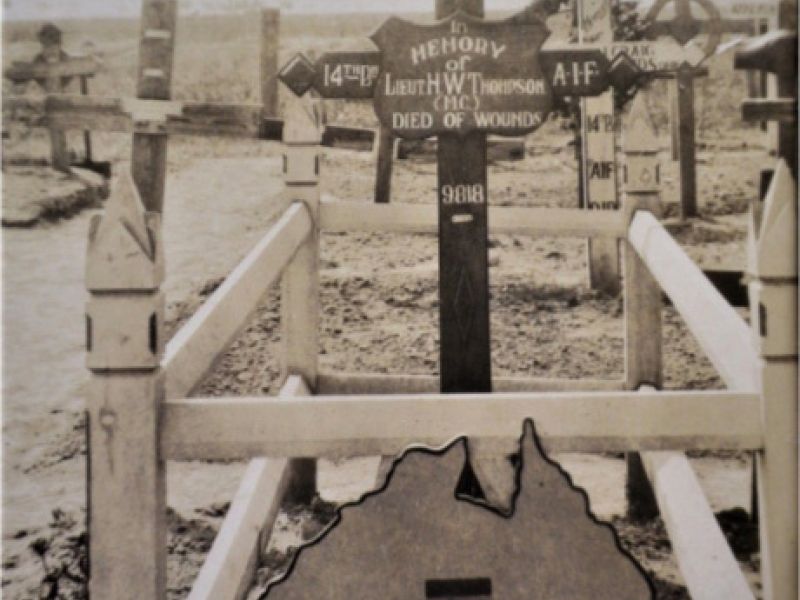
Lieutenant Harold William Thompson, 14th Australian Infantry Battalion
 Australian War Memorial
Harold Thompson was born Harold William Best in November 1891, the eldest of four children born to Ada Mary Best in East Melbourne. By 1900, Ada and her four children were living with architect Arthur Thompson in Fitzroy, and the children were given his surname.
Harold attended George Street State School in Fitzroy, before finding work as a photographer. He also spent four years with the junior cadets attaining the rank of captain before joining the senior cadets as a lieutenant in July 1911. He was promoted to captain in the senior cadets in August 1913, at the age of 23.
On 17 July 1913, Harold married Jessie Clifton. The couple moved into a two-story townhouse on Gore Street in Fitzroy, and on 29 November, Jessie gave birth to the couple’s only son: Jack Thompson.
Harold enlisted in the Australian Imperial Force on 26 September 1914. He was allotted to C Company of the 14th Battalion with the rank of sergeant, and began training at Broadmeadows Camp on the outskirts of Melbourne.
Sergeant Harold Thompson departed Melbourne in the troopship Ulysses on 22 December 1914, bound for Egypt.
He spent the opening months of 1915 training in Egypt, before joining the Mediterranean Expeditionary Force at Gallipoli on 20 May 1915.
On 26 June 1915, Harold was severely wounded in action and evacuated off Gallipoli. He was admitted to St George’s Hospital on Malta with an explosive shell wound to his skull, a bomb wound to his right shoulder, and mild amnesia. Given the severity of his condition, he was sent to England for treatment.
After recovering from his wounds, Harold rejoined the 14th Battalion at Mudros on the Greek island of Lemnos in October, before returning to Egypt. Harold was promoted to company sergeant major on 1 May 1916.
His battalion left Egypt in June, arriving at Marseilles in southern France a week later. By the end of the month Harold was in hospital again, having suffered a gunshot wound to his right arm outside Boulogne on 29 June. He rejoined the 14th Battalion on 20 July 1916, in time for its first major action at Pozieres.
Harold was promoted to 2nd lieutenant on 6 August 1916, and spent the rest of 1916 moving between the Somme and the Ypres sector in Belgium.
Harold began 1917 with a promotion to lieutenant. He was seconded to the 4th Training Battalion in England in mid-February, and left the Western Front for Codford in England. In September, he was court martialled for attempted fraud. Found guilty, he was reprimanded and stripped of his seniority as punishment.
He returned to the 14th Battalion in November 1917, and passed another bitter winter in the Somme Valley.
Harold had a difficult start to 1918. By mid-February he had been gassed three times, and been admitted to the 24th General Hospital. After treatment he was evacuated to England, and admitted to the 3rd London General Hospital. It took him two months to recover from issues caused by the gas attacks, suffering respiratory issues, vision problems, pain in his temples, and severe insomnia.
Harold returned to France in late April 1918, eventually joining the 14th Battalion outside Villers-Bretonneux.
On 19 July 1918, Harold was awarded the Military Cross “for conspicuous gallantry and devotion to duty” during a raid on Bois de Vaire outside Corbie in mid-June. The commendation read:
“This Officer organised and led a party of 30 men against the enemy position. Before reaching his objective he encountered heavy resistance from forward posts, but by his disregard for personal danger and energetic leadership he succeeded in overcoming these posts and in one instance rushed a post of three single handed, killing two while the other was shot trying to escape. By his personal example and the confidence he inspired he carried his party with fine dash to his objective, inflicting heavy casualties on the enemy, and returned with three prisoners and a machine gun. His tireless patrolling and skilful organisations in the preparatory stages rendered the success of the raid possible.”
By early August, the 14th Battalion was involved in the fighting outside Amiens. Before dawn on 8 August, a mass of assembled Allied forces, including Australians, launched an offensive to push through the German front lines. In just over three hours, the enemy's front line had been overrun. Success, however, came at a high cost, with over 20,000 Allied casualties.
Lieutenant Harold Thompson sustained a gunshot wound to the head. Rushed to the 61st Casualty Clearing Station, he succumbed to his wounds at 5 am on 9 August 1918.
He was 28 years old.
His remains were buried at Vignacourt British Cemetery. An Imperial War Graves headstone was later erected over his grave, bearing the personal inscription selected by his wife: “Dearly loved husband of Jessie Thompson and father of Jack”.
- AWM Roll of Honour https://www.awm.gov.au/collection/R1671436
- Virtual war memorial https://vwma.org.au/explore/people/84763