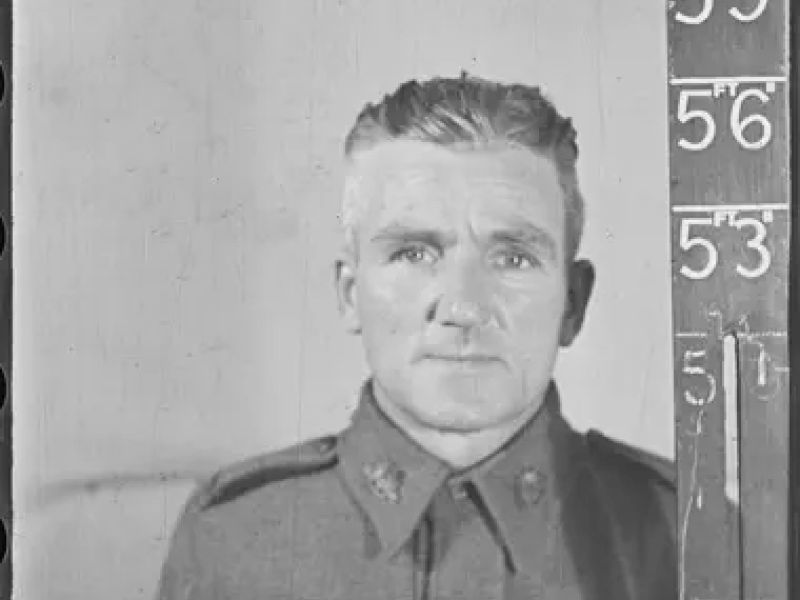
Private Frank Caine, 2/3 Ordnance Stores Company, Australian Army Ordnance Corps
 Australian War Memorial
Frank Caine was born in Nottingham, England on 22 October 1904, the son of Frank and Elizabeth Caine.
He grew up in Nottingham, alongside his sisters Winifred, Beatrice and Sarah. Frank’s mother died when he was four years old; his father died six years later.
Frank emigrated to Australia in September 1924 at the age of 19. Arriving in Sydney, he was employed for a time on a farm run by the Sauls family in Kempsey on the New South Wales north coast.
He returned to his home town in England with a friend in 1929, and spent time with family, before returning to Australia to continue working in Kempsey.
By the time he enlisted for service in the Second World War, however, Frank Caine was living in Brisbane. Volunteering for the Second Australian Imperial Force on 15 April 1941 at Brisbane, Caine listed his sister Winifred as his next of kin. Marched into Redbank Camp, Private Caine began training.
After a short period of pre-embarkation leave, in August he was admitted to camp hospital suffering from a carbuncle. He returned to duty soon afterwards, and in October was found absent without leave. After being confined to barracks for two days as punishment, he travelled to Sydney, and embarked for active overseas service on 29 October 1941.
During the journey, Caine accidentally injured his left hand. He received treatment on board, before arriving at Singapore in November.
In Singapore, Caine served with the 2/3rd Ordnance Stores Company, becoming part of the Australian Army Ordnance Corps, which supplied the army with the materials it needed to live, move and fight. The Australian Army Service Corps supplied consumable items, such as food and fuel, and the Royal Australian Engineers and Corps of Signals distributed specialist engineer stores and signals equipment. The Ordnance Corps supplied ammunition and non-consumable items, including weapons, munitions and vehicles – as well as tents, knives and forks, clothing and spare parts to maintain vehicles and equipment.
Just before midnight on 7 December 1941, Japanese forces landed at Singora and Patani in Thailand, and at Kota Bahru in northern Malaya, where they fought Allied forces.
By January, the rapid advance of Japanese forces seemed unstoppable. The threat to the Pacific was insistent and pressing. The Japanese invasion of Singapore, when it came, was swift and overpowering. Spread too thinly over too wide a front, Australians forces were unable to prevent Japanese amphibious landings which were launched on the 8th of February. Within five days, the battle for Singapore Island was all but over; British forces surrendered two days later. With that, Private Frank Caine became a prisoner of war.
Initially imprisoned in the sprawling Changi prisoner-of-war camp, Australian prisoners were soon allocated to external work parties. The first were dispatched around Singapore and southern Malaya, but Caine became part of “F Force”, one of the last labour forces to leave Changi in mid-April 1943.
Many of the men of F Force were unwell even before they left Singapore. Isolated in far up-country Thailand, remote from food and medical supplies, and drenched by monsoonal rains, almost a third of the Australians and two-thirds of the British prisoners would die.
F Force’s hardships began when they were packed into suffocating metal railway trucks with little food and water. On reaching Ban Pong in Thailand, F Force was then forced to march over 300 kilometres to camps near the border with Burma. Arriving up country in early May, F Force was spread across half a dozen camps progressing toward the Burma border. Most men were by now in a weakened state from exhaustion, hunger and disease.
On 21 September 1943, Frank Caine died of malaria.
He was 38 years old.
Initially buried near where he fell, his remains were later transferred to Thanbyuzayat War Cemetery in Myanmar, where they lie today under the inscription,
“His duty nobly done. Loved by all, resting where no shadows fall."
- AWM Roll of Honour https://www.awm.gov.au/collection/R1691661
- Commonwealth war graves commission https://www.cwgc.org/stories/stories/private-frank-caine-qx20941-23-ord-store-c…