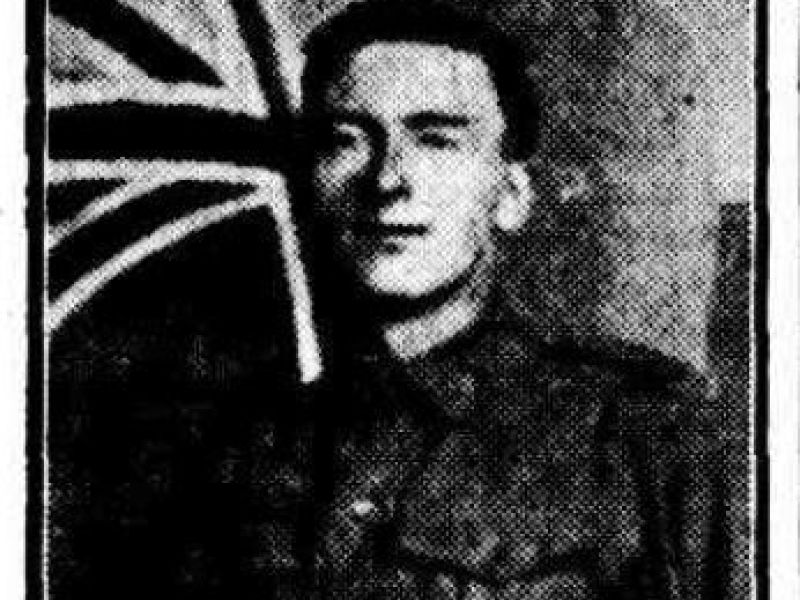
Private Robert Lang Dickson, 13th Australian Infantry Battalion
 Australian War Memorial
Robert Dickson was born on 12 May 1892 in the Sydney suburb of Balmain. Known as Bert, he was the eldest of nine children born to surveyor Robert James Dickson and his wife Theresa. Bert’s youngest brother William died only two days after his birth in 1904; their mother Theresa passed away a few months later. Robert Senior remarried in 1906, and the couple had one son together.
By 1914, the family were living in Kempsey, New South Wales, where Robert Senior was employed as a draughtsman and surveyor. Bert Dickson followed in his father’s footsteps, finding work as a surveyor’s assistant while studying to qualify as a licensed surveyor.
Dickson enlisted in the Australian Imperial Force shortly after the outbreak of the First World War, signing his papers at Liverpool Recruiting Depot on 22 October 1914. He was allotted to C Company of the 13th Infantry Battalion. After two months of initial training, Private Robert Dickson departed Melbourne on the troopship Ulysses on 22 December 1914, bound for Egypt.
Dickson arrived in Alexandria on 31 January 1915. Along with the rest of the 13th Battalion, he spent the next two and a half months training at Heliopolis Camp on the outskirts of Cairo, before sailing to the Greek island of Lemnos in mid-April. There, the 13th Battalion spent a week preparing for their role in the upcoming Gallipoli landing.
The 13th Battalion formed part of the later landing parties at Anzac Cove on 25 April 1915, arriving on the beach between 4.30 pm on 25 April and before dawn the next morning. After scrambling their way up the steep cliffs, the battalion was heavily involved in establishing and defending the new front line.
Over the next month, the 13th Battalion alternated between manning the frontline trenches at Pope’s Hill and Quinn’s Post, and waiting in reserve in Monash Valley.
On 11 May, during a quiet moment in the trenches at Pope’s Hill, Bert Dickson sat down to write to his family. He wrote:
“You could not imagine the awful time we have been through since landing. The first week was just hell. How I ever lived through it I don’t know. It was like a dreadful nightmare. It seemed impossible to live amid the awful hail of bullets and the roar and shriek of bursting shrapnel. I would not go through the first 50 minutes again for anything. Our christening was an awful experience … It is my birthday tomorrow – one I expect, if I have the luck to get through this, I will remember. All the boys are cheerful and looking well, and are always ready when the call to arms comes. They are indeed a fearless lot, and a real credit to dear old Australia.”
At the end of May 1915, the 13th Battalion resumed their positions in the trenches at Quinn’s Post. On 29 May, the Ottomans shelled and bombed a segment of their trenches. The battalion sustained 84 casualties during the attack.
One of the casualties was Private Robert Dickson, who suffered wounds to his shoulder that penetrated his chest.
Bert was rushed off the peninsula, and admitted to the Hospital Ship Gascon for transport to hospital on Lemnos or in Egypt. He never made it to hospital.
Private Robert Dickson died of wounds sustained in action on 29 May 1915 while on board the Gascon.
He was 23 years old.
Bert Dickson’s remains were buried at sea, 3 miles off the coast of Gallipoli. He is commemorated on the Lone Pine Memorial, alongside the names of over 4,000 Australians who have no known grave, or who were buried at sea during and after the Gallipoli Campaign.
- AWM Roll of Honour https://www.awm.gov.au/collection/R1725399
- Virtual war memorial Australia https://vwma.org.au/explore/people/219040