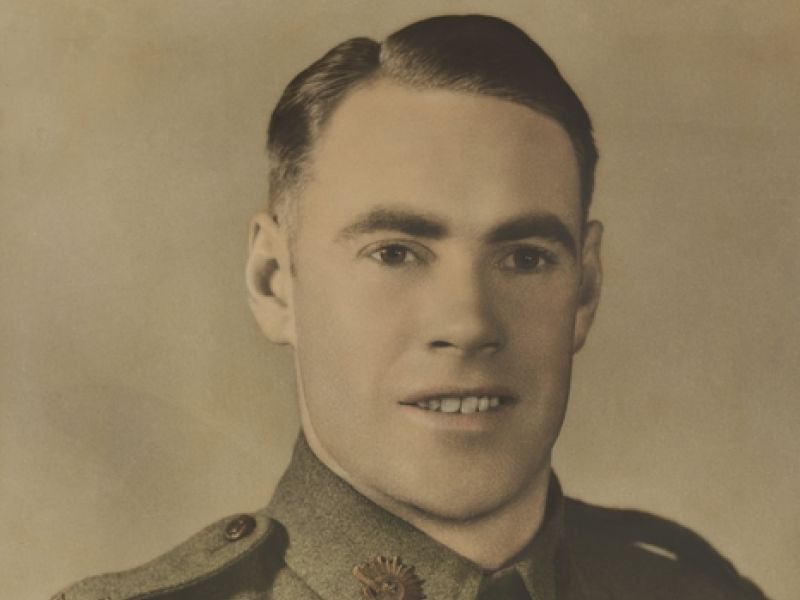
Corporal John Hurst Edmonson, 2/17th Battalion
 Australian War Memorial
John Edmondson was born on 8 October 1914 in Wagga Wagga, New South Wales. Known as “Jack”, he was the only child of Joseph and Maude Edmonson. When Jack was young, his family moved to a farm near Liverpool, south-west of Sydney. He attended Austral Public School and later Hurlstone Agricultural High School. He went on to become a council-member of the Liverpool Agricultural Society and acted as a steward at its shows.
Jack served with the 4th Militia Battalion from March 1939 as war clouds loomed in Europe. With the outbreak of war, he enlisted in the Australian Imperial Force on 20 May 1940. Allotted to the 2/17th Infantry Battalion, Jack adapted well to the life of a soldier and was soon made acting corporal, the rank being confirmed later that year.
Within months the 2/17th was warned for overseas service. Jack and his mother, Maude, had always been close, and on his suggestion she promised to keep a diary about happenings on the farm while he was away. He and his battalion embarked aboard on the Queen Mary in Sydney on 20 October, and a few weeks later arrived in Palestine.
In March 1941 the Australians were part of an Allied advance that drove Italian forces right across Cyrenaica - today’s Libya. The tables were turned with the intervention of Rommel’s German Afrika Korps, however, and Allied forces were forced into a hasty retreat to the port town of Tobruk. The enemy soon had them surrounded and the famous eight-month siege of Tobruk began on 11 April.
Two days later the Germans probed the Australian defensive perimeter near Post R33, a strong-point garrisoned by Edmondson’s platoon. Under cover of darkness some 30 Germans infiltrated the barbed wire defences, bringing machine-guns, mortars and two light field-guns. Lieutenant Austin Mackell led Jack Edmondson’s six-man section in an attempt to repel the intruders. But as they charged the German position Jack was badly wounded in the neck and stomach, but continued on. At the battle’s climax, Jack defended his platoon commander against two German attackers, killing both.
As the Australians pulled back to their post, Jack was in a bad way but could not be evacuated due to continual heavy fighting. An hour later, some 200 German infantry attacked and established a bridgehead in the defensive line. The fierceness of the Australians’ defence helped thwart the main attack, with German tanks being mauled and forced to retreat with heavy casualties.
In Australia at around the same time, Jack’s mother Maude was ill at ease. She wrote in her diary:
I shall never forget today. It started off so badly … and to make it worse, Stuffy the cat for some reason joined in; he came in and simply howled … The day before Jack left he asked me to take great care of his pet … On Easter Monday he wouldn’t stop crying, and worried me so much that eventually I couldn’t stand it, and put him outside ... We never saw him again. We searched the paddocks all next day.
Four days later, Jack’s parents read reports of heavy fighting at Tobruk in a newspaper article that described a bayonet charge on Easter Sunday, with an un-named lieutenant and corporal being prominent figures. Maude felt sure the corporal was Jack and sensed that all was not well with him. But the following Wednesday she received a letter from her son, dated 30 March. Maude set about preparing a food parcel to send Jack.
On Saturday the family received an official telegram stating that Jack had been killed in action. It was a terrible, shocking blow to his parents.
Private Athol Dalziel was with Edmondson when he died. He later wrote to Maude:
As dawn came up and it began to get lighter I knew, and Jack knew that he was dying. It was then that he asked me to keep the writing case and I said that I would keep it for him till he got out of hospital. His face broke into that wonderful grin of his and said,
“No, Athol, thanks all the same for trying. I know hospitals are no good to me now. Give my love to the folks, old boy, and good luck.”
For his exceptional bravery and valour, Corporal Edmondson was posthumously awarded the Victoria Cross.
Maude stopped writing in her diary but kept it along with newspaper clippings she collected in a scrapbook. Among them, a small cutting recounted the depth of love for her Jack: “Of course I am proud of him. I have always been proud of him. In a way, this great honour seems futile. I would rather have my son.”
Jack was buried at the Tobruk War Cemetery. He was 26 years old.
Corporal Jack Edmondson was the first Australian to be awarded the Commonwealth’s highest bravery award in the Second World War. Plaques, memorials, halls, schools and streets bore his name.
- AWM Roll of Honour https://www.awm.gov.au/collection/R1707711