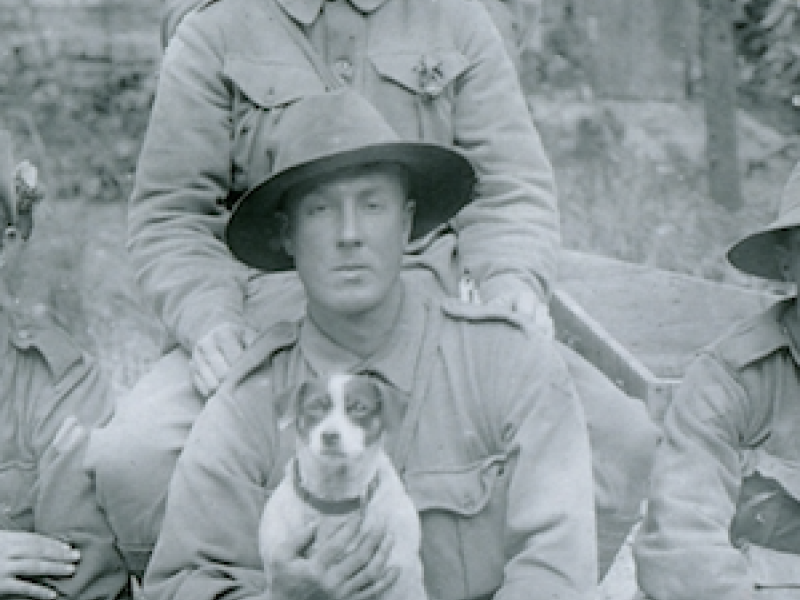
Private William Wallace Robert Dunn, 2nd Australian Machine Gun Battalion
 Australian War Memorial
William Dunn was born in 1890, in Ballarat East, Victoria. Affectionately known as “Wally”, he was the younger of two children born to James Dunn, a blacksmith, and his wife Margaret. Wally spent much of his childhood in Victoria, until his father died from heart disease. He then moved to Western Australia with his mother and elder sister, Florence, and settled in Perth. In 1901, his mother married Alfred McNaught, a hotel manager from Kalgoorlie. Wally relocated to the mining town with his family, where he later worked as a surveyor at Fimiston Gold Mine. He was there when the First World War broke out in 1914.
Wally Dunn enlisted in the Australian Imperial Force on 5 May 1915. He was assigned to the 28th Battalion with the rank of private and embarked for active service in late June, sailing from Fremantle on the troopship Ascanius.
After several weeks at sea, Private Dunn disembarked in Egypt where he continued his training. In September, he embarked for Gallipoli, where he was engaged in defensive operations after several failed offensives. Conditions at the front were harsh, with extremes of temperature, disease and poor sanitation. Dunn soon fell victim to these conditions, and he was evacuated back to Egypt for medical treatment in November 1915. Within only a few weeks, the entire Gallipoli campaign was abandoned, and Dunn’s comrades began returning to Egypt in preparation for deployment to other fronts.
By the New Year, Dunn had recovered sufficiently from his illness and returned to his unit on 10 January. After re-joining his comrades, Dunn developed a habit of going absent without leave, for which he was frequently punished. He was fined twice for this offence in Egypt, before being allocated to the 7th Machine Gun Company in March 1916. He embarked for the Western Front shortly after, arriving at the French city of Marseilles.
From there, he and his comrades were immediately sent north to the French and Belgian border, which had seen heavy fighting on and off since 1914. After further training, as well as periods of routine trench duty, Dunn’s unit was sent to the Somme, where allied forces were attempting to capture the ruined village of Pozieres. He and his comrades were involved in bitter fighting against German forces there between July and August, before travelling to the quieter Belgian front for a period of rest. His unit returned to the Somme in October, just in time to spend a bitterly cold winter in the trenches.
In January 1917, Dunn was sent to hospital after contracting a disease. He remained there until March, at which point he was again well enough to re-join his unit. His return to the front came in the midst of the enemy’s strategic withdrawal to the Hindenburg Line. This withdrawal was eagerly followed by allied forces, who were drawn into bloody attacks in the process. In mid-1917, this withdrawal halted around the French village of Bullecourt, which would become the site of two costly battles. Dunn and his comrades served in a supporting capacity during the second attack on the village in May, which cost the Australians 7,000 casualties. Among them was Private Dunn, who suffered a shrapnel wound to his head during the fighting. He was evacuated to a casualty clearing station, then on to England for further treatment.
He remained in hospital until June of 1917, when he was given a short period of leave before further training. At some point during this period, he met and married a Scottish woman, Sarah Wilson. He returned to his training camp, and soon he was again fined for being absent without leave. Dunn spent a further short period in hospital in September 1917, but saw out the rest of the year in a training camp.
By January of 1918, Dunn had returned to his unit at the front. Again, his return coincided with a major German operation, the Spring Offensive. Over the next months, the enemy launched multiple heavy attacks along the allied front, which proved costly for both sides. By March of 1918 the German offensive had clearly failed, and allied forces began preparing for a major operation of their own. The 2nd Australian Machine Gun Battalion was raised during this period, and Dunn was transferred to its ranks.
Dunn was with his new comrades in July 1918 when the Australians attacked enemy’s positions at Hamel. The attack was formulated by Lieutenant General John Monash and was planned to overwhelm the enemy and capture the high ground within 90 minutes. Using a combination of troops, tanks and aircraft, the attack proved to be hugely successful with allied forces capturing all their objectives and thousands of prisoners in just 93 minutes, but at a cost of more than a thousand Australian casualties. Among the dead was Private Wally Dunn.
Dunn was buried nearby at Adelaide Cemetery in the town of Villers-Bretonneux where he lies today, beneath the simple words chosen by his mother: “Ever Remembered”.
Wally Dunn was 27 years old.
- Australian War Memorial Roll of Honour https://www.awm.gov.au/collection/R1725402