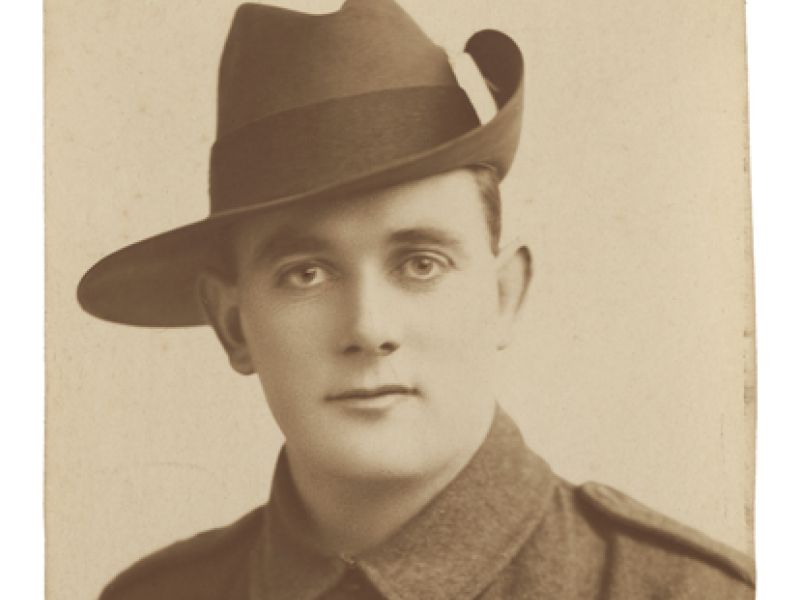
Corporal Charles Raeburn Crane, 1st Battalion, AIF
 Australian War Memorial
Charles Crane was born on 4 September 1891 in the Sydney suburb of Ashfield. He was the youngest of 10 children born to Frederick and Mary Crane, though only seven of their children survived beyond their first year. Charles was the grandson of George Ekins Crane, a London-born businessman, whose company continued to be run by Charles Crane’s father and uncles.
Charles – known to his loved ones as Chas – grew up in Ashfield and attended Sydney Grammar School, before undertaking office training and working as a clerk, probably at his family’s business.
Chas and his older brother Eric enlisted in the Australian Imperial Force on 7 September 1915 – though they enlisted at different depots and joined different battalions. Eric was assigned to the Australian Service Corps, where he remained throughout the war, rising to the rank of company sergeant major.
After enlisting, Charles was eventually assigned to the 14th Reinforcements of the 1st Battalion and trained in camp at Liverpool. He left Sydney in RMS Osterley on 15 January 1916, sailing for Egypt. There, he was taken on strength of the 1st Battalion at Tel el Kebir. After the reorganisation of the Australian Imperial Force in early 1916, the 1st Battalion left Egypt for France and the Western Front in March. By mid-July, the battalion were in frontline trenches preparing for their first major battle on the Western Front: the battle of Pozieres.
Taking the high ground at Pozieres was a key objective for the allied forces. The first Australian attack was launched on the village on 23 July 1916. The battalion captured its objectives, clinging to its gains despite almost continuous artillery fire from the Germans. By the end of the first day of the battle, the 1st Battalion had suffered 874 casualties.
During the fighting, Chas was wounded in action, suffering a gunshot wound through his right leg. He was immediately admitted to the British Red Cross Hospital for treatment, then transferred to Calais for evacuation to England on HMS Dieppe. In England he was admitted to the 2nd Northern General Hospital in Leeds. After four months in hospital, he was discharged in November 1916 and spent another three and a half months in physical therapy. After an absence of nearly eight months, Chas rejoined the 1st Battalion at Fricourt in the Somme Valley in March 1917.
On 27 July 1917, Chas was promoted to lance corporal, and then to temporary corporal. On 25 September 1917 he was promoted to corporal.
On 7 November 1917, the 1st Battalion were stationed between Zonnebeke and Westhoek Ridge in Belgium, undertaking fatigue duty. As the men were working, a transport on the road was hit by an enemy shell, leaving several men wounded. Chas and a small party of other men rushed to help the wounded. Another enemy shell landed in the area, killing three men from the 1st Battalion, including Corporal Charles Crane.
He was 26 years old.
Fellow members of Charles’s company collected the bodies of the dead. Still under enemy shell fire, they buried Charles and his fallen comrades in front of Westhoek Ridge near a track leading towards Zonnebeke. Despite the detailed recollections of eyewitnesses, his final resting place remains unknown.
Charles Crane’s name is recorded on the Menin Gate Memorial in Ypres, alongside the names of 6,177 other Australians who served in the campaign and have no known grave.
- Australian War Memorial Roll of Honour https://www.awm.gov.au/collection/R1727546