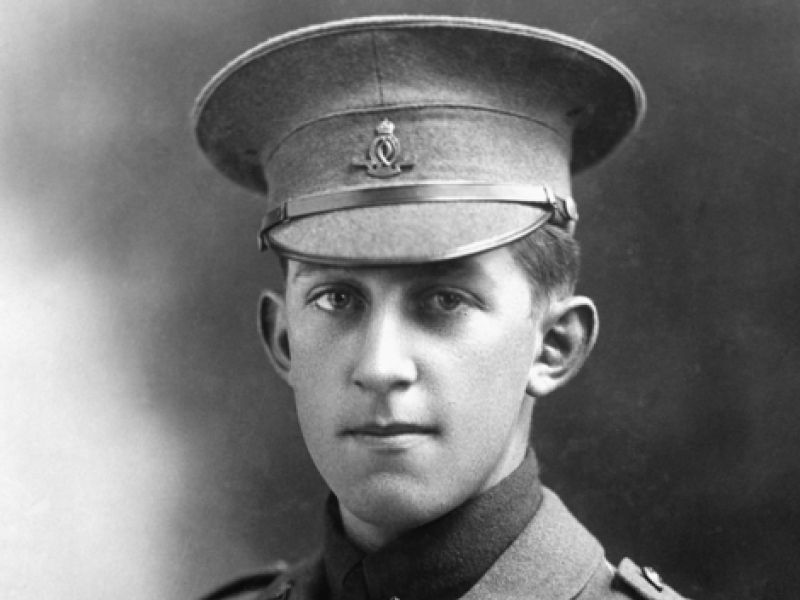
Lieutenant Arthur Edward Carl Gepp, 28th Australian Infantry Battalion
 Australian War Memorial
Arthur Gepp was born on 25 November 1896 in Adelaide, South Australia. He was the only son of hotelkeeper Henry Gepp, and his wife Marie. Arthur was educated at Pulteney Street School, and later at Prince Alfred College where he was a keen student, particularly of German and chemistry. On his 16th birthday, Alfred sat the entrance exam for the Royal Military College, Duntroon. He came first in South Australia and second overall in the Commonwealth, winning a scholarship to start officer training.
Gepp entered Duntroon, here in the Federal Capital Territory, in March 1913. He was less than eighteen months into his training when the First World War broke out in August 1914. At the end of June the following year, Gepp and his classmates were graduated early to allow them to enlist in the Australian Imperial Force. Gepp received a commission as second lieutenant, and returned to South Australia where he was assigned to B Company of the 32nd Battalion. He embarked with the rest of his unit in November 1915, sailing from Adelaide on the troopship Geelong.
Gepp and his comrades arrived at Suez in December. By this stage of the war, allied forces had abandoned the ill-fated Gallipoli campaign. As a result, Gepps’ unit remained in camp, where they continued training to fight on the Western Front. In February 1916, Gepp was transferred to the 28th Battalion and was promoted to the rank of lieutenant. He and his men embarked for France the following month, and arrived in the French city of Marseilles on 21 March.
From there, the 28th Battalion was immediately sent north to the Franco-Belgian border, where it was billeted behind the lines. The men entered the trenches for the first time in early April. They rotated in and out of the front lines, as well as training in the rear areas, before being sent south to the Somme in July 1916. Here, the men of the 28th Battalion were drawn into the fighting to capture the high ground surrounding the village of Pozieres.
Their first advance took place in the early hours of the morning on 28 July when they attacked German trenches north of Pozieres. The fighting was horrendous, and hundreds of men quickly became casualties. They were withdrawn from the front lines the following day, having gained very little ground at a cost of more than 500 casualties.
Gepp and his men were only given a short respite from the fighting, and returned to the trenches on 4 August to make a second attack on the positions they had failed to capture in July. They immediately came under heavy shelling and machine-gun fire which cut down men in waves. Private Herbert Harris described the battle:
“Imagine men dug in a few feet into the ground and shells falling just like rain. Trenches blown up and men digging for dear life to rebuild them, or rescuing their comrades who were buried and in most cases the rescuers were also buried by shells … When entering the trenches we were bombarded with tear and gas shells which made us wear our gas helmets … it is almost impossible to see and hard to breathe … I have heard officers and men say that the landing and the Lone Pine battle at Gallipoli were a picnic compared to this last fight.”
On this occasion, Gepp and his men reached the German trenches and held them, but were subjected to heavy shelling. It was during this period that Lieutenant Gepp was hit by shrapnel and killed. His men buried him where he fell, but were forced to continue fighting. Afterwards, Gepps’s final resting place could not be located.
The German trenches were captured the following day, on 6 August 1916. Their success cost the 28th Battalion alone more than 200 casualties.
After his death, Gepps’ parents paid tribute to their son with a poem placed in the Adelaide newspaper:
“No one knows the silent heartache,
Only those can tell,
Who have lost their best and dearest
Without a last farewell.”
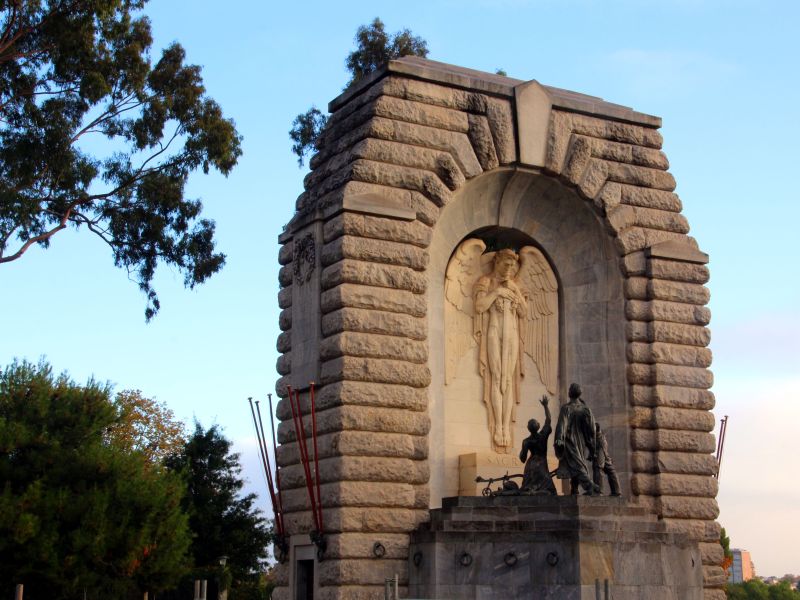
Today, Lieutenant Arthur Gepp is commemorated on the Australian National Memorial at Villers-Bretonneux.
He was just 19 years old.
- Roll of Honour, Australian War Memorial https://www.awm.gov.au/collection/R1730307