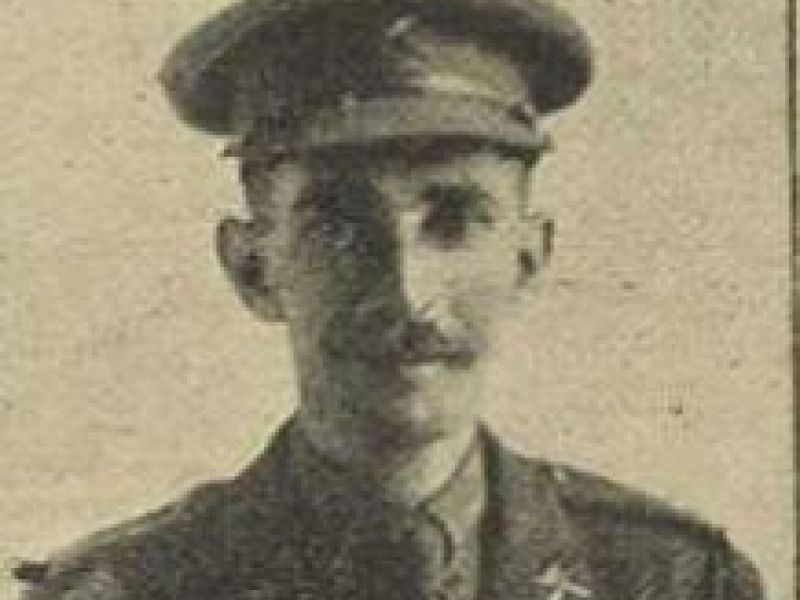
Major Edgar Geoffrey Sawer, 12th Australian Machine Gun Company
 Australian War Memorial
Edgar Sawer was born on 2 October 1876 in East Keswick, Yorkshire, England. He was one of three children born to John Riley Sawer, a textiles manufacturer, and his wife Lucy. Edgar attended the local school, and later went to Leeds University where he completed a bachelor of science. He then joined the Imperial British Army and served in India and Burma. There he married Edith Longman on 19 March 1910. In December they welcomed their first child, Geoffrey. Sawer was later posted to Australia for staff duties, and settled in South Australia in early 1914. Just a few months later, in August, the First World War broke out.
Edgar Sawer joined the Australian Imperial Force on 1 September 1914 and was assigned to the machine-gun section of the newly-raised 10th Battalion. After a very short period of training in Australia, he embarked for active service in October, sailing from Adelaide on board the troopship Ascanius. He arrived in Egypt where Allied units were preparing for war with the Ottomans. At Anzac Cove on 25 April 1915, Sawer and his comrades were among the first ashore, reaching the beaches around 4:30 am.
Sawer was soon made second lieutenant. He and his men then engaged in establishing and defending the Anzac beachhead: Sawer was promoted to lieutenant and was later Mentioned in Despatches. In September, however, he contracted malaria and was evacuated from the peninsula for treatment in hospital. The Gallipoli campaign was abandoned and allied forces were withdrawn in December. Sawer re-joined his unit in Egypt in February and was promoted to captain.
Soon Sawer was transferred and given command of the 12th Machine Gun Company. He embarked for the Western Front in June 1916. From Marseilles, Sawer and his unit were sent north to the Franco-Belgian border to take up their position at the front. His unit’s first major battle took place in August, around Pozieres and Mouquet Farm. It was during this period that Sawer began experiencing abdominal pain and vomiting. He spent the rest of the month in hospital but was back with his unit by September 1916.
Sawer received a second Mention in Despatches in October 1916, just as a bitterly cold winter began to set in. He spent this period in the trenches with his men, despite his declining health. In the New Year, Sawer was awarded the Military Cross for his actions at Pozieres and was promoted to the rank of major. Soon, Sawer’s condition worsened and he was again sent to hospital.
Unable to keep down any food, Sawer had lost a significant amount of weight and was suffering from insomnia and lethargy. He was evacuated to England and was admitted to Wandsworth Hospital in April. There, he was found to be suffering from a gastric ulcer which rendered him unfit for active service.
He was invalided back to Australia in July, and was admitted to Caulfield Military Hospital in Melbourne. There, his condition gradually improved until he was found fit to return to the front. He embarked for the second time on 27 November 1917, sailing on board the troopship Indara.
But by the time he disembarked at Southampton in February 1918, his health had again deteriorated. By the end of the month, Sawer had been found permanently unfit for service. In March, he was admitted to the hospital ship Kanowna, and after several weeks at sea, Major Sawer was re-admitted to Caulfield Hospital. For several months his condition continued to decline. He rapidly lost weight and became increasingly weak and exhausted. On 31 May 1918, Sawer died in hospital.
He received a full military funeral and was buried at Melbourne’s Brighton Cemetery, where he lies today. He would never meet his second child, a son named Derek, who was born just two weeks later.
Edgar Sawer was 40 years old.
- AWM Roll of Honour https://www.awm.gov.au/collection/R1662914
- Virtual war memorial https://vwma.org.au/explore/people/302718