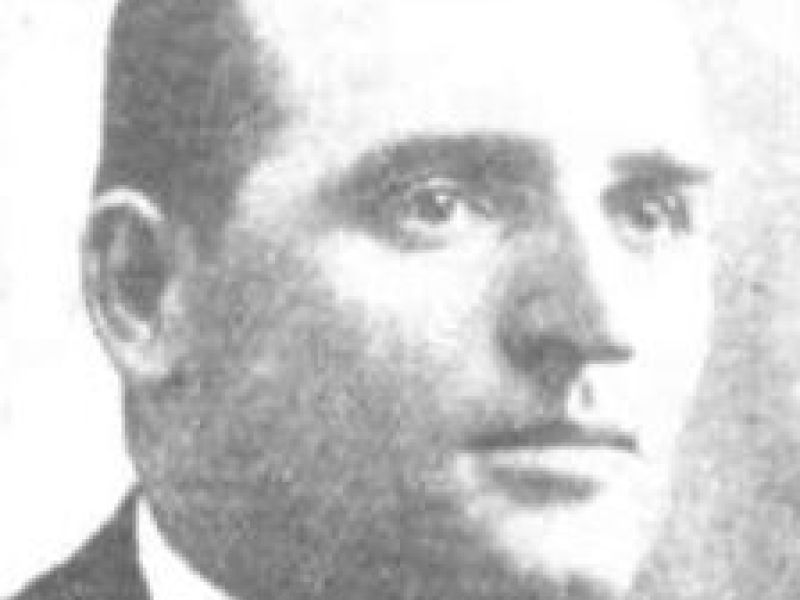
Private David William Hood, 50th Australian Infantry Battalion
 Australian War Memorial
David Hood was born on 16 January 1886 in East Glenelg, South Australia. Known as Dave, he was one of eight children born to English emigrants Thomas and Hannah Hood.
The family lived in the beachside suburb of Glenelg in Adelaide throughout Dave’s childhood. When Dave was five, his mother died after contracting typhoid fever. Thomas senior remarried two years later, and had a further two children with his new wife, Ada.
While Dave was at the local state school, his older brothers Tom and George enlisted for service in the South African War. Both brothers returned home at the end of the war in 1902.
Dave Hood travelled throughout Australia and New Zealand, eventually settling back in Glenelg and working as a telegraph linesman.
Tragedy struck the Hood family twice during this otherwise peaceful period; Dave Hood’s youngest brother John drowned in the sinking of the cutter Wanderer near Kangaroo Island in 1907, and Tom died after a short illness.
Following the outbreak of the First World War, Dave Hood enlisted on 18 July 1915. He was allotted to reinforcements of the 10th Infantry Battalion with the rank of private. He departed Adelaide in the troopship Ballarat on 14 September 1915.
After a brief period in camp in Egypt, Hood joined the 10th Battalion on the Greek Island of Lemnos in December 1915. He returned to Egypt, and in late February was transferred to the newly-formed 50th Infantry Battalion as part of the restructuring of the Australian forces.
In early March, Hood was charged with overstaying his leave by 15 hours. He was fined two days’ pay, and returned to training.
Hood left Alexandria in HMT Arcadian on 5 June 1916, arriving at Marseilles in southern France a week later. Following two months adjusting to life on the Western Front, the battalion moved into the front lines near Mouquet Farm in the Somme on 12 August 1916.
The farm stood in a dominating position on a ridge. Although the farm buildings had been reduced to rubble by artillery, the strong stone cellars below ground had been incorporated into German defences. Between 8 August and 3 September, the 1st, 2nd, and 4th Australian Divisions mounted nine attacks on the farm, each failing to capture and hold the position.
The 50th Battalion launched their attack on 13 August, in the face of heavy enemy artillery bombardments. While withdrawing through the trench system three days later the battalion were subjected to heavy shelling and constant “showery weather”. By the time the battalion reached their billets behind the lines at 9 am on 16 August, they had sustained 414 casualties, including 67 missing in action.
Dave Hood was one of the men from the battalion declared to be missing. It took 10 months for his fate to be determined, during which time his family waited anxiously for news.
Finally, a court of enquiry held on 1 June 1917 determined that Private David William Hood had been killed in action during the withdrawal from Mouquet Farm on 16 August 1916: “blown to pieces” and “killed instantaneously” by an enemy shell.
He was 30 years old.
Dave Hood’s death did not mark the end of the family’s war service. His brother Henry survived the war, returning to Australia in 1919. Two decades later, half-brother Robert Hood would see service in the Second World War on board HMAS Pirie.
Despite a handwritten note in Hood’s service record stating he had been buried at Mouquet Farm, his final resting place was never identified. He is commemorated today on the Australian National Memorial at Villers-Bretonneux, among 10,000 Australians who died fighting in France and have no known grave. His name appears on the Honour Roll of the Adelaide Postmaster General’s Department.
- AWM Roll of Honour https://www.awm.gov.au/collection/R1631839
- Virtual war memorial Australia https://vwma.org.au/explore/people/353803