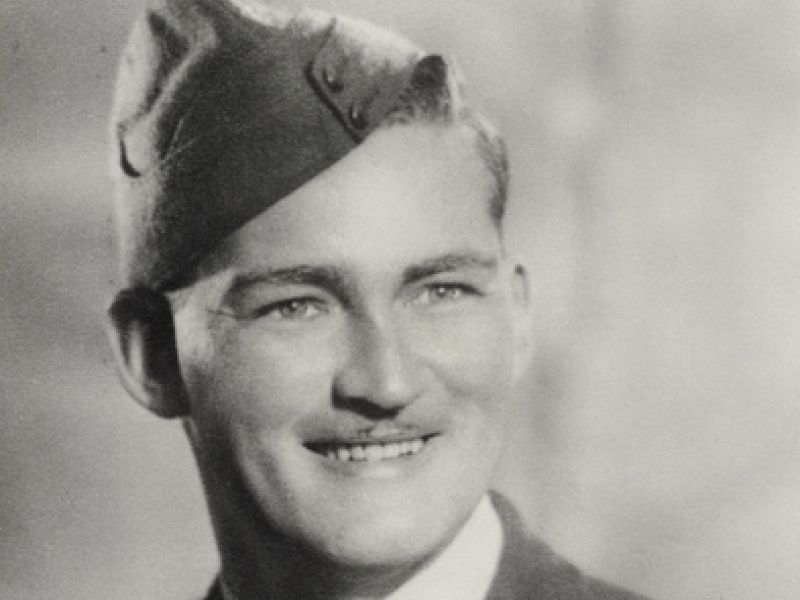
Flight Sergeant Joseph William Muntz, No. 460 Squadron, Royal Australian Air Force
 Australian War Memorial
Joseph Muntz was born on 2 November 1920, in Nathalia, Victoria. Known as “Joe”, he was the eldest of three sons born to local farmers Leslie and Ella Muntz. Joe received his early education at Yielima Public School, and later attended Nathalia Elementary School. He left school in 1934, and began working on the family property, “Elswood”, managing teams of horses used for ploughing and harvesting.
Joe Muntz enlisted in the Royal Australian Air Force on 27 February 1942. Mustered as aircrew, he later trained at the wireless air gunner’s school. He later attended the bombing and air gunnery school in West Sale, when he met his sweetheart, Marjorie Branchflower. The two became engaged just before Muntz embarked for England in January 1943. As part of the Empire Air Training Scheme, he was one of almost 27,500 RAAF pilots, navigators, wireless operators, air gunners, and flight engineers who, throughout the course of the war, joined Royal Air Force squadrons or Australian squadrons based in Britain.
Muntz arrived in England on 19 March 1943 and joined No. 27 Operational Training Unit in April. Based at Litchfield, Muntz and his comrades were trained as night bomber crews, and learned to operate the Vickers Wellington medium bomber. In May, Muntz was promoted to flight sergeant, before travelling to the Royal Air Force base at Lindholme, where he joined a heavy conversion unit. Over the months which followed, Muntz learned to operate the new heavy bombers, including the Lancaster and the Halifax.
On 12 October 1943, Muntz joined his first operational unit, No. 460 Squadron of the Royal Australian Air Force. Based out of Binbrook, in the north-east of England, the squadron’s operations formed part of the Allies’ strategic bombing offensive against Germany. Muntz soon found himself in the thick of the fighting, undertaking several raids on German cities including Hanover and Kassel.
In November, the Battle of Berlin recommenced, continuing the Allies strategic offensive against the German capital. Muntz and his comrades took part in several successful raids. On 23 November, they took off in Lancaster W4162 to undertake another routine attack on Berlin. Despite encountering heavy flak and cloudy conditions, the attack was largely successful, bringing the total weight of incendiary and explosive bombs dropped on Berlin to some 5,000 tonnes. But Muntz and the crew of Lancaster W4162 had failed to return to base and were all listed as missing in action. His commanding officer wrote to Muntz father:
It is of some consolation to know that quite a number of airmen reported missing are eventually found to be prisoners of war, and I sincerely hope that it will be my pleasure to let you have such good news of your son and the other members of his crew before long.
Nothing further was heard of Muntz and his comrades for several months. In May 1944 their names were published in a German casualty list, and they were then listed as missing, presumed dead. Their deaths were confirmed a month later, when a surviving member of the crew was located in a prisoner of war camp in Germany. He told the authorities:
“Our aircraft was attacked by a fighter at 21,000 feet over Lubben-Unter-Spree. Fire broke out and the pilot gave the order to bail out. Almost immediately the aircraft exploded. I myself was blown out and landed by parachute. I was wounded and was taken to the local hospital where I was told by the Germans that all the rest of the crew had been found dead in or near the wreckage of the aircraft.”
Despite receiving this confirmation, it was not until March 1949 that remains of the crew were located. They were found buried in a wood near the scene of the crash, and were exhumed, identified, and reburied at the Berlin War Cemetery, where Muntz and his comrades lie today.
Flight Sergeant Joseph Muntz was 23 years old.
- Australian War Memorial Roll of Honour https://www.awm.gov.au/collection/R1721544