Trooper Allan John Laverty, 7th Australian Light Horse Regiment
 Australian War Memorial
Allan Laverty was born in 1890 in the village of Binda, near Crookwell in New South Wales. He was one of five children born to John Laverty, a grazier, and his wife Mary Rosanna. He received his education at Bourke Street Superior School and was working as a stockman when the First World War broke out in 1914.
Allan Laverty enlisted in the Australian Imperial Force on 14 August 1915. He was assigned to the 12th Reinforcements of the 7th Light Horse Regiment and embarked on 18 November 1915 on board the troopship Persic.
Laverty arrived in Egypt where he joined other new recruits and veterans of the Gallipoli campaign. By April, Laverty’s unit had joined the forces defending the Suez Canal from the Turkish advance across the Sinai Desert. In May, he wrote home to his mother:
“We are at present occupying a deserted camp of the English Yeomanry … There are signs of fighting a few miles out - dead men, horses and camels and gear strewn about. We have not seen much of the enemy except a few Bedouins and Turks we have captured. I may not be able to write regularly, but remember: no news is good news.”
His unit took part in the attack on Romani in August 1916 which marked the beginning of the Allies’ drive from Egypt into Palestine. The next morning, the Turks surrendered and it was discovered that the main group of the enemy had departed during the night. A general advance was ordered, and the Turkish forces were on the run. Laverty’s letter continued:
“We engaged the rear-guard while other troops advanced on the flanks and captured thousands of prisoners. Several of my mates have been wounded, none seriously I think. I was one of the lucky ones and haven’t a scratch.”
Following their success at Romani, the 7th Light Horse Regiment spent the rest of the year engaged in patrol work around the region.
In early 1917, the allied advance towards Jerusalem halted before Gaza. On 26 March 1917, two British infantry divisions attacked the city from the south while mounted units, including Laverty’s, attacked from the flanks and the north to surround Gaza.
The mounted regiments quickly swept through, capturing the high ground to the north and beginning their advance into Gaza. But with the lack of progress by the infantry, and fears over water supplies, they were ordered to withdraw at dusk. The next morning, the Allied commanders realised victory had been within reach and they attempted to resume the attack. By this stage, the exhausted troops could no longer fight, and Turkish reinforcements had already arrived, causing the attack to flounder once more.
Laverty was sent to hospital suffering from sunstroke as well as some apparent internal bleeding. His condition gradually worsened as he was sent from hospital to hospital before finally arriving at the 19th General Hospital in Alexandria. There, he began to show signs of shell shock and manic attacks before becoming depressed and detached. The medical board decided that Laverty would not be able to return to the front. He boarded the troopship Neuralia on 21 May 1917 to return to Australia for discharge.
On the voyage, Laverty’s condition worsened and at Cape Town in South Africa he was admitted to Valkenberg Mental Hospital, suffering from depression and memory loss. He remained there until August 1917, when he continued his journey to Australia.
Laverty was admitted to Broughton Hall Military Hospital in Sydney for treatment. Though his doctors agreed he was severely depressed and suicidal, they decided he was rational and no risk to others. He was granted leave to return to his family home in Goulburn.
But Laverty’s condition did not improve and his father made plans to take him back to Broughton Hall Hospital. His father woke early on 29 December but could not find him in the house.
He found Trooper Laverty’s body in the back yard. Police concluded that Laverty had died from a close-range gunshot wound to the chest. His father noted that Laverty had been “at his brightest before the war” but had been moody and avoided company since his return. An inquest into Laverty’s death determined that he had died by suicide while temporarily insane.
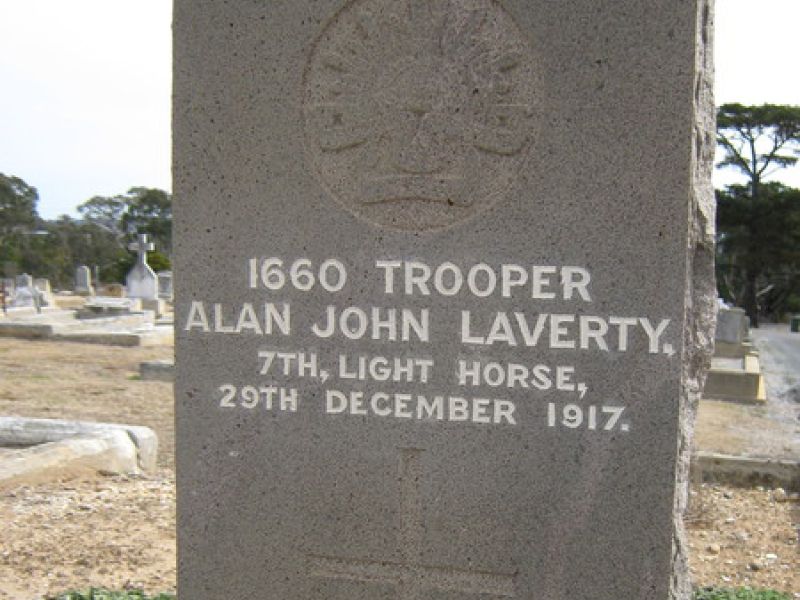
He was buried on 30 December 1917 in Goulburn General Cemetery, where he lies today, beneath the inscription:
“He gave his life for others.”
Trooper Allan Laverty was 27 years old.
- Australian War Memorial Roll of Honour https://www.awm.gov.au/collection/R1640586