Flying Officer David John Sandell, No.467 Squadron
 Australian War Memorial
David Sandell was born on the 9th of September 1923 in Goulburn, New South Wales, the son of Frederick and Lorna Sandell.
Frederick Sandell was a clothing manufacturer based in Goulburn and a prominent member of the local Chamber of Commerce. However, after the factory closed during the Great Depression, the family moved to Sydney, where David grew up with his brothers Ronald and Frederick, and sister Patricia.
After completing his schooling, he worked as a junior shoe salesman at Marcus Clark & Co., a department store where his brothers also worked: Ronald as a salesman, and Frederick as an advertising assistant.
Ronald enlisted in the Royal Australian Air Force in May 1941, and Frederick followed suit barely a month later, but David was not yet 18 years old, and was too young to enlist.
In June 1942 the following year, David, who had turned 18, followed in his brothers’ footsteps by enlisted in the RAAF.
After initial training school and elementary flying training school, David Sandell embarked for overseas service.
As part of the Empire Air Training Scheme, he was one of almost 27,500 RAAF pilots, navigators, wireless operators, gunners, and engineers who, throughout the course of the war, joined Royal Air Force squadrons or Australian squadrons based in Britain.
Sandell was first sent to Canada, where he attended flying training school in Aylmer, Ontario. After receiving his wings and being made pilot officer, he travelled to the United Kingdom, joining an advanced training unit in South Cerney, and then an operational training unit in Lichfield.
On the 20th of April 1943, David’s brother Ronald died when his aircraft crashed in Tunisia. Ronald was just 22 years old.
David continued training. After being appointed to a commission in July 1943, he was posted to No. 467 Squadron on the 16th of August 1944.
467 Squadron was formed at Scampton in the United Kingdom, intended as an Australian squadron. Although the majority of its personnel were originally British, towards the end of the war the squadron became mostly Australian.
Equipped with Avro Lancaster heavy bombers and forming part of 5 Group, RAF Bomber Command, the squadron's operational focus for much of the war was the strategic bombing offensive against Germany. Bombing almost entirely by night, 467 Squadron participated in all of the major campaigns of the offensive.
On the 29th of August 1944, after less than a fortnight with his new squadron, Sandell was the pilot of a Lancaster tasked with attacking Kōnigsberg, port city on the south-eastern corner of the Baltic Sea. Nothing was heard from Sandell or the other crewmembers after their take off from RAF Waddington.
Frederick Sandell would be the only one of the three brothers to return home after joining the RAAF, being discharged on compassionate grounds in July 1945.
Today, David Sandell’s name is listed on the Runnymede Memorial, on the banks of the Thames in England, which commemorates more than 20,000 airmen and women with no known grave who were lost in the Second World War during operations from bases in the United Kingdom and North and Western Europe.
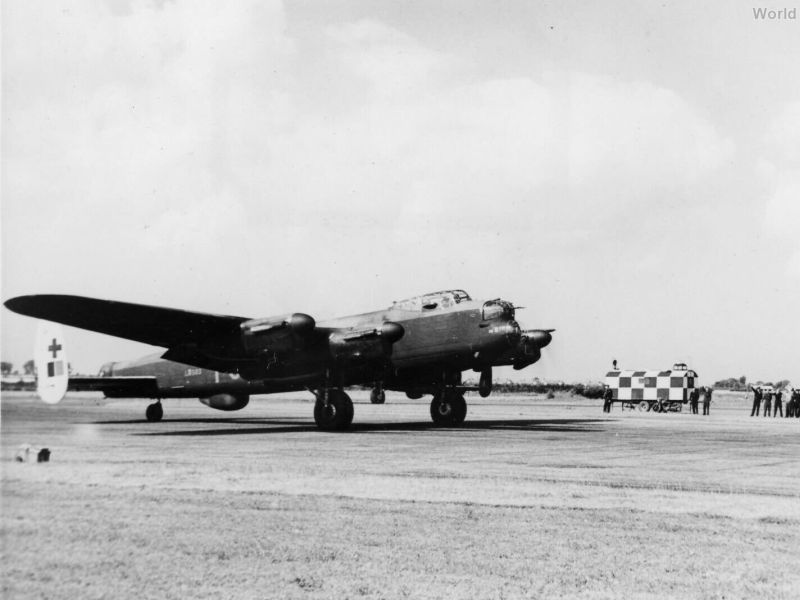
Image of lost Lancaster LM583 PO-O "O for Oboe" No. 467 Squadron Piloted by Flying Officer David John Sandell.
- AWM Roll of Honour https://www.awm.gov.au/collection/R1718563