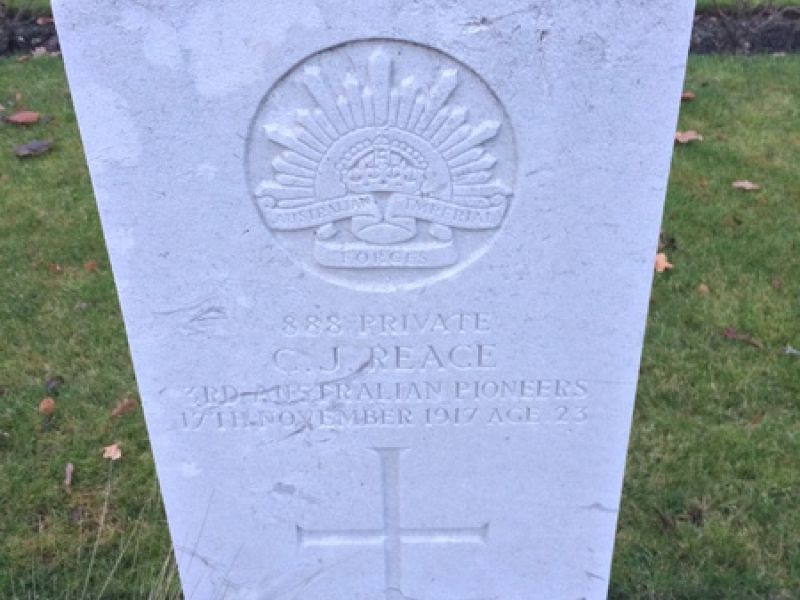
Private Charles John Reace, 3rd Australian Pioneer Battalion
 Australian War Memorial
Charles Reace was born on the 20th of January 1893 in Toowoomba, Queensland. Known as Jack, he was one of five sons born to German-Australians John and Mary Reiss. There is some evidence to suggest that Jack was baptised Johann Carl Reiss, but anglicised his name at some stage prior before the outbreak of the First World War.
The Reace family remained living in Toowoomba throughout Jack’s childhood. He attended the local school, before finding work as a windmill fitter, plumber, and gas fitter.
Reace enlisted in the Australian Imperial Force on 12 February 1916 at Longreach, Queensland. He was allotted to the 3rd Pioneer Battalion with the rank of private. After four months of initial training in Australia, Private Jack Reace departed Melbourne in HMAT Wandilla on 6 June 1916.
He arrived in Plymouth, England, on 26 July 1916, and with the rest of the pioneers marched into Larkhill camp for further training. While at Larkhill, Reace ran afoul of military authorities twice, first for going absent without leave for two days in September, and again for disappearing from camp for four days in November. He was sentenced to a total of 14 days Field Punishment Number 2 for his absences.
The 3rd Pioneer Battalion departed England for France in late November 1916. Pioneer Battalions were infantry with light military combat engineer skills, who were typically located at the very forward edge of the battle area. They were used to construct defensive positions, command posts and dugouts; to prepare barbed wire defences, maintain roads and tracks, and to fight as infantry as required.
After passing the bitter winter of 1916 to 1917 in the quieter section of the front around Armentieres in northern France, the pioneers moved into Belgium in June 1917 as the allied operations switched focus to the Ypres salient. They were engaged in every action undertaken by the 3rd Division, fighting as infantry alongside their light combat engineering.
On 4 June, Jack was wounded in action while undertaking maintenance work, and evacuated to the 9th Australian Field Ambulance suffering from shell shock. A week later, he was transferred through the 2nd Australian Casualty Clearing Station to hospital for further treatment. He remained hospitalised until mid-September 1917, when he was released to the 12th Convalescent Depot to prepare for his return to the front.
Jack rejoined the 3rd Pioneer Battalion on 29 October 1917, just as it was coming to the end of a week of recreation and training behind the lines in northern France.
In early November, the battalion returned to Belgium, moving into the area between Nieppe and Warneton. A nearby tower at German-held Warneton gave the enemy a good observation point of the allied forward areas, so the Australian battalion were instructed to complete their work under the cover of early morning fog or after nightfall to avoid casualties.
On 17 November 1917, while undertaking repair and maintenance work outside Warneton, Private Jack Reace was killed in action.
He was 23 years old.
- Roll of Honour, Australian War Memorial https://www.awm.gov.au/collection/R1653528