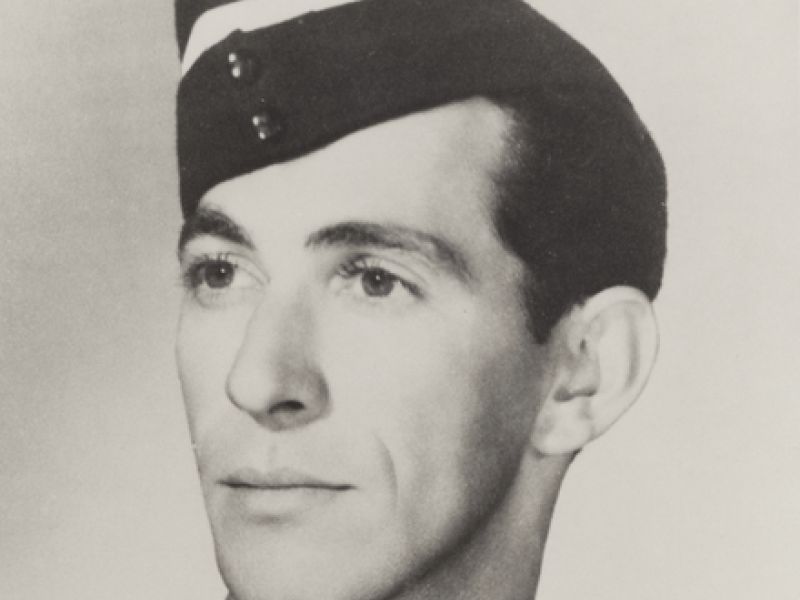
Flight Sergeant Alexander Bennett No. 148 Squadron (RAF)
 Australian War Memorial
Born on the 21st of September 1914 in Perth, Alexander was the fourth and youngest son of Maxwell and Sarah Bennett. The couple, of the Jewish faith, had emigrated from England to Western Australia sometime around 1904. Maxwell, originally from Romania, soon became naturalised as a British subject and the family name was legally changed from Bercov to Bennett.
After the family moved to Melbourne, Alexander attended Caulfield Central School from 1925 to 1927, where he passed maths, English, physics and drawing. He next went to Caulfield Grammar School, graduating in 1929. For leisure, Alexander enjoyed tennis and swimming, while working as an office clerk, a salesman and a shop assistant. He married Lydia Ellis in Melbourne on the 26th of February 1942. Their sons Rodney and Paul were born in 1943 and 1944.
In January 1942 Alexander joined the Royal Australian Air Force Reserve, then in June he was called up. He joined as an Aircraftman Class 2, mustering as aircrew. He moved from Station Headquarters at Laverton, to the Initial Training School at Somers, then on to No. 2 Air Observers School at Mount Gambier. He was promoted to Leading Aircraftman, continued training into 1943, first at No. 3 Bombing and Air Gunnery School at West Sale, then at No. 2 Air Navigation School where he completed a navigator’s course. Then it was time to head overseas.
On May the 25th 1943 Temporary Sergeant Alexander Bennett embarked in Sydney, arriving in the United Kingdom six weeks later. Now attached to the Royal Air Force, he was first posted to No. 9 Advanced Flying Unit, then in October to No. 30 Operational Training Unit. After other postings, on the 18th of May 1944, Bennett, now a flight sergeant, joined No. 148 Squadron, RAF.
148 Squadron had been re-formed on Malta in December 1940. When Bennett joined them, they had seen more than two years’ service in the Mediterranean and North Africa. Now based at Brindisi, on the heel of Italy, they had become a ‘Special Duties’ squadron. This meant working closely with Special Operations Executive conducting clandestine missions to supply Partisan groups throughout the Balkans and Poland. In addition, they performed regular bombing missions. Flying the four-engine Halifax, Bennett’s role among the seven-man crew was bomb aimer.
During the Summer of 1944 as the Western Allies landed in Normandy, on the Eastern Front the Red Army had pushed the Germans back into Poland. By August they had reached the River Vistula and the Polish capital, Warsaw. Sensing imminent relief, on the 1st of August the Polish Resistance Home Army led an uprising in the city. Soviet forces, however, remained in place, advancing no further. This left the Poles dangerously exposed to a vengeful German Army.
On the 3rd of August Warsaw called for urgent help from the Western Allies. British Prime Minister Winston Churchill ordered supply flights to begin at once. 205 Group including – No. 1586 Special Polish Duty Squadron, RAF Nos. 178 and 148 Squadrons, and Nos. 31 and 34 Squadrons of the South African Air Force – would launch what became known as the Warsaw Airlift. From southern Italy, the round trip would be some 2,800 kilometres. This was necessary because the Soviets would not allow them to land in their territory, and would even shoot at them if they infringed. The alliance would always be temporary and tenuous.
Inbound, they flew mostly in broad daylight, timed to reach Warsaw by dark. Only a small amount of supplies - food, medicine, weapons and ammunition - could be taken, since they had to carry so much fuel. On reaching the Vistula, the aircrew could see an inferno glowing in the distance. Warsaw was burning.
A day after Warsaw’s call for help, the airlift’s first sortie took off at 8 p.m. with the Polish squadron accompanied by seven Halifaxes from No. 148 Squadron. Alexander Bennett was onboard one of those, captained by Pilot Officer Charles Crabtree. After reaching Warsaw, this maiden sortie made partially successful drops over Krasinski Square and Wola, as well as Kampinos and Kabaty forests, providing the Poles a boost more in morale than in materiel.
On this mission, five aircraft were shot down, including Bennett’s. Given the position of the crash site, about 250 kilometres due south of the city, it is likely they were lost before reaching Warsaw. All seven of the crew were killed, and all were buried in the Rakowicki Cemetery in Krakow.
The Allied airlift continued for nearly two months, dropping over 200 tons of supplies, but much of it fell into German hands. Forty-one Allied aircraft and their crews were lost - a staggering 13.3 percent. Despite the aircrews’ bravery, ultimately it was nowhere near enough to save the Polish resistance. They held out for 63 days in vain, desperately trying to liberate their capital. While inflicting some 15,000 casualties on the Germans, of the 40,000 men and women of the underground army, around 18,000 lost their lives, with many more wounded. Warsaw’s civilian casualties were estimated as at least 180,000. The Uprising stood out as a truly awful episode in a most terrible war.
- Roll of Honour, Australian War Memorial https://www.awm.gov.au/collection/R1703117