Flight Sergeant Charles Raymond Skerrett, No. 78 Squadron (RAF)
 Australian War Memorial
Charles Skerrett was born on 28 January 1922 in the Victorian goldfields city of Bendigo. Known as Ray, he was one of two sons born to Captain William Charles Skerrett and his wife Amelia.
Captain Skerrett had served in the British Regular Army from 1907 to 1921, and upon arriving in Australia joined the Australian Instruction Corps. His job assignments led to the family moved frequently, and Ray moved to Bendigo, Melbourne, and Mildura during his childhood.
While the family were living in Mildura, Ray won first prize in a local competition for his balsawood flying model. He loved building models of aircraft and ships, beginning a lifelong infatuation with aviation.
The family returned to Melbourne in 1940, moving into a home in Kew. Ray returned to University High School in Parkville, where he had begun his schooling.
The following year, on 20 July 1941, he enlisted in the Royal Australian Air Force.
Initially mustered as air crew, he remustered as a pilot during initial training. Over the next five months, Ray undertook flying training in South Australia and Victoria. Awarded his Flying Badge on 27 February 1942, Sergeant Charles Skerrett embarked from Sydney for the United Kingdom on the 16th of June 1942.
As part of the Empire Air Training Scheme, he was one of almost 27,500 RAAF pilots, navigators, wireless operators, air gunners, and flight engineers who, throughout the course of the war, joined Royal Air Force squadrons or Australian squadrons based in Britain.
Ray Skerrett arrived in the United Kingdom in late August. He was granted a week of leave in early September, before transferring to No. 15 (Pilots) Advanced Flying Unit, which acclimatise pilots from the British Dominions to flying conditions in the United Kingdom. Skerrett completed additional advanced training, and was promoted to flight sergeant in late October 1942.
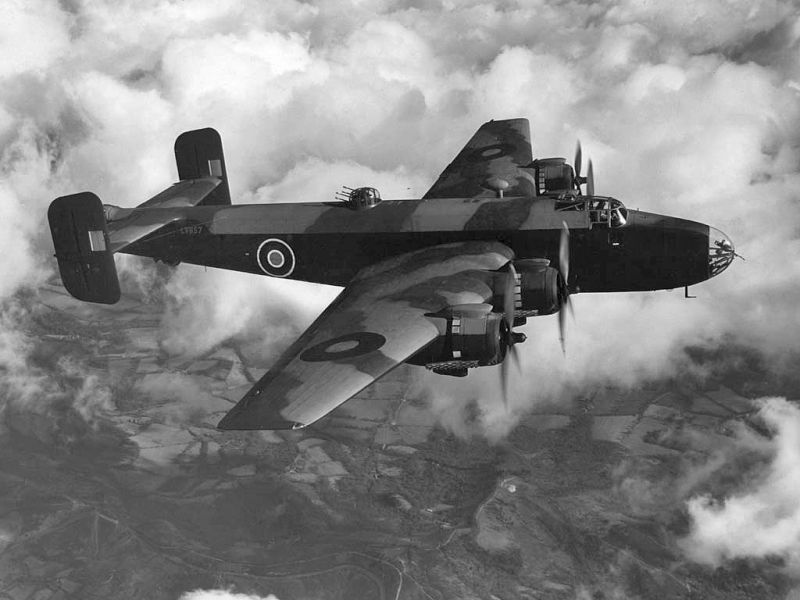
Skerrett spent the next five months moving between Operational Training Units, Conversion Units, and RAF Stations, before being mustered to No. 10 Squadron at the end of April 1943. No. 10 Squadron was based at RAF Melbourne in Yorkshire, flying four-engine Handley Page Halifax aircraft in bombing raids over Germany and occupied France as part of Bomber Command.
While serving with No. 10 Squadron, Skerrett received the news that his father had died in Australia.
After two and a half months flying Halifaxes with No. 10 Squadron, Skerrett was transferred to No. 35 Squadron. This pathfinder unit specialised in precision navigation and target marking for bombing raids.
In early September 1943, Ray was transferred to his third Squadron within Bomber Command: No. 78 Squadron. Based back in Yorkshire at RAF Breighton, No. 78 Squadron flew Halifaxes in bombing raids against Germany.
On 23 September, Skerrett was piloting a Halifax during a bombing raid over the northern German city of Hanover. Hanover was an important railway junction in northern Germany, which housed factories producing arms, batteries, tyres, and tracks for the German war effort. The city was subjected to a series of 88 air raids by Allied aircraft, with almost a million bombs dropped on the city claiming the lives of about 7,000 people, mostly civilians.
Four days later, Skerrett and his crew of seven other men set off in a Halifax JD.416 for another bombing raid over Hanover. Their aircraft never returned.
Skerrett’s mother was informed that he and the rest of his crew were listed as missing in air operations in late September. In May 1944, Ray Skerrett was officially declared to be presumed dead.
He was 21 years old.
After the war, Ray’s fate was uncovered. His Halifax was one of six aircraft shot down near Wunstorf on the night of 27 September. The burning aircraft was seen to spin into the ground north-west of Wunstorf, with the fire continuing for some time.
Once the area was safe to approach, members of the Luftwaffe Salvage Crew removed severely burnt remains from the wreckage, and buried them in the Wunstorf Cemetery.
In 1949, the remains of 32 airmen buried at Wunstorf Cemetery in late September 1943 were exhumed for identification. As the only Australian in the Halifax crew, Ray’s remains were identified by his uniform, along with the remains of his British co-pilot Sergeant Elson and Sergeant Fox, another British member of the crew.
His body was reinterred at Hanover War Cemetery in 1951, where it lies today. His headstone bears the inscription selected by his grieving family: “underneath are the everlasting arms”.
- Australian War Memorial Roll of Honour https://www.awm.gov.au/collection/R1719015