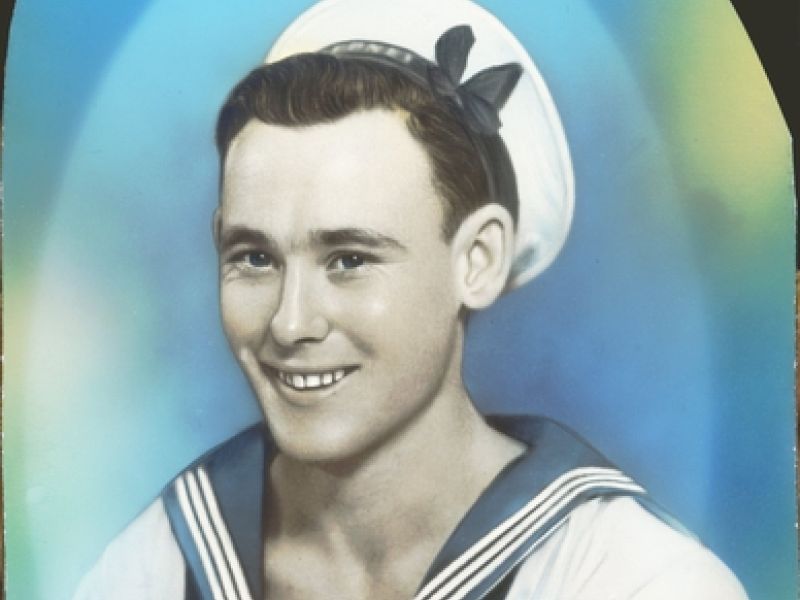
Able Seaman Rex Albert Cooper, HMAS Sydney (II)
 Australian War Memorial
Rex Cooper was born on 10 June 1920 in the Sydney suburb of Randwick, the youngest son of nine children born to John and Harriet Cooper. His young niece, Pam, to whom he was more like a brother than an uncle, also lived with the family. Rex Cooper was an electrician, who had begun dating a girl, Florence, who he had met in Fremantle.
Eighteen-year-old Rex joined the Royal Australian Navy on 21 March 1938, signing on for an initial service period of 12 years. His first posting was to HMAS Cerberus where he trained as a torpedoman. On completion of his training, in September 1938 he was posted to HMAS Sydney (II) where he would spend the rest of his naval career. He was rated as an ordinary seaman on 10 June 1938 and promoted to able seaman in August the following year.
In 1938 and 1939, before the outbreak of the Second World War in September, Sydney was operating and training on the Australian Station. Based in Fremantle in preparation for hostilities, the vessel commenced the war with gunnery training and escort duties off the Western Australia coast. Returning home to Sydney for docking and Christmas respite in December of 1939, the new year saw the vessel return to operations based out of Fremantle, until it commenced operations with the Royal Navy Mediterranean Fleet in Egypt in late May 1940. Sydney and her crew, including Able Seaman Rex Cooper, operated with distinction, undertaking celebrated actions including the sinking of the Italian cruisers Espero and Bartolomeo Colleoni, the Battle of Calabria, and the Battle of Cape Spada, of which Rex wrote in his diary.
HMAS Sydney returned to Australia in February 1941 to public celebration and acclaim, and Rex was briefly reunited with his brothers – John, Lew, and Wilton – who were all serving in the Australian Imperial Force.
The respite did not last long, however, and Sydney soon returned to patrol and escort task on the Australia Station. In late September 1941 it began operating off the Western Australian coast, escorting convoys from Fremantle to the Sunda Strait in the Netherlands East Indies. Arriving at Sunda Strait, Sydney would hand the convoy over to other Allied warships, which would continue escorting the ships to Singapore.
Writing to his mother from Fremantle after returning from Singapore, Rex said he had not much to report but was glad to be out of the tropics, and was hoping to be home to see his family soon. It was not to be.
On 11 November 1941, Sydney steamed from Fremantle escorting the troopship Zealandia, carrying troops of the Australian 8th Division. Six days later, Sydney handed the troopship escort over to HMS Durban before commencing the return passage to Fremantle.
After months of reports of missing merchant vessels and sightings of unidentified vessels in the area, on the afternoon of 19 November 1941 Sydney sighted what appeared to be a merchant ship some 200 kilometres west of Shark Bay, Western Australia, and closed to investigate. Sydney signalled the ship to identify itself while continuing to approach. The vessel replied that it was the Dutch steamer Straat Malakka, and at one point feigned a distress code to add to the deception. But it could not provide the allotted secret call sign in response to Sydney’s demands to confirm her identity.
Sydney drew closer, relinquishing her advantage of superior gunnery and range, unaware that she was approaching the disguised German merchant raider HSK Kormoran, which was heavily armed. Kormoran had already sunk ten unsuspecting merchant ships in the Indian Ocean and taken another as a prize. When Sydney was about 900 yards on his starboard beam, the captain of the German raider, Theodor Detmers, ordered the immediate hoisting of the German battle ensign and opened fire with guns and torpedos. Sydney returned fire, and in the ensuing battle conducted at point blank range, both ships were badly damaged. The surviving crew of Kormoran abandoned ship and the raider was scuttled. Approximately three quarters of her crew survived to become prisoners of war.
Sydney, listing heavily and ablaze from torpedo and gunfire, sank during the early hours of 20 November 1941, with the loss of all 645 members on board.
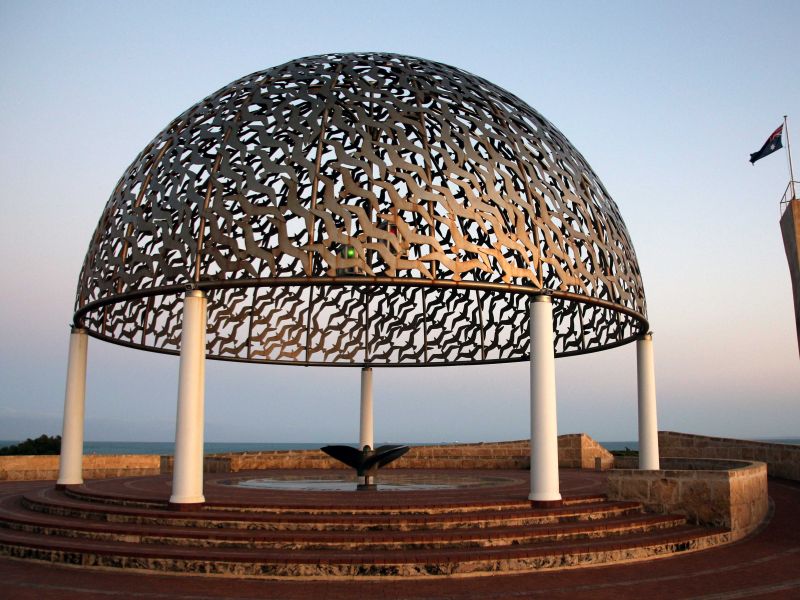
With no grave but the sea, Able Seaman Cooper and his shipmates are commemorated on the Plymouth Naval Memorial, England among thousands of others with no known grave, and on the Canarvon and Geraldton HMAS Sydney (II) Memorials in Australia. Rex Cooper was 21 years old.
- AWM Roll of Honour https://www.awm.gov.au/collection/R1690677