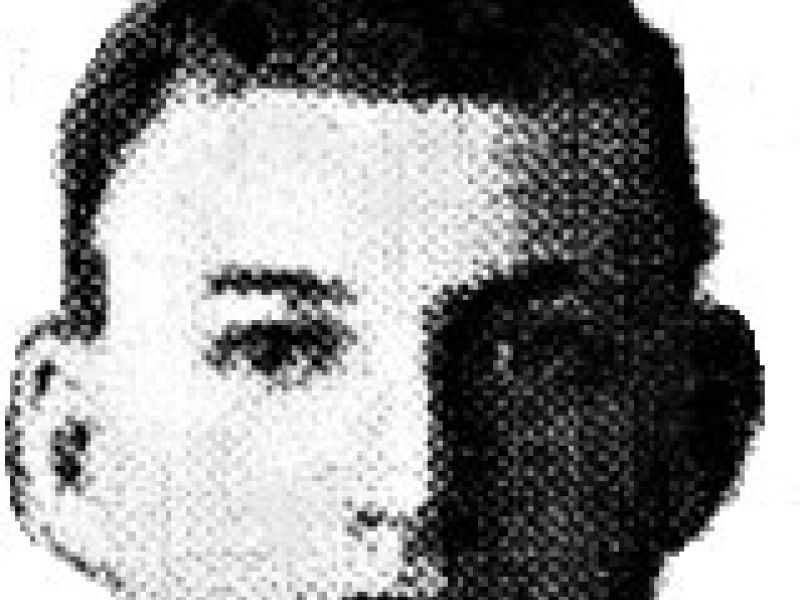
Trooper Norman Douglas Sherwin, 6th Australian Light Horse Regiment
 Australian War Memorial
Norman Sherwin was born on 1 November 1894 in Cargo, New South Wales, one of seven children born to Arthur and Catherine Sherwin. Norman and his siblings attended St Joseph’s Convent School in Cargo.
Sherwin enlisted in the Australian Imperial Force on 14 September 1914, one of the first men to enlist from Cargo. He was assigned to the 6th Light Horse Regiment with the rank of Trooper. After initial training, Sherwin left Sydney in HMAT Suevic on 21 December 1914, bound for Egypt.
The Light Horse remained in Egypt in the early months of 1915. The terrain of the peninsula meant that the Light Horse were considered unsuitable for the campaign. However, by May, members of the Light Horse were deployed without their horses to reinforce the infantry. Before leaving camp in Egypt, Sherwin wrote home, telling his parents,
“Do not be anxious about me, as I can look after myself alright.”
The 6th Light Horse Regiment landed at Gallipoli in late May 1915, and became responsible for a sector on the far right of the Anzac line. A month later, Sherwin received a gunshot wound to his left hand. Reporting the incident to his family, he recalled:
it was a packet of cigarettes that saved me … I was opening a packet of cigarettes at the time … when [the bullet] went through my hand, through the cigarettes, and through five thicknesses of tunic, made a hole in my shirt, and hit me in the stomach, taking some skin off and making a large bruise.
Although the cigarette packet may have saved him, the wound in his hand turned septic and Sherwin was hospitalised at the end of June.
He remained in hospital at Heliopolis until 27 July. But on 15 August he was back, this time with sunstroke. After his discharge, Sherwin was on light duties, before re-joining his regiment at Anzac in October.
The 6th Light Horse left Gallipoli on 20 December 1915, and began reorganisation at camp in Egypt. During this period Sherwin was hospitalised once more with mumps, returning to the regiment in early March 1916.
From April 1916, the 6th Light Horse Regiment joined the British defence of the Suez Canal, undertaking reconnaissance and patrolling in the Sinai Desert region throughout 1916 and early 1917. During this time, the 6th Light Horse took part in several offensives, including the Battle of Romani and the Battle of Gaza.
In early 1918, the regiment was involved in operations in the Jordan Valley after the collapse of Ottoman positions in southern Palestine. On 27 March, the regiment was involved in the first attempt to capture Gaza directly. The next day, Sherwin was one of 13 men sent to capture a Turkish machine-gun position near Amman. Leaving their horses behind, the men advanced over the open country and were subjected to heavy machine-gun fire. They were ultimately forced to surrender, as high casualties and Turkish resistance made the objective impossible to secure.
During the attack, Sherwin was wounded by machine-gun fire, and then shot in the abdomen by a Turkish soldier and taken prisoner. With the other men, he was taken to a train at Amman station and placed in a carriage. He received no treatment for his wounds, and his fellow prisoners reported that he was “semi-conscious”, “far gone”, and “spoke with difficulty”. Norman Sherwin succumbed to his wounds early in the morning of 29 March, 1918.
He was 23 years old.
He and two other Australians were buried by Turkish soldiers close to the railway line in an unmarked grave. His remains were never recovered. He is commemorated today at the Basra Memorial in Iraq
- AWM Roll of Honour https://www.awm.gov.au/collection/R1662324