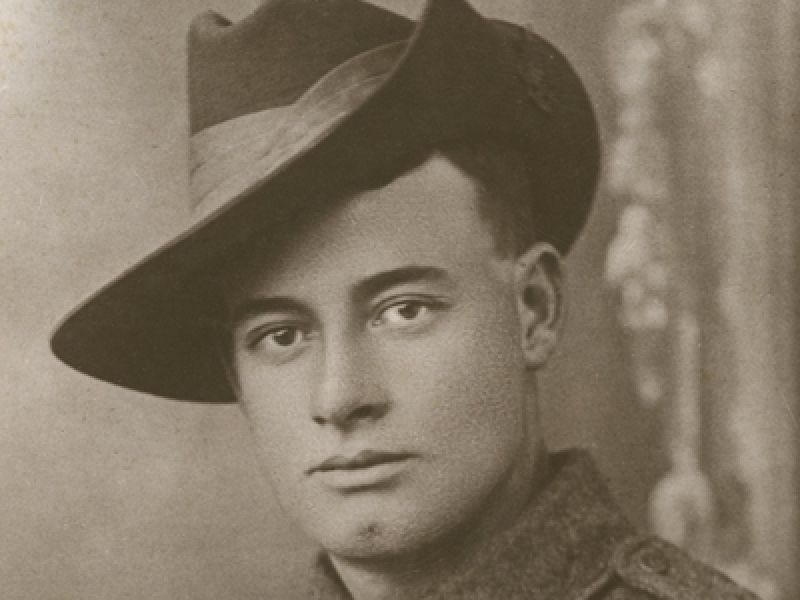
Sapper August Carl Meyer, 2nd Australian Division Signals Company
 Australian War Memorial
August Meyer was born on 30 August 1896 in Petersburg, South Australia. Known as “Gus” he was the youngest of nine children born to store-keeper August Meyer Senior and his wife Mary. He grew up in Western Australia, and received his education at Subiaco State School. After his schooling, he went to work as a clerk and volunteered in the Goldfields Militia.
August Meyer enlisted in the Australian Imperial Force on 21 June 1915. He was assigned to the 2nd Reinforcements of the 28th Battalion with the rank of private and began a short period of training in Australia. He embarked for active service from Fremantle just a month later, sailing on board the troopship Demosthenes.
Private Meyer arrived on the Gallipoli peninsula in October 1915, after a brief time in Egypt. His introduction to the war was a quiet one, as he had joined his comrades after the August Offensive. He spent the next two months manning the trenches and front lines before he was evacuated from the peninsula when the campaign was abandoned in December. Meyer and his comrades returned to Egypt where they continued training as the AIF underwent a period of restructuring. He embarked for the Western Front in early March, arriving in the French port city of Marseilles.
His unit was immediately sent north to the Somme Valley which had been the site of bitter fighting since 1914. There, his unit was engaged in training exercises and working parties until July, when they were sent into battle near the village of Pozieres. Before his unit reached the front lines, Meyer contracted influenza and was sent to England for treatment. He remained in England until March 1917, when he was transferred to the 2nd Division Signals Company, taking on the rank of sapper. He returned to the front as the enemy made a strategic withdrawal to the fortified Hindenburg Line.
His division eagerly followed the German retreat, which finally halted near the village of Bullecourt in April 1917, sparking two bloody clashes with the enemy which cost more than 10,000 Australian casualties. Following the carnage of Bullecourt, the 2nd Division was moved to the Ypres Salient in Belgium. There, it took part in costly battles at Menin Road, Polygon Wood, Poelcappelle and Broodseinde Ridge. On 15 September the enemy began to bombard Meyer’s unit with gas shells. Meyer was one of several men that day who were poisoned by the mustard gas, which caused coughing, bloody nose, vomiting, nausea and burns to the skin.
Meyer was transferred to hospital behind the lines for treatment and did not return to his company until November 1917. After a cold winter in the trenches, allied units spent much of early 1918 fighting to repulse the German Spring Offensive which threatened to break through key positions at Amiens and Villers-Bretonneux.
In June 1918, Meyer returned to England on leave, where he became ill again and was hospitalised for several months. He re-joined his comrades in France on 13 November, two days after the Armistice had been signed and the war was ended. By the end of the month however, Meyer was again hospitalised with pneumonia. He was treated in a casualty clearing station for a week, but little could be done for him, and he died on 5 December 1918.
He was buried at Le Cateau Communal Cemetery, where he lies today. Two of his older brothers, Albert and Edward, had also been killed in action earlier in the war.
The three brothers were remembered by their family in a simple memorial notice placed in The West Australian which read:
“All so sadly missed.”
Sapper August Meyer was just 22 years old.
- Roll of Honour, Australian War Memorial https://www.awm.gov.au/collection/R1647565