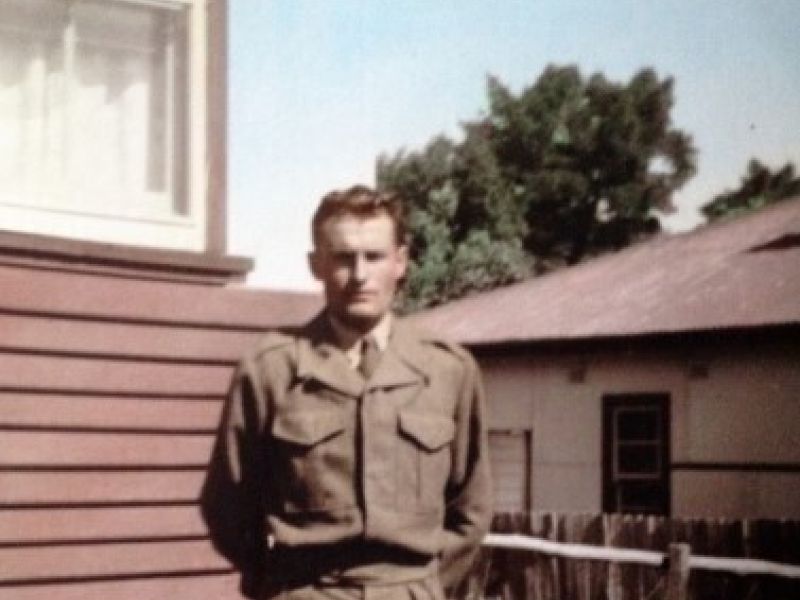
Private William Gordon Christie, 3rd Battalion, the Royal Australian Regiment
 Australian War Memorial
Known as Bill, William Christie was born on 5 September 1928 in Paddington, New South Wales. He was the first of three children and the only son of William and Elizabeth Christie. Over the next five years, his sisters Valerie and Shirley were born.
Christie’s father Neil had served with the 55th Battalion during the First World War and had been awarded a Military Medal in September 1918 for attacking a German machine-gun position near Peronne. Neil worked for the Tumbarumba Shire Council. After the Second World War began, he joined the Royal Australian Air Force in 1942. He remained in New South Wales until he discharged from service in June 1945.
His son Bill grew up in Tumbarumba and attended the local school. After gaining his intermediate certificate, he left school and moved to Yass, where he was employed as a linesman for the Postal Department at Yass Junction. Three years later he moved into the office as a clerk.
Christie was noted for his courteous manner and his diligent work ethic. Outside work he was known for his quiet nature, but loved riding his motor bike.
Soon after arriving at Yass, he met Alice White and they began a courtship. After they were married they moved in to a house on Mount Street.
In June 1950, the Korean War began. The Australian government raised K-Force, calling for volunteers to serve in the army for three years, one of which would be in Korea. Christie enlisted for service with K-Force at Marrickville on 30 July 1951. He was sent to Ingleburn Camp for basic infantry training.
During his training he was arrested at Milton on 29 September for trying to drive a vehicle while intoxicated and unlicensed. He went before the court on 1 October, where he was convicted and fined the large sum of 20 pounds. He was also banned from holding a licence for 12 months.
On 20 December he was posted to the 1st Battalion, the Royal Australian Regiment, which was also located at Ingleburn. Only four days later he was allocated as a reinforcement to the 3rd Battalion, the Royal Australian Regiment, which was on active service in Korea. He flew out of Sydney on 26 December, travelling via Darwin to Japan. At this time Alice was pregnant with their first child.
Christie saw in the New Year at the 1st Reinforcement Holding Unit. He spent the next month training, which included the Battle School at Haramura. The school simulated front-line conditions in Korea as much as possible, to give the reinforcements the best training possible.
He joined 3RAR in Korea on 9 February and was sent to C Company. Christie received an immediate initiation when his company took Chinese mortar fire throughout the afternoon. Over the next two month he was involved in the nightly patrol war.
In mid-April 3RAR went into reserve. During this time 1RAR arrived from Australia and joined 3RAR in the same brigade. Two months of building defensive works and training followed, before 3RAR returned to the front line in late June. It was around this time that Alice gave birth to their daughter, Elizabeth.
The monsoon season began soon after, and such was the intensity of the rainfall that a number of 3RAR’s bunkers collapsed and several men had to be dug out. Despite the weather, the patrolling of no man’s land was as intense as ever, as was the daily Chinese artillery and mortar fire on the Australian positions.
During the afternoon of 22 July, 3RAR’s positions came under Chinese artillery fire. Just after 4 pm, Christie was killed instantly when he was hit through his back by shrapnel.
He was laid to rest with full military honours in the United Nations Cemetery at Tanggok on 29 July. He was 23 years old.
- Roll of Honour, Australian War Memorial https://www.awm.gov.au/collection/R1714295
- Virtual War Memorial, Australia https://vwma.org.au/explore/people/617266