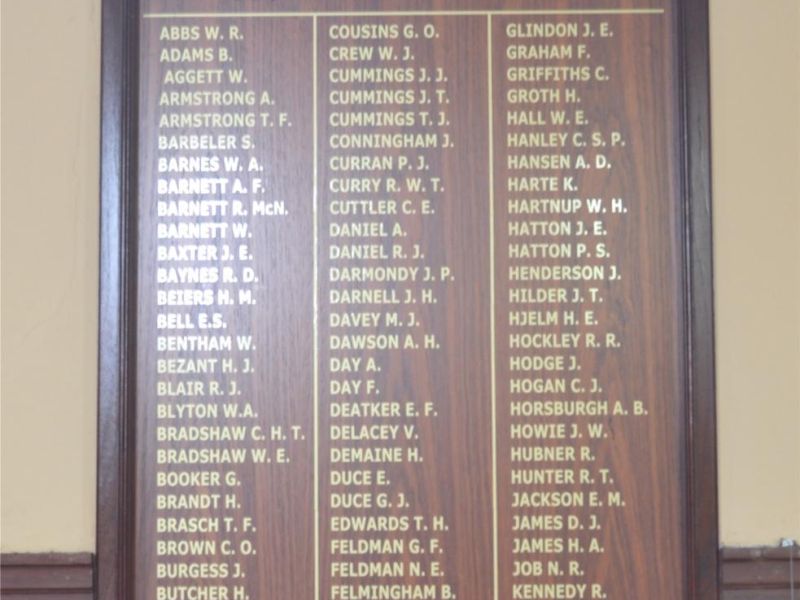
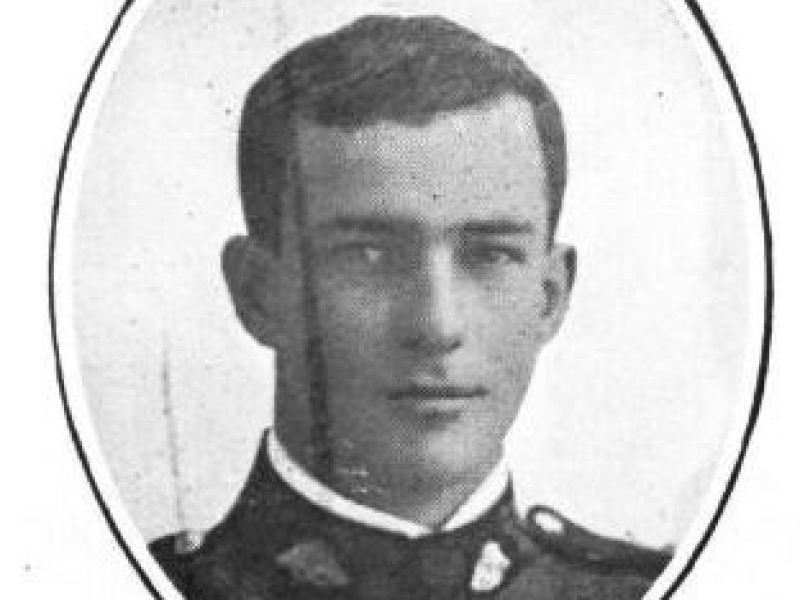
Lieutenant Victor Thomas Symes Warry 25th Australian Infantry Battalion
 Australian War Memorial
Victor Warry was born on 15 July 1895 in Maryborough, Queensland. He was one of five children born to Richard Symes Warry, a businessman, and his wife Sarah. Victor received early education in Maryborough, before moving to Sydney where he attended Newington College. On completion of his education, Victor began working as a clerk for Sydney warehousemen Messrs Brabant and Co. He was employed in this position when the First World War broke out in 1914.
Victor Warry enlisted in the Australian Imperial Force on 28 May 1915. He was commissioned as a second lieutenant and was assigned to the 25th Battalion, and soon embarked for active service on 29 June aboard the troopship Aeneas.
After a short stop in Egypt, Warry, newly promoted to lieutenant, joined his unit on Gallipoli in September 1915. By the time he reached his comrades, the campaign had descended into a stalemate and allied forces were considering abandoning it altogether. As a result, Warry’s time on the peninsula was primarily spent undertaking defensive duties in the trenches.
Like many on Gallipoli, Warry eventually became ill and was removed from the lines for treatment. He re-joined his comrades shortly after, but could not shake his illness and was eventually evacuated to Malta for treatment. He did not re-join his unit until the end of February 1916, by which time allied forces had withdrawn from Gallipoli.
His unit embarked for the Western Front, arriving in the French city of Marseilles on 19 March 1916. The 25th Battalion was the first Australian unit to arrive, and the men were given a short period to explore the city. Later that month, they travelled north towards the Franco-Belgian border, entering the trenches for the first time on 4 April 1916.
Over the weeks which followed, Warry’s unit undertook periods of training behind the lines, as well as short stints on duty in the trenches. In July, the 25th was sent south to the Somme Valley, to take part in the advance on German positions around the French village of Pozieres.
They entered the front lines around the village on 28 July 1916, in preparation for an attack under the cover of darkness the following morning. They began their advance just after midnight on 29 July, tasked with taking two lines of German trenches on Pozieres Ridge. In five waves the men of the 25th Battalion jumped the parapets, immediately coming under murderous machine-gun fire from enemy lines. As they pressed forward, Warry and his men were hit by the enemy’s artillery, as well as fire from mortars just as they reached their first objective. By the time they made it to the second trench, the men were so outnumbered that they were forced to dig in for cover. Private Herbert Harris, who was also caught in the fighting at Pozieres, described the battle:
“Imagine men dug in, a few feet into the ground, and shells falling just like rain. Trenches blown up and men digging for dear life to rebuild them, or rescuing their comrades who were buried and in most cases the rescuers were also buried by shells … When entering the trenches we were bombarded with tear and gas shells which made us wear our gas helmets … it is almost impossible to see and hard to breathe … I have heard officers and men say that the landing and the Lone Pine battle at Gallipoli were a picnic compared to this last fight.”
Shortly after, they received their orders to retreat to their own lines. By the following morning, the 25th Battalion had suffered some 340 casualties. Among the missing was Lieutenant Victor Warry. His commanding officer described Warry’s final moments in a letter to the young lieutenant’s mother:
He was most anxious to lead his men and he was allowed to go. He died a true soldier’s death and he went under while rallying his men right in front of the enemy’s barbed wire entanglements … it was a shell that killed poor Vic, death was instantaneous. The men of Vic’s company who lived through that charge speak very highly of the bravery he displayed. For the rank and file to speak of their officer in that strain is, I think, the highest praise any officer can earn.”
Warry’s final resting place was never found. Today, he is commemorated on the Australian National Memorial at Villers-Bretonneux among more than 10,000 others who have no known grave.
Lieutenant Victor Warry was 21 years old.
- Roll of Honour, Australian War Memorial https://www.awm.gov.au/collection/R1668110
- Virtual War Memorial, Australia https://vwma.org.au/explore/people/372134