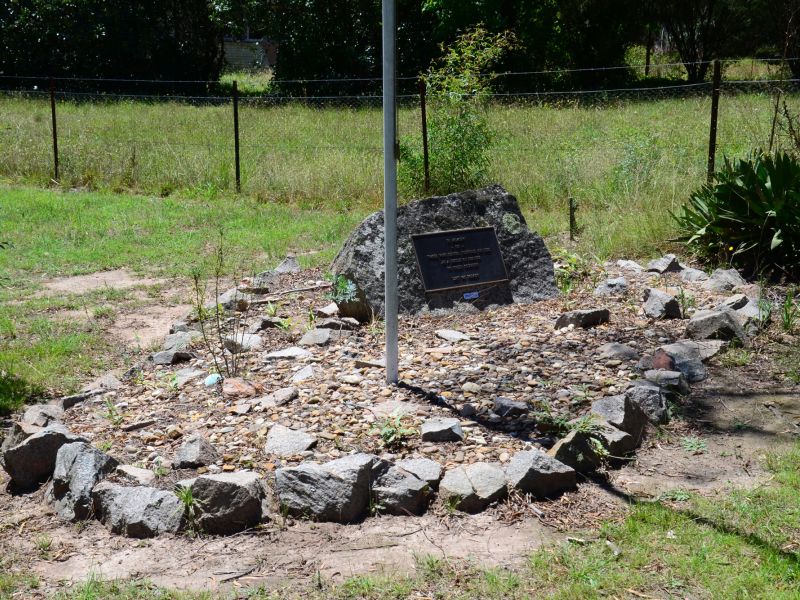
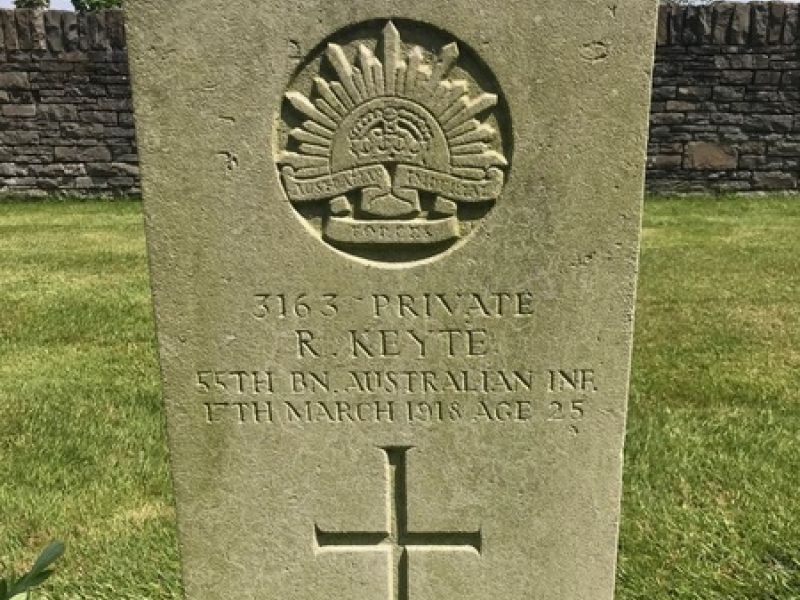
Private Robert Keyte, 55th Australian Infantry Battalion
 Australian War Memorial
Robert Keyte was born on 5June 1883 at Major’s Creek, near Braidwood in New South Wales. Affectionately known as “Clocky”, he was one of nine children born to William and Hannah Keyte, who owned and operated the local store. Clocky was educated at Major’s Creek Public School and was known as one of the district’s best football players. When the First World War broke out in 1914, he was working as a labourer.
Clocky Keyte enlisted in the Australian Imperial Force on 3 October 1916. He was assigned to the 8th Reinforcements of the 55th Battalion with the rank of private and began a short period of training. In October, he returned to Major’s Creek for a farewell from his community. He returned to Sydney in early November, and embarked for active service later that month, sailing on the troopship Suevic.
Private Keyte arrived in Devonport, England, on 30 January 1917 and continued training alongside his new comrades. In April, he travelled to the Western Front to rejoin the 55th Battalion. His arrival at the front came after a major attack on enemy positions at the village of Bullecourt, which had been a disaster for Australian forces. The failed attack cost some 3,000 Australian casualties and the village remained in enemy hands. Despite the appalling losses, a second attack on Bullecourt was ordered in May. On this occasion, allied forces successfully broke through enemy lines, but it came at the cost of a further 7,000 casualties. The 55th Battalion later defended the gains made during this ill-fated attack, which proved to be a bloody introduction to war for Private Keyte.
Following the attacks on Bullecourt, Keyte and his comrades were moved to the Ypres sector in Belgium. In September, the 55th was involved an attack on Polygon Wood. The attack was largely successful, but was again costly, resulting in some 5,770 Australian casualties. Keyte and his comrades saw out the rest of the year under wet and freezing conditions, with training and routine duty in the trenches.
In early 1918, German forces launched a major offensive along the allied front. The 55th Battalion was near Wytschaete on 17 March, and Keyte was among a party of men selected for fatigue duties in the support lines. The enemy began bombarding their position with gas and high explosive shells, causing a number of casualties. Among the wounded was Private Keyte, with a shrapnel wound to the stomach. His comrade, Corporal Young, told the Red Cross:
“Within five minutes of receiving his wounds he was carried into safety. The advanced dressing station was only 20 yards from where he got wounded. Here, he received every attention. I remained by special request, to spend the last few minutes we thought we had with him … He was then moved to another station, where everything was done for him that could have been done. He was moved from there to Kemmel Dressing Station, where he died just before reaching it.”
Keyte was buried at Irish House Cemetery in Belgium, where he lies today beneath the words chosen by his parents. They read:
“Brave boy. Gave your life that we may live. We will meet in Heaven.”
Robert Keyte was 34 years old.
- AWM Roll of Honour https://www.awm.gov.au/collection/R1642708
- Virtual war memorial https://vwma.org.au/explore/people/64950