Sergeant Lionel Timothy Watson, No. 55 Squadron Royal Air Force
 Australian War Memorial
Lionel Watson was born in Sydney on 2 July 1921, one of five children born to Frederick and Edith Watson. Lionel grew up in the suburbs of Sydney and attended Petersham Intermediate Boys High School, where he was known as a keen sportsman. He went on to find employment as a shipping clerk, and was working as a pay and ledger clerk when the Second World War broke out in 1939.
Lionel was 18 years old when war was declared. He immediately sought to enlist in the air force, but with few training spaces available for new airmen, he was put in the reserve until a place could be found for him. On 3 July 1940, the day after his 19th birthday, Lionel was called up for service with the Royal Australian Air Force. He began training, undertaking courses across the country to prepare him for active service abroad. In February 1941 he received his air gunner’s badge at the bombing and air gunnery school at Evan’s Head.
Watson soon embarked from Sydney and began his journey to the Middle East. He arrived in Egypt at the beginning of May, before being sent to Somalia where he was briefly attached to the Royal Air Force Radio School. In July 1941 he travelled to Kenya where he joined East Africa Air Headquarters at Mombasa. On 25 August, Watson was posted to No. 70 Operational Training Unit, and was sent inland to the unit’s base at Nakuru. There, he and his comrades were trained to operate in Middle Eastern conditions, predominantly flying Bristol Blenheims.
Sergeant Watson completed his training by early October, at which point he joined his first operational unit, No. 55 Squadron, Royal Air Force. Based out of Fuka in Egypt, the squadron had been undertaking day bombing missions on enemy targets in North Africa. By the time Watson joined in October, the squadron was undertaking a series of anti-shipping sweeps in the Mediterranean Sea. Many of his early missions were of this nature.
On 12 November 1941, Watson took off from Fuka with two of his comrades in Blenheim 9549. Their aircraft was one of eight detailed to investigate a report of unidentified ships north-west of Derna on the Crete–Benghazi Line. With the aircraft operating in pairs, Watson and his comrades began sweeping the area, having the advantage of perfect visibility. After conducting a thorough sweep, nothing of note was found and the aircraft began returning to Egypt. While a number of Blenheims landed at Sidi Barrani, Blenheim 9549 carried on towards Fuka. Not long into its descent towards the airstrip, the pilot appeared to lose control of the aircraft which crashed into the ground. On impact, the two bombs that had not been used on their mission exploded, killing all those on board. It was later discovered that the Blenheim had run out of petrol, causing the crash.
In a letter to Watson’s father, the Air Board wrote:
“The members of the board desire me to extend to Mrs Watson and yourself their sincere sympathy in your great loss. It is hoped that you will both find a measure of consolation in the fact that your late son’s life was given in the service of the Empire.”
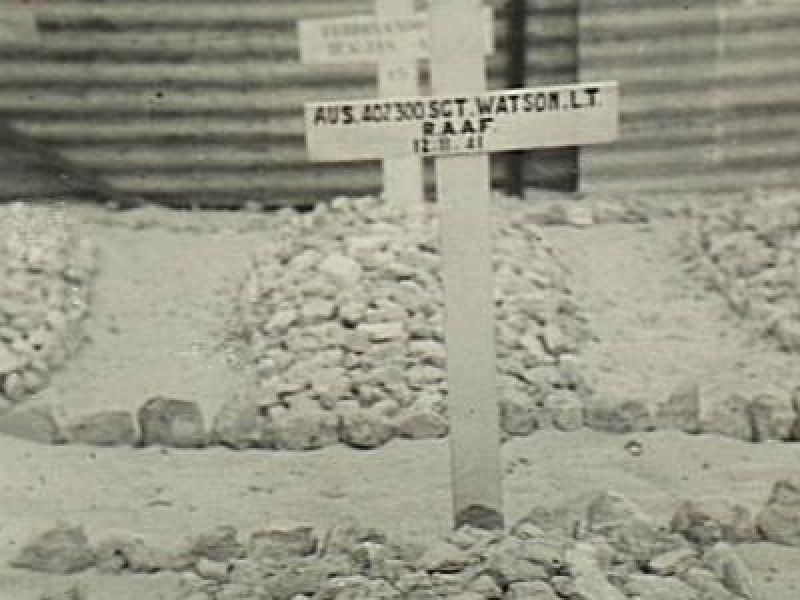
Watson and his comrades were interred at El Alamein War Cemetery in Egypt where his lie beneath the inscription chosen by his family: “Bravely he did his duty.”
Sergeant Lionel Watson was 20 years old.
- AWM Roll of Honour https://www.awm.gov.au/collection/R1718481