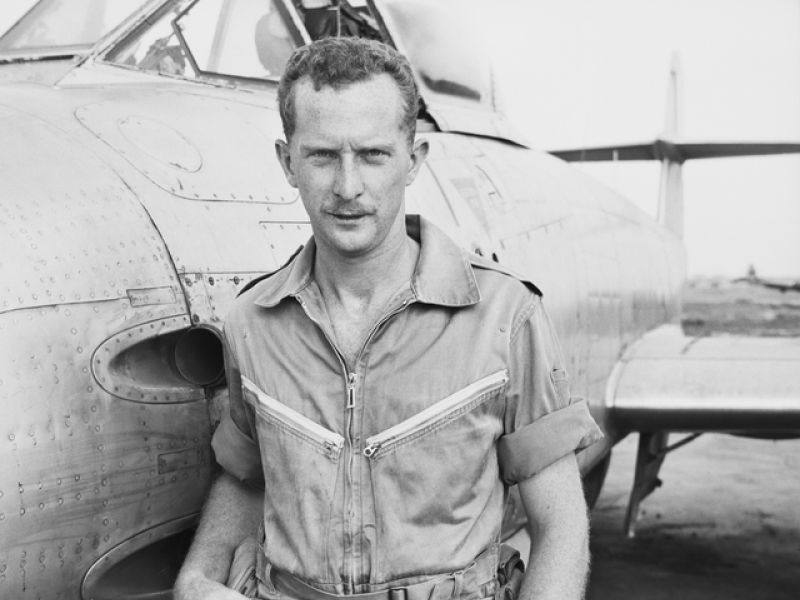
Pilot Officer Maxwell Edwin Colebrook DFM, No. 77 Squadron, RAAF
 Australian War Memorial
Max Colebrook was born in West Perth on 8 May 1926, the third of three children and the second son born to Claude and Ivy Colebrook.
Known as “Bluey” because of his red hair, he attended Kalamunda State School in Perth’s east. He left school in November 1941 after attaining his junior certificate. Outside school, Colebrook had been a boy scout and enjoyed playing cricket and Australian Rules football. He also spent many hours building model aeroplanes.
All three Colebrook siblings served in the Royal Australian Air Force during the Second World War. Harvey enlisted in 1940, and would make the RAAF his career, retiring as an air commodore. Their sister Merrial enlisted in March 1942, and Max, initially underage, joined No. 78 Squadron, Air Training Corps in May 1942.
During the war, Merrial met Neville O’Neal and they were married at St Mary’s Church, West Perth, in 1944. The bonds of friendship were so strong that Max accompanied them on their honeymoon.
In May 1944, Max Colebrook joined the Royal Australian Air Force and was accepted for pilot training. By May 1945, he was considered suitable for training as a fighter pilot. But as the war in Europe had come to an end, Colebrook remustered as a transport driver until he was demobilised in March 1946.
After returning to “civvie street” Colebrook ran a successful suburban grocery store in Perth. He tried to be re-considered for service, but as the RAAF was downsizing, his request was declined. Undeterred, he joined the RAAF reserve in June 1948 and lobbied for a return to full-time service.
His persistence paid off, and in February 1949, he re-joined the RAAF as a trainee pilot. At the end of his course he was awarded the flying prize for most outstanding pilot, and in August 1950, Colebrook was posted to No. 3 Squadron, which was equipped with P-51 Mustang fighters. While at the squadron, he was promoted to sergeant.
In late February 1951 Colebrook was posted to No. 77 Squadron in Korea. He flew his first operation on the 2nd of March, days after arriving in Korea. In April, the squadron was withdrawn to Japan where it was re-equipped with Meteor fighter aircraft. The squadron spent several months learning to fly it before returning to Korea in July.
At the end of his tour in early December, he was awarded the United States Distinguished Flying Medal. His citation stated that he “completed a total of 23 missions on Mustang aircraft and 78 missions on Meteor aircraft. As a section leader he has displayed skill and determination in air combat with superior forces.”
He was also awarded the US Air Medal. Part of his citation reads: “Sergeant Colebrook participated in 30 operational flights; in the course of these operations, dive bombing, rocketing and strafing runs were made from dangerously low altitudes, destroying and damaging enemy installations and equipment.”
Colebrook returned to Australia and spent Christmas 1951 at home with his parents in Perth. Before returning home, he had requested a second tour in Korea, which was granted. Now a flight sergeant, Colebrook returned to Korea and 77 Squadron in March 1952 and was soon on operations. On 12 April, he was appointed to a short service commission with the rank of pilot officer.
The following day Colebrook flew two operations. The first, paired with Sergeant Phil Zupp, targeted North Korean positions along a well-known supply route. Two hours later, Colebrook took off again, this time as wingman to Flight Lieutenant Peter Middleton. The were to patrol the main supply route from Panmunjom to Pyongyang, and investigate a known heavy-gun position at Masan-Ni. There, Middleton flew a low pass over it but did not observe any ground fire.
But during Colebrook’s attack run he radioed Middleton calling, “I’m hit!” Middleton told him his aircraft was trailing fire from the ventral tank. Colebrook jettisoned the burning tank and called, “OK! I’ve dropped it … I’m heading for home.” It was his last transmission.
Extensive searches were carried out, but neither Colebrook nor his aircraft was located. He was listed as missing in action, in the hope that he had been taken prisoner of war. However, by 1956, with the war long over, the RAAF declared him missing, presumed killed. He was 26 years old.
In March 1954 Colebrook’s mother received his Distinguished Flying Medal from Queen Elizabeth II at Western Australia’s Government House.
Today Colebrook is commemorated among the names of the missing at the United Nations Memorial Cemetery at Pusan. He is one of 43 Australians still listed as missing in action from the Korean War.
His name is listed on the Roll of Honour at the Australian War Memorial, among the 340 Australians who died as a result of their service during the Korean War.
- AWM Roll of Honour https://www.awm.gov.au/collection/R1714545