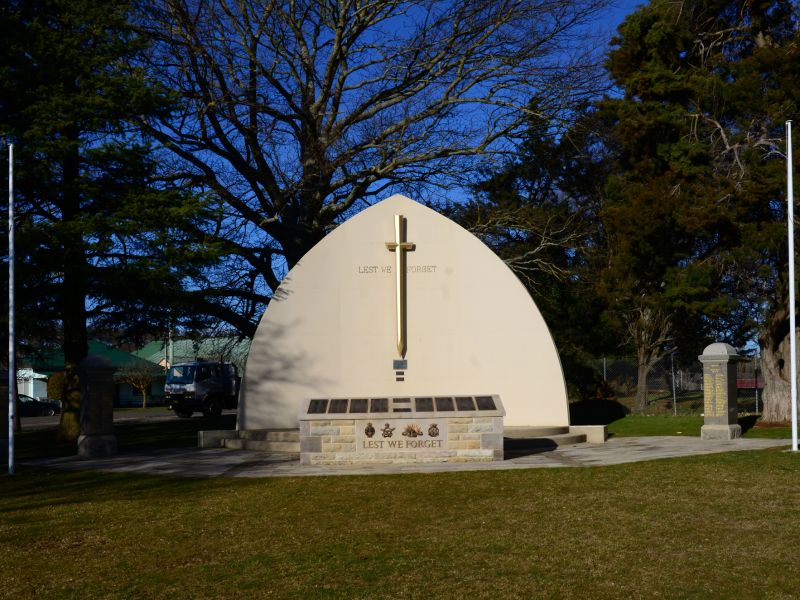
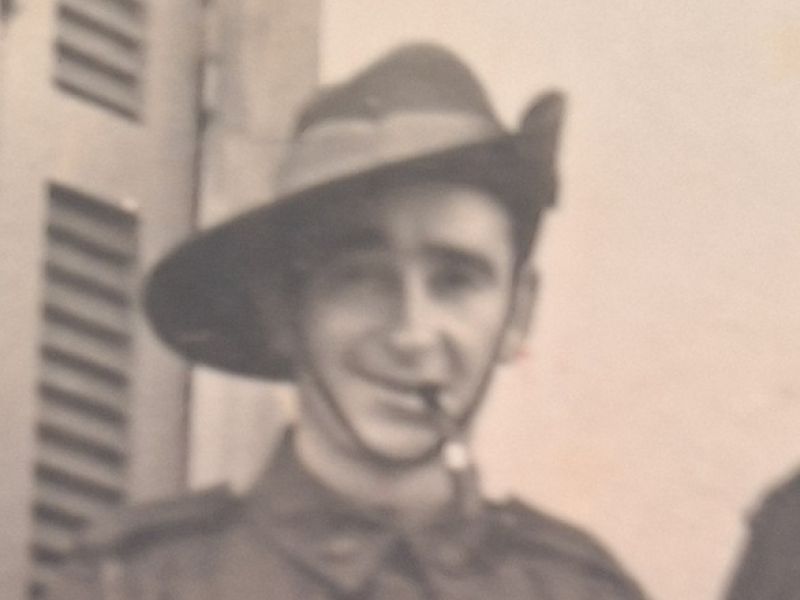
Private William Hearn Farrelly, 2/17th Australian Infantry Battalion
 Australian War Memorial
William Hearn Farrelly was born on 6 June 1918 in Crookwell, New South Wales. He was one of seven children born to Charles and Emily Farrelly. Known as “Stan” to his friends and family, he worked as a butcher in Crookwell. His duties included driving the delivery cart, and in this way he became quite well-known in the local district.
In June 1940, Farrelly travelled to Goulburn to volunteer for service in the Australian Imperial Force. He had undertaken compulsory military training and as a result of his experience, he was temporarily appointed corporal for the duration of training.
In early 1941, Farrelly embarked at Sydney and sailed to the Middle East. Arriving in March, he continued his training. In July, he joined his unit, the 2/17th Australian Infantry Battalion, which was at that time among the defenders of the besieged port city of Tobruk.
In October 1941, the battalion departed Tobruk for Palestine, where it continued training at Camp 69. During the first half of 1942, the 2/17th Battalion moved to Syria and Lebanon in support of the Allied campaign against Vichy French forces in that region. In early July, the battalion travelled to Alexandria in Egypt, and from there deployed to the Western Desert in readiness for a showdown with the Axis forces.
The British-led Allies defended a line between the Mediterranean Sea in the north and the impassable Qattara Depression in the desert to the south. Allied units took up positions around the tiny desert locality of El Alamein. The 9th Australian Division, of which the 2/17th Battalion was a member, was on the right flank of the Allied position, on the coast.
In September 1942, Farrelly’s father received a letter from his son. He mentioned the flies and sand of the desert, but assured his parents that he was healthy and well. In part, he wrote:
“I was in a bit of a stoush the other day. We captured about 100 prisoners. It was pretty hot at times, but a man can’t let that worry him; he’s here to do a job and it’s got to be done — no matter what the costs”.
During September and October the Eighth Army prepared for the main Allied counter-offensive. The men of the 2/17th Battalion trained alongside tanks and anti-tank guns, so that they knew how to work together on the battlefield. There was still time for recreation, though, and the battalion diary notes that the men played cricket and held a surfing carnival.
On the night of 23 October 1942, the Allies launched what became known as the Second Battle of El Alamein. After a supporting artillery barrage, the men of the 2/17th Battalion crossed a minefield strung with barbed wire to engage the German positions. They held the ground they had captured, but during the fighting on 25 October, Farrelly was killed when an enemy artillery barrage landed on Australian positions.
He was 24 years old.
Farrelly’s remains were buried near where he fell. Towards the end of the war, his grave – among more than 7,000 Allied burials of the Western Desert campaigns – were consolidated in El Alamein War Cemetery.
His grieving parents chose the inscription for his headstone: “One of the best God could send. Dearly loved by all his friends”. Farrelly was survived by his parents, his six sisters and his brother.
Two of Farrelly’s siblings also served in the armed forces during the war. His older brother Gunner Charles Farrelly served in New Guinea and Bougainville in the 4th Field Regiment, and returned to Australia in 1945. His younger sister, Corporal Vera Farrelly, served with the Women’s Auxiliary Australian Air Force in Australia, and was discharged in 1946.
- Australian War Memorial Roll of Honour https://www.awm.gov.au/collection/R1707992