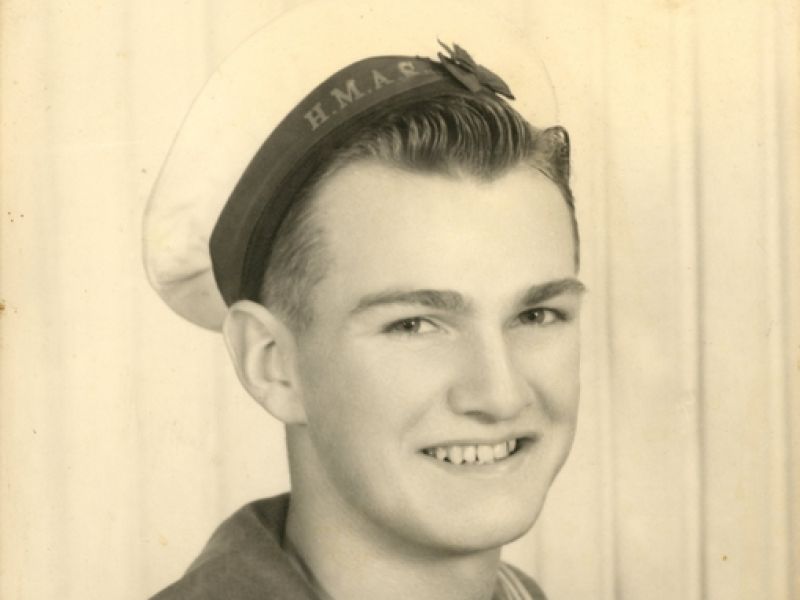
Able Seaman Leslie Laurence Hart, HMAS Australia, Royal Australian Navy
 Australian War Memorial
Leslie Hart was born in Queanbeyan, New South Wales on 1 November 1925. Known a Les, he was one of two children born to Stanley and Esther Hart.
Leslie grew up with his parents and sister Noelene in the Canberra suburb of Ainslie, where he attended local public schools. He went on to work as an employee of the Department of Post-War Reconstruction following its establishment in late 1942.
Les Hart enlisted in the Royal Australia Navy on 1 July 1943. He was given the rating of ordinary seaman, and commenced his initial training at HMAS Cerebrus on the Mornington Peninsula in Victoria. For the next five months, Les gained qualifications in seamanship and gunnery at HMAS Cerebrus and HMAS Penguinin Sydney.
In early December 1943, Hart joined the crew of HMAS Australia. The large heavy cruiser had been in service since the beginning of the war, and by the time Hart arrived onboard was involved in bombarding enemy-held islands in the South West Pacific, particularly along the north-eastern coast of New Guinea and the island of New Britain. The ship remained in the region for the next ten months, providing bombardment support for allied assults in the Pacific, from Cape Gloucester in the New Britain area to Morotai in the Netherlands East Indies.
In mid-October 1944, Hart was promoted to able seaman. A few days later, HMAS Australia took part in a precursor to the Battle of Leyte Gulf in the Philippines. On the morning of 21 October, the ship was hit by a Japanese aircraft, killing 30 of the crew and injurying a further 65. Captain Nicholls of HMAS Shropshire reported: “During the dawn stand-to, a low-flying aircraft approached from the land between Australia and Shropshire … although under heavy fire, [it] passed up the port side of Australia and crashed into the foremast … There was a large explosion and an intense fire was started in the air defence position and bridges.”
For those on board Australia, there was little doubt the attack had been a deliberate suicide attack. One eye witness explained after the fact that “among those of us who saw the incident, there was no doubt as to the pilot’s suicidal intention”. However, the question of whether the attack was an organised kamikaze attack remains unsettled.
HMAS Australia was escorted to Manus Island and then Espiritu Santo in the New Hebrides to undergo repairs to its damaged bridge and foremast.
By early January the repairs had been completed, and Australia returned to action in the Lingayen Gulf, providing bombardment cover for the allied invasion of Luzon Island in the Philippines.
On 5 January 1945, HMAS Australia was subjected to a kamikaze attack. Able Shipman Leslie Laurence Hart was one of the 25 crewmen killed in the explosion that followed. He was 19 years old.
Leslie was buried at sea in the Lingayen Gulf soon after his death.
In the years following his death, Leslie’s family and friends inserted commemorative notices in his honour into the Canberra Times. On the first anniversary of his death, his “loving Grandma” reflected that Les had been “loved by all who knew him”, while his parents and sister inserted the short commemorative notice: “Thy memory and our love will never die”.
Leslie is commemorated today on the Plymouth Naval Memorial in the United Kingdom, alongside the names of almost 16,000 sailors from Britain, Australia, and South Africa who died during the Second World War and have no known grave.
- AWM Roll of Honour https://www.awm.gov.au/collection/R1690814