Winged Victory by Gilbert Doble - a thesis by Julia Freeman (formerly Julia May)
 Irene Sutherland
Summary of the thesis
Julia Freeman (then Julia May), in her 1993 thesis Gilbert Doble’s ‘Winged Victory’ War Memorial, Wellington, N.S.W., examines the Wellington War Memorial not simply as an isolated sculpture but as a complex commemorative ensemble whose architecture, landscape, sculpture and classical imagery embody particular attitudes towards war, sacrifice, heroism and national identity in Australia after the First World War. Central to her argument is the proposition that Gilbert Doble’s monument is considerably more intellectually and symbolically complex than its relatively obscure provincial location or the sculptor’s modest reputation might suggest.
May begins by locating Doble within the conservative artistic environment of early twentieth-century Australia. Trained as a stonemason rather than through the conventional academic route of the professional sculptor, Doble worked across funerary monuments, architectural ornament and decorative metalwork. His art developed within a culture still strongly influenced by nineteenth-century Realism, Neo-Classicism and, in the applied arts, Art Nouveau. His earlier works demonstrate both technical competence and an increasing ambition to undertake large public monuments. At the same time, May does not attempt to elevate Doble uncritically into the first rank of Australian sculptors. Her analysis acknowledges awkwardness and inconsistency in his modelling and composition. His significance lies instead partly in his ability to draw upon a remarkably wide inherited visual vocabulary and adapt it to Australian civic commemoration.
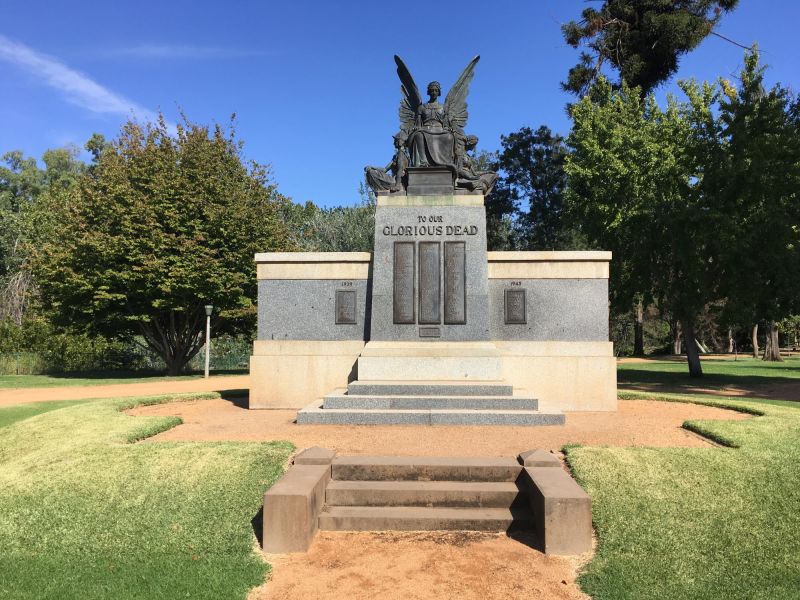
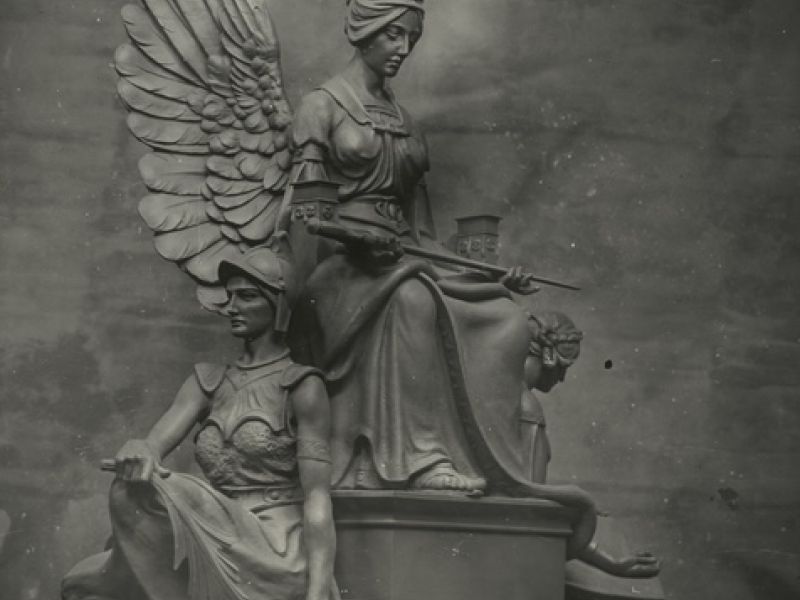
The Wellington memorial represents the most ambitious development of this process. Doble conceived not merely the statue but an entire commemorative environment incorporating the monument, mound, paths, garden beds, trees, gates and boundary fence. At its centre stands the large stone and polished-granite plinth supporting an electro-formed copper sculptural group. The seated central figure is a winged female Victory, or Nike, with an unsheathed sword across her lap. She is flanked by two figures: one martial and partly armoured, associated either with the spirit in which Australia entered the war or with the legendary Spartan mother; the other representing History, recording the deeds or names of those who served.
The thesis argues that these elements must be read together. Doble’s original 1920 proposal was architecturally more elaborate, incorporating a bas-relief and features reflecting contemporary architectural design, but the eventual monument became simpler, more monumental and more concentrated symbolically. Its polished granite, dressed stone, inscriptions, plaques, wreath and sculptural group combine with the surrounding garden to create an integrated place of remembrance. The plinth was dedicated in 1923, while the sculptural group was not unveiled until 1933, giving the memorial an unusually extended history of construction.
A major concern of May’s analysis is the tension between mourning and militarism within this ensemble. At first glance the seated Winged Victory can appear contemplative or sorrowful—almost angelic. The garden setting similarly suggests tranquillity, mourning and a cemetery. Yet the monument is emphatically not simply funerary. Victory’s sword is unsheathed, while the accompanying figures invoke martial courage and the historical recording of heroic deeds. May observes that the garden therefore becomes less simply a cemetery than a kind of classical grove for heroes. The memorial simultaneously laments the dead and celebrates the ideals for which their deaths were understood to have occurred.
This duality leads into one of the thesis’s most important arguments: the Wellington monument expresses a secular and essentially classical mythology of heroic sacrifice, rather than relying principally upon Christian imagery. The choice is striking in the Australian context. Doble drew upon Nike, laurel, the Spartan tradition, History and other motifs inherited from Greece and Rome and transmitted through European art. Even the composition of an enthroned central figure flanked by subsidiary figures belongs to a much older visual tradition, one found in classical and subsequently Christian art. May traces comparable compositional structures through images of Christ enthroned, the Madonna and saints and other hieratic arrangements. Doble therefore employs forms whose authority derives from centuries of Western visual culture, even while giving them an overtly non-Christian or “pagan” content.
The classical imagery also enables May to explore the meaning assigned to the Australian soldier after 1918. The monument belongs to the broader cultural transformation through which the dead soldier became a heroic, sacrificial figure. The fact that Australia’s First World War army consisted of volunteers was particularly important to this mythology. Voluntary enlistment allowed military death to be interpreted as a freely chosen sacrifice rather than merely an obligation imposed by the state. May connects this to a longer European tradition in which the volunteer soldier acquired a special moral status: the individual willingly offering his life for an ideal could be understood almost as having undergone an initiation into a heroic order.
Wellington provided particularly fertile ground for such an interpretation. The district responded strongly to wartime recruiting, including the famous Coo-ee March through western New South Wales. May records that 895 men enlisted from a total local population of approximately 3,900—a proportion she regards as highly significant even allowing for the distortions created by the district’s mining and railway workforce. The monument therefore arose from a community with a profound investment in the war and in the idea of voluntary service to King and Country.
The inscriptions reinforce this meaning. “TO OUR GLORIOUS DEAD”, “PRO PATRIA”, and the dedication “ERECTED BY THE PEOPLE OF WELLINGTON IN REMEMBRANCE OF THE BRAVE” do more than identify the monument’s purpose. They interpret the dead. Death is transformed into glory; military service becomes bravery; individual loss becomes sacrifice for the patria. The laurel wreath similarly belongs to the ancient iconography of victory and honour. The monument consequently does not describe the horror or futility of warfare. Rather, it converts death in war into a culturally intelligible narrative of courage, sacrifice, victory and permanent remembrance.
May nevertheless avoids claiming that either Doble or the people of Wellington consciously understood every layer of symbolism she identifies. Indeed, she explicitly acknowledges that it is unclear whether the community—and perhaps even Doble himself—was fully aware of all the historical implications of the memorial’s various elements. Her argument instead rests on the concentration and coherence of the classical motifs. Whether consciously formulated in every detail or inherited through artistic convention, together they produce meaning.
This distinction is important because the thesis is ultimately concerned with the operation of myth. The monument takes historically contingent values—voluntary service, martial courage, patriotic duty, sacrifice and victory—and presents them through forms that make those values appear timeless. Ancient Greece, Rome, European artistic tradition, modern Australian nationalism and local Wellington experience become interwoven. The soldier who died in an industrialised twentieth-century war is symbolically translated into the heroic warrior of an ancient tradition.
The monument is therefore both intensely local and part of a much larger Western commemorative tradition. It records particular Wellington men and reflects the extraordinary wartime participation of a particular community, yet it gives those deaths meaning through symbols extending backwards for millennia. Its classical language lifts the local dead out of ordinary history and places them within an imagined continuum of heroic sacrifice.
May’s assessment of Doble is consequently more nuanced than a straightforward judgement of his sculptural quality. The Wellington Winged Victory matters because Doble successfully created a total commemorative environment in which landscape, architecture, inscriptions and sculpture work together. Some aspects of the figure modelling may reveal his limitations, but the conception of the memorial is ambitious and unusually coherent. The quiet garden and apparently mournful Victory initially soften its martial character; closer examination reveals an unsheathed sword, heroic attendants, victory symbolism, patriotic inscriptions and an entire classical vocabulary celebrating those who fought and died.
The thesis thus ultimately presents the Wellington War Memorial as an artefact of the way Australians attempted to make sense of the First World War. Faced with immense loss, communities required more than lists of names: they required a language capable of transforming death into meaning. At Wellington, Doble provided that language through an unusual synthesis of classical mythology, civic monumentality, landscape and contemporary Australian ideas about the volunteer soldier. The Winged Victory does not merely commemorate Wellington’s dead; it mythologises them, turning the historical experience of local men into a timeless narrative of voluntary sacrifice, courage, heroism and national remembrance.
Summary written by AI and informed by Julia May's thesis, which you can access via the URL below.
Hero image: Maquette for Winged Victory. Source: Australian War Memorial image archive.
View more images in the Australian War Memorial's image archive.
Julia Freeman (formerly Julia May) was born Julia Sutherland and is the grand daughter of John Cade Murray, who fought at the Battle of Poziéres, and Alice Isabel Catrina (Kit) Murray (née Dawson) who was a First World War nurse.
- Read the Winged Victory thesis by Julia Freeman (formerly Julia May) https://suthau.github.io/Wellington_Soldiers_Memorial_NSW/