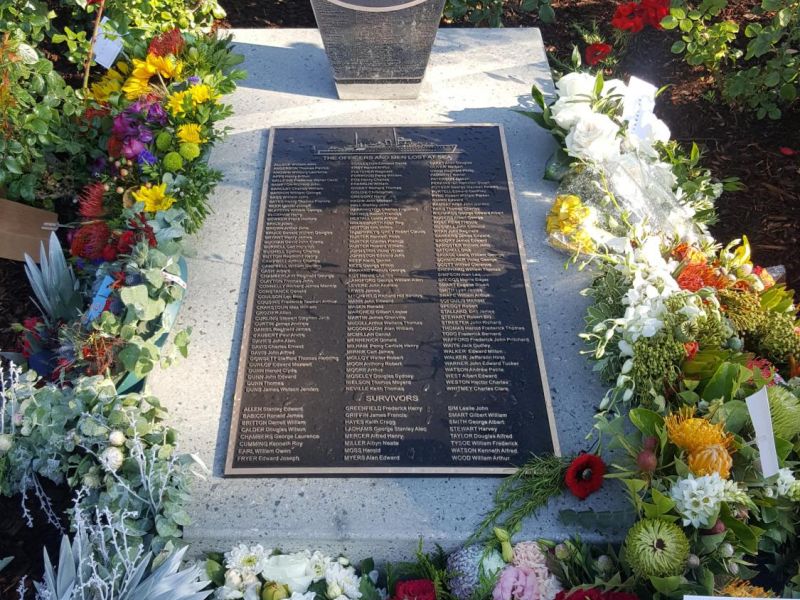
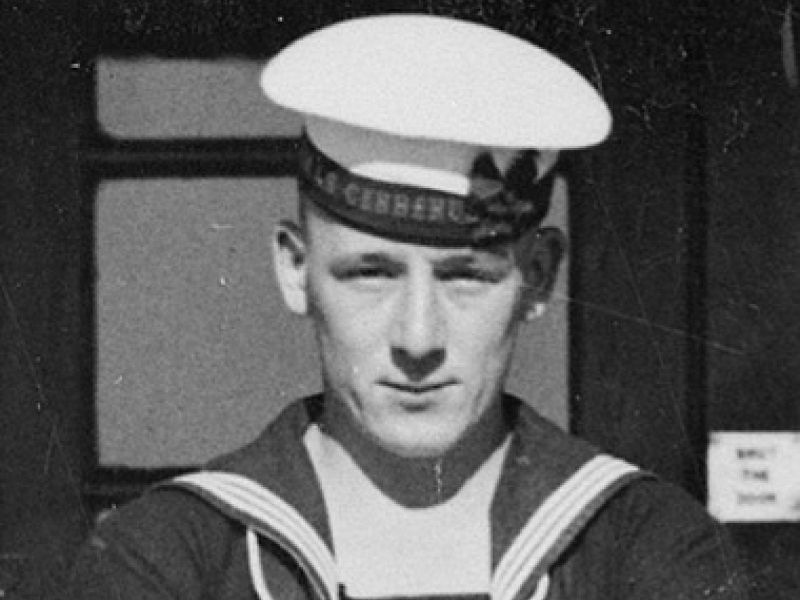
Stoker Daniel Joseph Beer, HMAS Parramatta, RAN
 Australian War Memorial
Daniel Beer was born in Toowoomba, Queensland, on 24 December 1919, the son of David and Mary Beer.
He grew up in Toowoomba. His mother died in 1934, by which stage Daniel and his brothers and sisters were old enough to look after themselves and their father.
Daniel Beer enlisted in the Royal Australian Navy on 11 January 1938 and began training at HMAS Cerberus, the primary training establishment for RAN personnel. Rated stoker, and hence specialising in engine room duties, in the period leading up to the Second World War he joined HMAS Canberra, a 10,000 ton County Class heavy cruiser and flagship of the Australian Squadron.
With the declaration of war Beer was again under training at Cerberus, as the RAN readied for conflict.
On 17 June 1940, Stoker Beer posted to HMAS Parramatta, a Grimsby Class sloop laid down at Cockatoo Island Dockyard in Sydney in November 1938 and commissioned in early April 1940.
By the end of June 1940 Parramatta had sailed from Fremantle to the Red Sea, where she reported for duty. Apart from a visit to Bombay in December 1940, Parramatta spent the next nine months escorting, patrolling and minesweeping in this area of conflict.
After taking part in British operations against Italian Eritrea, in May 1941 Parramatta transferred to the control of the Commander-in-Chief, Mediterranean Station, beginning with three weeks based on Port Tewfik at the head of the Gulf of Suez. Soon afterwards Parramatta was assigned to escort duty in support of the campaign in Libya.
Parramatta sailed for Tobruk on 22 June 1941, in company with the sloop HMS Auckland and escorting the small steamer Pass Of Balmaha which was carrying a cargo of badly needed petrol. The warships were to leave Pass Of Balmaha off Tobruk, waiting to seaward while she discharged her cargo and then escort her back to Alexandria. For 36 hours there was no sign of the enemy. On the second day out, a reconnaissance plane was sighted to the west. Half an hour later the first of three attacks began. Later that afternoon, Parramatta sighted three formations of dive bombers manoeuvring to attack.
Auckland was hit in the stern and disappeared from view in a cloud of thick brown smoke. She emerged out of control, guns still firing, and heading straight for Parramatta who had to swing away to avoid a collision. While Parramatta and the petrol carrier escaped damage, Auckland began to abandon ship. She was barely cleared when a heavy explosion lifted the stricken ship “slowly and steadily about six or seven feet into the air,” before she rolled over and sank.
When the enemy returned, machine-gunning Auckland’s survivors in boats, skiffs, and rafts – some still afloat in their lifebelts – Parramatta was forced to withdraw until darkness fell. As the light faded, Parramatta was joined by the Australian destroyers HMAS Waterhen and Vendetta. While the destroyers circled, Parramatta picked up survivors before shaping course for Alexandria.
After cleaning ship and making good minor damage, Parramatta soon resumed escort duties between Alexandria and Tobruk.
On 25 November 1941, Parramatta and the destroyer HMS Avon Vale sailed from Alexandria, escorting the deeply laden ammunition ship Hanne to Tobruk.
About midnight the following night, the three ships were north of Bardia off the Libyan coast. The night was black, it was raining and there was a heavy sea running. Hanne was confused as to her route into Tobruk, so Parramatta closed to hail by megaphone. Half an hour later the two ships lay close alongside one another steaming slowly towards the harbour.
At 12 minutes past midnight, a German U-Boat fired a spread of three torpedoes. All three torpedoes missed. Disappointed and puzzled by his failure, the German submarine closed and re-engaged. A torpedo hit Parramatta amidships and there were two almost simultaneous explosions. Parramatta was torn apart, all lighting failed and the Commanding Officer, Commander Walker, had time only to issue the order to abandon ship before she rolled rapidly to starboard and sank.
Only those on deck had any chance to escape. About 30 men clung to an Oropesa minesweeping float among the mass of debris. They could hear shouts close by in the darkness. Two seamen decided to take a chance and swim for safety. After almost three hours in the water and near exhaustion, they were picked up by Avon Vale, which had by then plucked 19 survivors from the wreckage strewn over the sea. No others were found and although she searched a wide area, the destroyer could find no trace of the Oropesa float nor its human cargo. Three more survivors reached the Libyan coast unaided and were rescued by advancing British troops; 138 men lost their lives, including Stoker Daniel Beer, who was 21 years old.
With no grave but the sea, today those men are commemorated at the Plymouth Naval Memorial, alongside over 23,000 casualties of the first and second world wars.
- Australian War Memorial Roll of Honour https://www.awm.gov.au/collection/R1673702