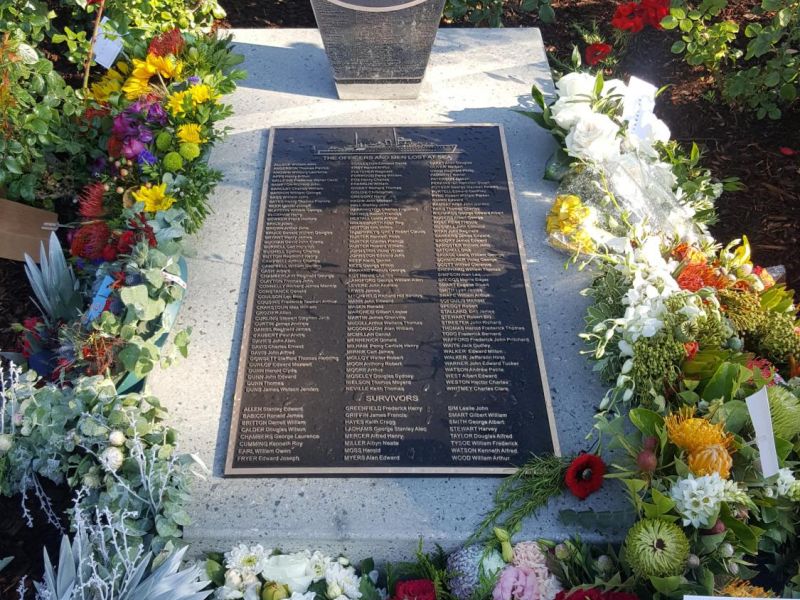
Sick Berth Attendant George Maxwell Rowen Poyser, HMAS Parramatta
 Australian War Memorial
George was born on 5 October 1918 in Kensington, Victoria, the second son of Leslie and Ruby Poyser. He grew up in suburban Melbourne with older brother Leslie, and a younger brother Alan. The family later moved to the city’s south-eastern suburb of Caulfield, Little is known about George Poyser’s early life, other than that he became a Linotype operator before the Second World War.
With the outbreak of the war, George decided to join the Royal Australian Navy Reserve, signing on and reporting for duty on 15 April 1940. Both his brothers joined the Army. George initially went for training to HMAS Cerberus, located on the Mornington Peninsula, and remained there until early February the following year. During this time he trained and qualified as a sick berth attendant. Then on 3 February 1941 he was posted to a warship, HMAS Parramatta.
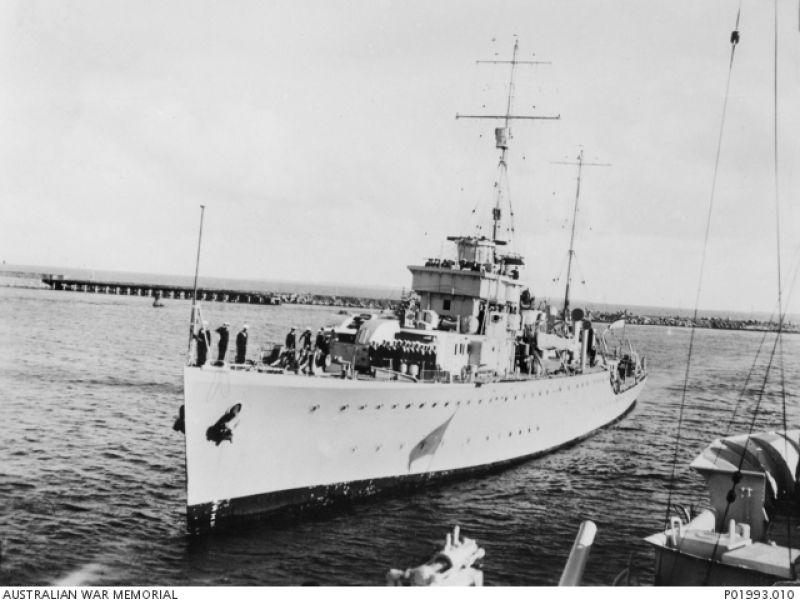
Parramatta was a new 1,060 ton Grimsby Class sloop, launched on 10 June 1939 and commissioned at Sydney on 8 April 1940. Armed with three four-inch guns, four 3-pounders, torpedoes and depth charges, her complement was 135 officers and men. Parramatta was under the command of Lieutenant Commander Jefferson Walker.
After initial workup exercises, Parramatta sailed from Fremantle on 29 June 1940 and shaped course for the Middle East. Over the next nine months, as part of Red Sea Force, the ship conducted numerous operations escorting, patrolling and minesweeping this critical waterway. Apart from occasional attacks from Italian aircraft, Parramatta's main action was participating in operations against Italian Eritrea in April 1941.
The following month Parramatta transferred to the Mediterranean Station. In late June she made her first run from Alexandria, escorting vital supplies being shipped to the besieged port of Tobruk in Libya, where Australian troops were holding out against German forces. Subjected to heavy air and submarine attack, Parramatta fortunately survived unscathed. The next few months saw Parramatta undertaking less hazardous duties, making escort runs to Cyprus, followed by duty in the Suez Canal zone.
On 18 November 1941, the Allies launched Operation Crusader, a land offensive aimed at relieving Tobruk. Parramatta again conducted escort duties in support. Despite being subjected to enemy air and submarine attacks, once more the ship returned safely to Alexandria on 23 November. The pace was relentless and supplies were desperately needed, so two days later, on 25 November, Parramatta cast off for a return to Tobruk.
Around midnight on 26 November, Parramatta, HMS Avon Vale and the ammunition supply ship Hanne were sighted off the coast of Bardia by German submarine U-559. After missing the Hanne, U-559 fired a single torpedo at HMAS Parramatta, which hit.
There were two almost simultaneous explosions, the second probably in the magazine as the ship was torn apart. All lighting failed and Walker, standing on the bridge, only had time to issue the order to “abandon ship” before she rolled to starboard and sank. Only twenty-four survived, mostly those who were on the upper decks: 138 officers and sailors were lost. Among them was George Poyser. He was 23 years old.
The remains of those lost on HMAS Parramatta that fateful day still lie with the wreck. Their names are commemorated on the Plymouth Naval Memorial in Devon, England. They are also listed on the Roll of Honour on my left, among almost 40,000 Australians who died while serving in the Second World War.
- AWM Roll of Honour https://www.awm.gov.au/collection/R1674504