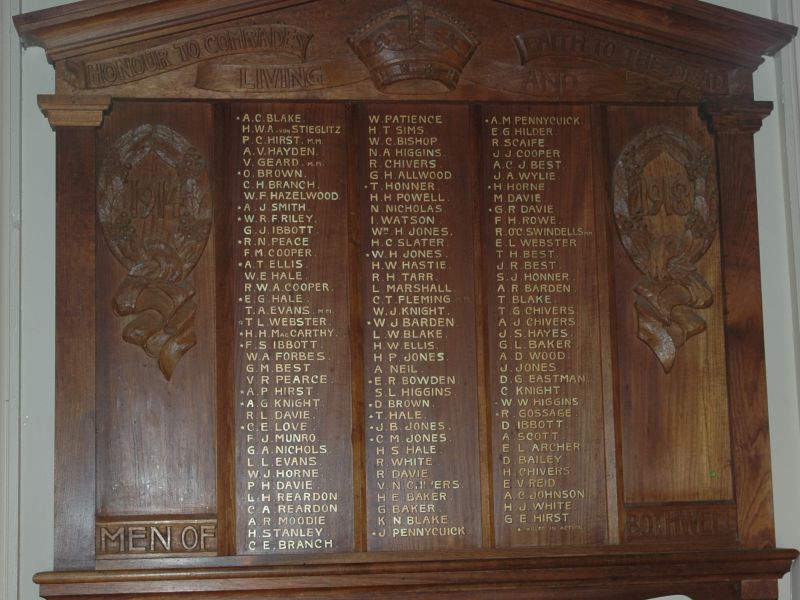
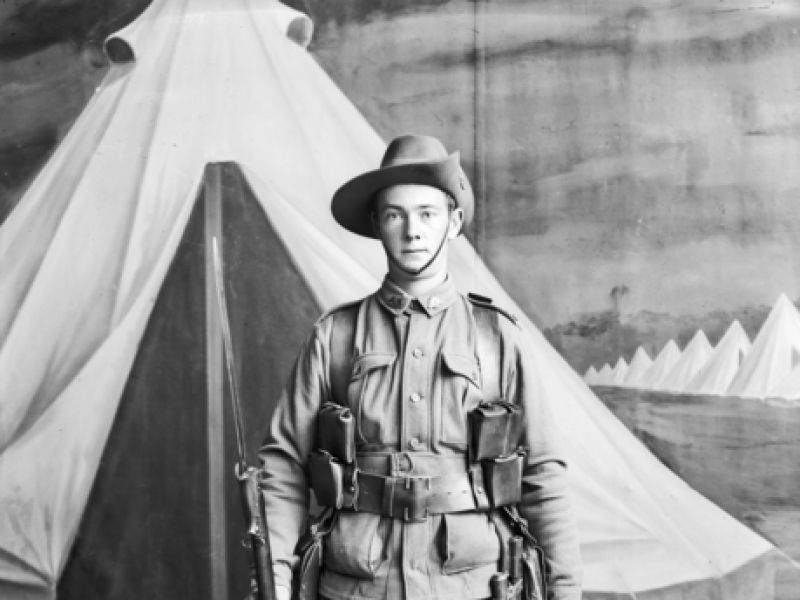
Private Charles Edward Love, 47th Australian Infantry Battalion
 Australian War Memorial
Charles Love was born on 29 March 1892 in Balfour, Tasmania. He was the youngest of seven children born to William and Ellen Love. The family moved to Bothwell in central Tasmania shortly after Charles’s birth. Tragedy struck the Love family in 1894, when Ellen and eldest son George succumbed to diphtheria as an epidemic of the disease swept through Bothwell. It is believed that Charles’s father, William, died the following year, though there is some confusion in the historical record over the date of his death.
After his mother also died, Charles was taken in and raised by his mother’s sister Catherine and her husband William Medhurst. Charles was raised alongside their four daughters, but it is unclear whether his surviving siblings also lived with the Medhursts or were cared for by other relatives.
Although it was later recorded that Charles had attended the local public school, he appears to have been largely illiterate. As an adult, he worked as a farm labourer around Bothwell, and was an active member of the community’s Rifle Club.
Charles enlisted in the Australian Imperial Force on 13 August 1915. He was allotted to the 11th reinforcements of the 15th Australian Infantry Battalion with the rank of private. After completing his initial pre-embarkation training at Claremont in Tasmania, he departed Australia from Melbourne in HMAT Ulysses on 27 October 1915.
After he arrived in Egypt, Charles was admitted to Convalescent Camp 550 at Helouan in Egypt on 27 December 1915, suffering from bronchitis. He returned to the 4th Training Battalion three days later, but the illness was the beginning of a trend of sicknesses for Charles. In the first four months of 1916, he was hospitalised twice more: firstly with mumps in January, and again with a fever and mild jaundice in March.
In May, following his release from the Ras-el-Tin Convalescent Depot, Charles was transferred to the 47th Infantry Battalion on 24 May 1916. He departed for the Western Front with the battalion in early June, arriving in France on 14 June.
After a brief period at the 4th Australian Divisional Base Depot, Charles rejoined the 47th Battalion outside the heavily-contested village of Pozieres on 19 July 1916.
After their two stints in the frontline trenches of Pozieres and a period in reserve, the battalion spent the rest of 1916 and early 1917 alternating between duty in the trenches and training and rest behind the lines. In early April 1917, they took part in the attack on the heavily defended village of Bullecourt, part of the formidable German Hindenburg Line. Lacking the element of surprise, and dependent on the support of unreliable tanks, the Australians sustained 3,000 casualties and failed to capture their objectives.
When the focus of Australian operations switched to the Ypres sector in Belgium in mid-1917, the 47th Battalion moved into the trenches in the area. They took part in the battle of Messines in June 1917, and in the Battle of Passchendaele from September.
Throughout his war service, Charles frequently worked as a runner for battalion headquarters, which meant he spent periods of time away from the front line and avoided some of the worst dangers of trench warfare. He was at battalion headquarters early on the morning of 12 October when men from the battalion left their trenches to attack German positions between Zonnebeke and Passchendaele.
At 5:45 am on 12 October, the battalion headquarters was heavily shelled by German artillery. The unit diary recorded that “nearly all signallers, runners, and scouts [were] casualties, this upsetting all arrangements for communication forward. Many valuable lives [were] lost, that will be hard to replace.” Twenty-seven men died as a result of the shelling of the headquarters, with a further 60 men wounded.
One of the men killed during the shelling was Private Charles Edward Love.
He was 25 years old.
Although Charles’s remains were likely buried close to the battalion headquarters where he was killed, after the war his grave could not be located. He is commemorated on the Menin Gate Memorial, alongside the names of more than 6,000 Australians who died while fighting in Belgium and who have no known grave.
- Roll of Honour, Australian War Memorial https://www.awm.gov.au/collection/R1637912