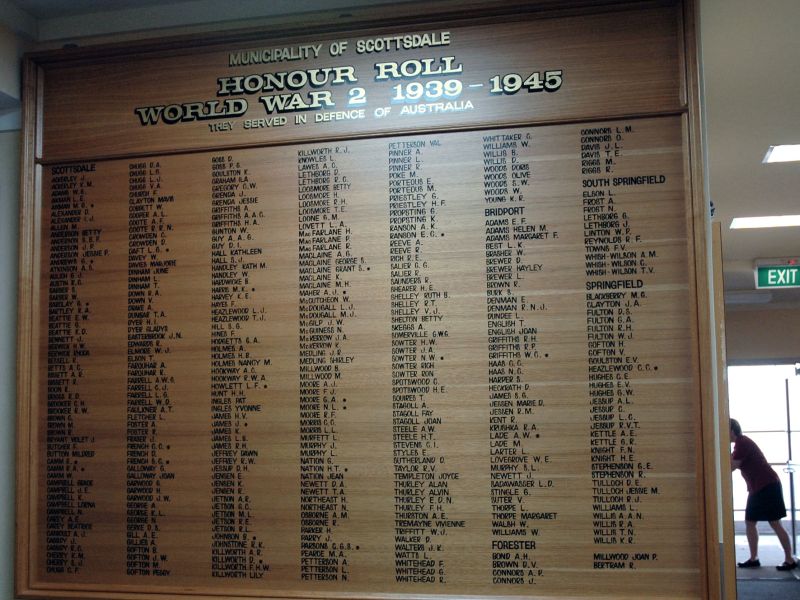
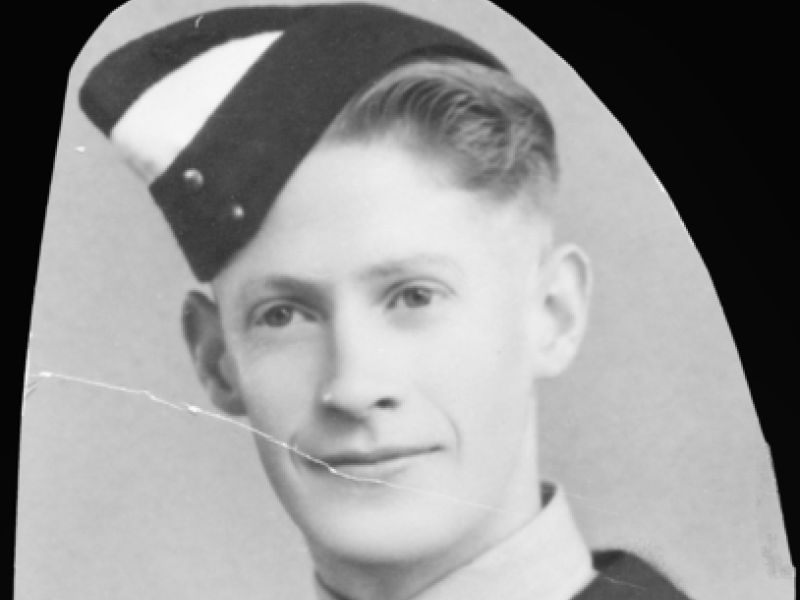
Flight Sergeant William Deldon Douglas Killworth, No. 467 Squadron, Royal Australian Air Force
 Australian War Memorial
William Killworth, known as “Doug”, was born on 14 February 1924 in Launceston, Tasmania, to David and Ella Killworth. His father was a carter, and the family lived in Scottsdale. He had three sisters: Olive, Joan and Betty. Growing up, Doug was fond of cricket, football, and swimming, and was took part in the Boy Scouts.
Killworth attended Scottsdale Primary and High Schools, where he was an excellent student. After leaving school he worked as a flax worker, and on 25 May 1942 he enlisted in the Royal Australian Air Force, aged 18. He underwent training as an air gunner, and received his badge in June 1943, when he was made sergeant.
Killworth embarked for overseas service from Adelaide on 4 August 1943, arriving in England in September. As part of the Empire Air Training Scheme, he was one of almost 27,500 RAAF pilots, navigators, wireless operators, air gunners, and flight engineers who, throughout the course of the war, joined Royal Air Force squadrons or Australian squadrons based in Britain.
Further specialist training followed in England, and in December he was promoted to flight sergeant. On 6 June 1944 he was posted to No. 467 Squadron, RAAF. As part of Bomber Command, the squadron flew the four-engined Avro Lancaster heavy bomber.
On the night of 7 July, Bomber Command launched a major raid on the flying bomb storage sites at St Leu d’Esserent north of Paris. Killworth was the air gunner on board Lancaster “PO-U”, which took off shortly before 10.30 pm.
Cloud cover meant that the bombers had to fly lower to see the target, but as a result 31 Lancaster were shot down by enemy fire. One of those aircraft that never returned to base was Killworth’s Lancaster, which crashed at the town of Courgent, about 95 kilometres south-west of the target. There were no survivors.
Those killed with Flight Sergeant Killworth were Australians Flying Officer Philip Ryan, Warrant Officer Clifford Jones, and Flight Sergeants Verne Cockroft, Leonard Porritt, and James Steffan, along with British Sergeant George Hayes.
The airmen were buried by the town’s people in a moving ceremony, and after the war the remains of Flight Sergeant Killworth were identified and reinterred there under the inscription: “His duty nobly done. Ever remembered.”
He was 20 years old.
The locals at Courgent held annual ceremonies at the cemetery for years afterwards in honour of the killed airmen, and a monument was erected there in 1951.
- Australian War Memorial Roll of Honour https://www.awm.gov.au/collection/R1720349
- Courgent Cememtery https://www.aerosteles.net/steleen-courgent-lancaster
- War graves https://www.cwgc.org/find-records/find-war-dead/casualty-details/2234769/willia…