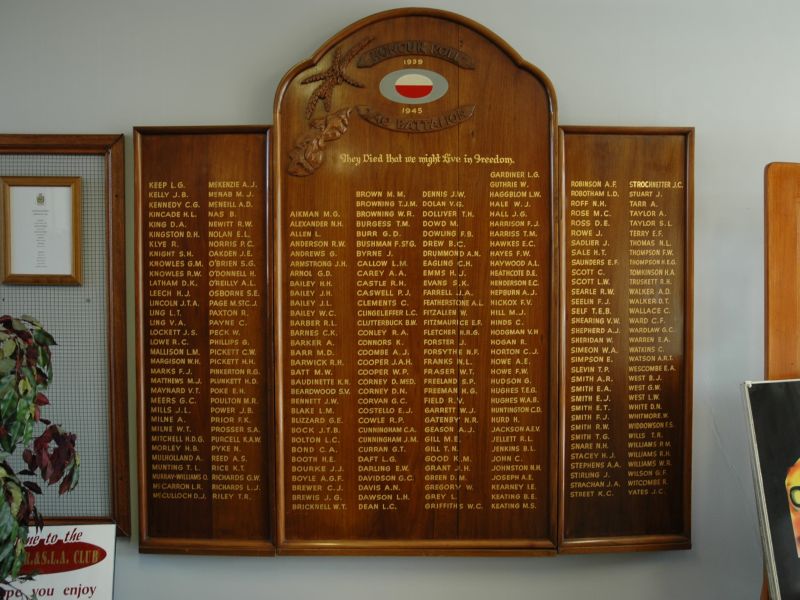
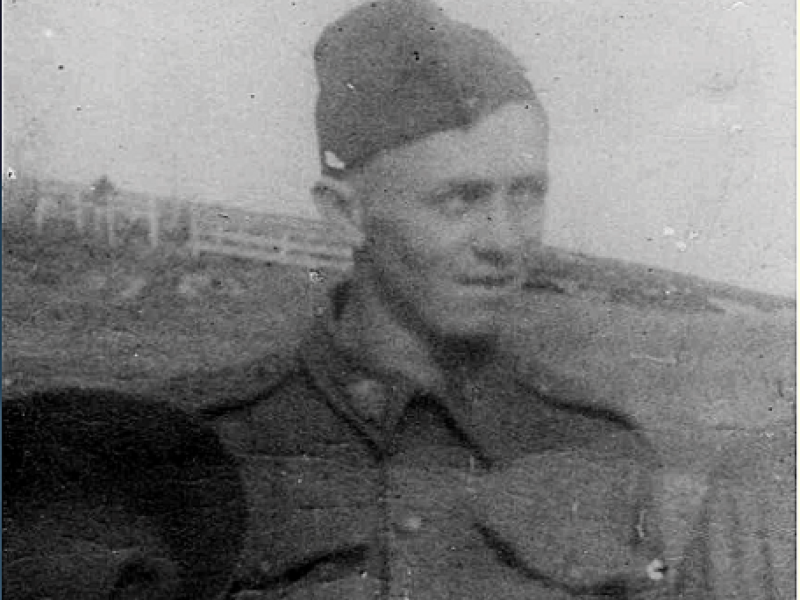
Private Mervyn George Aikman, 2/40th Australian Infantry Battalion
 Australian War Memorial
Mervyn Aikman was born in Scottsdale, Tasmania, on the 18th of July 1921, the son of James and Rose Aikman.
He grew up nearby in Kamona, and went on to work as a farm labourer, as well as serving in the 22nd Light Horse, a Tasmanian Militia unit that had originally been formed before the Boer War.
With the start of the Second World War, the 22nd Light Horse trained recruits and provided patrols covering the southern approaches to Tasmania.
Mervyn Aikman enlisted in the Second Australian Imperial Force on 4 June 1941.
While at camp for initial training, he sprained his ankle and was taken to Hobart for treatment. He rejoined his unit soon afterwards, continuing to train until early August, when he was granted pre-embarkation leave and allotted to reinforcements to the 2/40th Battalion, the only battalion recruited almost entirely from Tasmania.
The 2/40th had been earmarked for deployment to Dutch West Timor, to protect the airfields in the event of a Japanese attack. However, it was thought that early deployment might provoke Japanese action.
Once Japan made its intentions clear with attacks throughout the Asia-Pacific region in early December 1941, the 2/40th was rushed to Timor. It left Darwin on 10 December, arriving at Koepang two days later. The 2/40th formed the bulk of Sparrow Force, which defended the airfield at Penfui, the operational base for the Hudson bombers of 2 Squadron, Royal Australian Air Force. Like the other bird forces deployed across the islands to Australia's north, Sparrow Force was ill-equipped and likely to be overwhelmed by enemy attack. The commanding officer, Lieutenant Colonel William Leggatt, made repeated requests for greater reinforcement, artillery, and supplies, which were never met.
Japanese air attacks on Timor began in late-January and increased in intensity. When 2 Squadron withdrew to Australia in mid-February, there were doubts about the role of Sparrow Force. The Japanese attack on Dutch Timor began on the morning of 20 February, with an amphibious landing south of Koepang and a parachute landing to the east. Faced with a strong advance from the south and paratroopers on the only road running inland to the Allied supply dump, Sparrow Force destroyed the airfield and began to move inland.
Over the following days the small force battled its way along the road, overcoming several Japanese positions. By the morning of 23 February, however, the odds against the men were mounting: food, water, and ammunition were running out; casualties were mounting; and a large Japanese force was closing on its rear.
After the Japanese delivered Sparrow Force an ultimatum to surrender or be bombed, the bulk of the battalion – including Private Mervyn Aikman – became prisoners of war.
Aikman and his comrades spent the first seven months of their captivity interned in a camp at Usapa Besar. Lax security allowed parties to slip out of camps to forage and gather intelligence. A small party of senior officers was shipped to Java in late July, and the rest of the prisoners on Timor followed in September. From Java the prisoners were sent out to work camps throughout Japan’s conquered territory.
They were usually transported in small, slow, overcrowded merchant ships. Conditions aboard them were appalling, and they became known to the prisoners as “hellships”.
On 24 June 1944, Aikman was in a group of around 770 prisoners of war – British, American, Australian and Dutch – being transported on the Tamahoko Maru. Their journey to Japan had begun four days earlier, with the prisoners loaded onto the cargo ship carrying rice and sugar, along with about 500 Japanese servicemen.
Just before midnight, the prisoners were awoken by an explosion as another ship was torpedoed. Three American submarines had intercepted the convoy, and were attacking.
Within seconds another torpedo hit the Tamahoko Maru forward of the bridge on the starboard side, blowing the covers off the hatches. The explosion killed many sleeping men, while others on deck were struck by falling debris. With two large holes in the deck of the hold, men rushed forward for the ladders which had been blown away, and the men fell into the cargo. Others rushed toward the life belts and were trapped. Some escaped after reaching iron ladders under the hatches, but most were washed out by the sea. The ship sank in less than two minutes.
Around 560 prisoners of war died. Among them was Mervyn Aikman. He was 22 years old.
With no grave but the sea, today he is commemorated on the Singapore Memorial, which bears the names of more than 24,000 Commonwealth casualties of the campaigns in Malaya and Indonesia, or in captivity, and who have no known grave.
- Australian War Memorial Roll of Honour https://www.awm.gov.au/collection/R1689669