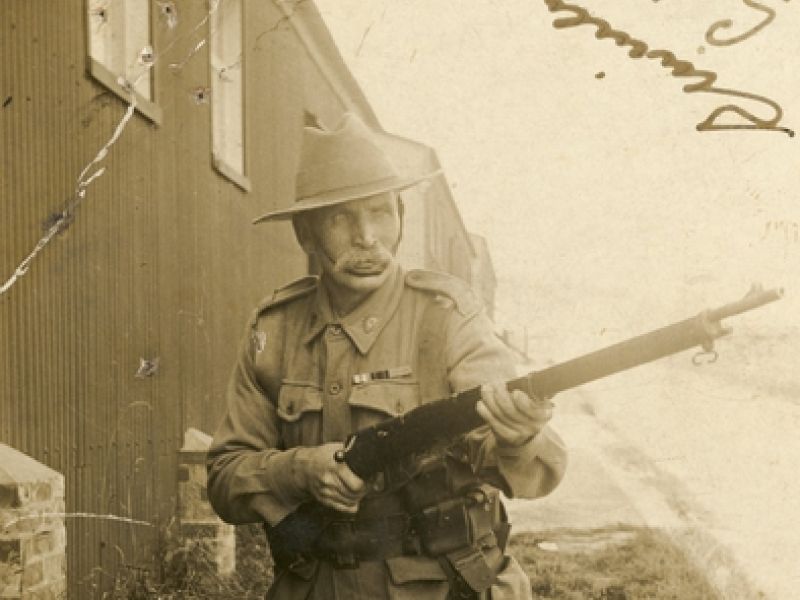
Private George Forrest, 34th Australian Infantry Battalion, AIF
 Australian War Memorial
George Forrest was born in 1858 in Stewartstown, County Tyrone, Ireland. He eventually emigrated to New South Wales and settled in Sydney.
From the mid-nineteenth century, the Australian colonies began to develop their own military units. Forrest enlisted in the colonial military forces in 1883, joining “A” Battery of the New South Wales Artillery.
At this time, the region south of Egypt known as Sudan was in a state of political turmoil. A British-backed Egyptian regime was nominally in charge, but a large-scale rebellion led by a leader known as the “Mahdi” had defeated Egyptian forces on several occasions. In the aftermath of the killing of a popular British general in Khartoum in January 1885, a large British force was sent to Sudan.
The New South Wales government offered to send a contingent of infantry and artillery to Sudan. This contingent was the first time a self-governing British colony had sent its own military forces overseas in service of the Empire. Places in the contingent were preferentially given to soldiers already serving in New South Wales military units. Forrest volunteered, and sailed with the artillery from Sydney in March 1885. He served at the rank of driver, suggesting that he was an experienced horseman.
The contingent arrived at the Red Sea port of Suakin at the end of March and marched inland to confront Mahdist forces, while the artillery carried out drill exercises in Suakin and surrounds. The deployment to Sudan was brief, and the British soon decided to withdraw from the region. Forrest and the remainder of the contingent returned to Sydney in June 1885.
In 1896, Forrest married Mary Ball in Sydney. Two years later the couple had a daughter, Linda Elizabeth, before Mary died later in the year. It seems that baby Linda was taken into the care of her maternal grandmother.
When the Sudan contingent had been disbanded, Forrest had returned to service with “A” Battery. The battery’s next overseas service was to be in the South African War, often called the Boer War.
In October 1899, after a worsening political deadlock in southern Africa, Boer forces invaded the British colonies of Cape Colony and Natal. Britain declared war on the two Boer republics, the Orange Free State and the South African Republic. In support of the British Empire, the Australian colonies committed troops to the conflict. In addition to mounted infantry, the colony of New South Wales also committed “A” Battery, the only Australian colonial artillery unit to be sent to the South African War.
On arrival in South Africa, the battery was split into three sections, which each joined different British forces in the field. After 18 months of service, “A” Battery returned to Sydney in August 1901.
Shortly after returning from the war, Forrest left “A” Battery, in which he had served for 19 years, and moved to Newcastle to work as a labourer. His mother-in-law became the guardian of his daughter Linda, and she later reported that she never heard from him again.
In January 1916, Forrest attended a recruitment station in Newcastle to volunteer for service in the Australian Imperial Force. He told the recruiter that he was 45 years old, which was the maximum age for enlistment; in truth he was about 58.
Forrest joined the newly-raised 34th Australian Infantry Battalion. After initial training in Australia, the battalion sailed from Sydney on board the transport ship Hororata in early May 1916. The unit continued training in England, and sailed to France in November.
The northern French winter of 1916 and 1917 was the coldest in living memory. The men of the 34th Battalion spent time in billets near the city of Armentieres, close to the Belgian border. In the trenches, the men endured German artillery barrages, snipers, machine-gun fire, gas attacks, and raiding patrols. In March, Forrest spent some time in hospital, but soon recovered and re-joined his unit.
In the middle of 1917, British commanders turned their attention towards the Franco-Belgian border. They planned to capture the high ground outside the town of Ypres in Belgium. The first step was capture of the ridgeline outside the town of Messines.
In preparation for the assault, British, Canadian, and Australian soldiers had dug mines underneath the German positions and filled them with explosives. Just after 3 am on 7 June 1917, these explosives were detonated, and the allied soldiers charged the German lines.
Forrest was working as a batman to the company commander, Captain Walter Matthews. He took part in the charge, but what happened next is unclear. Captain Matthews later recalled “we went over together and he was never seen again”. It seems likely that Forrest was killed by a shell.
He was 59 years old.
Forrest’s body was found and buried five days after the attack, but in the subsequent fighting, his gravesite was lost. His name appears on the Menin Gate Memorial in Ypres, alongside more than 54,000 Commonwealth troops who were killed in Belgium during the war and who have no known grave.
Forrest was survived in Australia by his daughter Linda. In early 1917, he had a chance encounter in England with his former brother-in-law. This meeting prompted Forrest to write a letter to Linda, whom he had not seen since 1902, when she was four years old.
- AWM Roll of Honour https://www.awm.gov.au/collection/R1732092