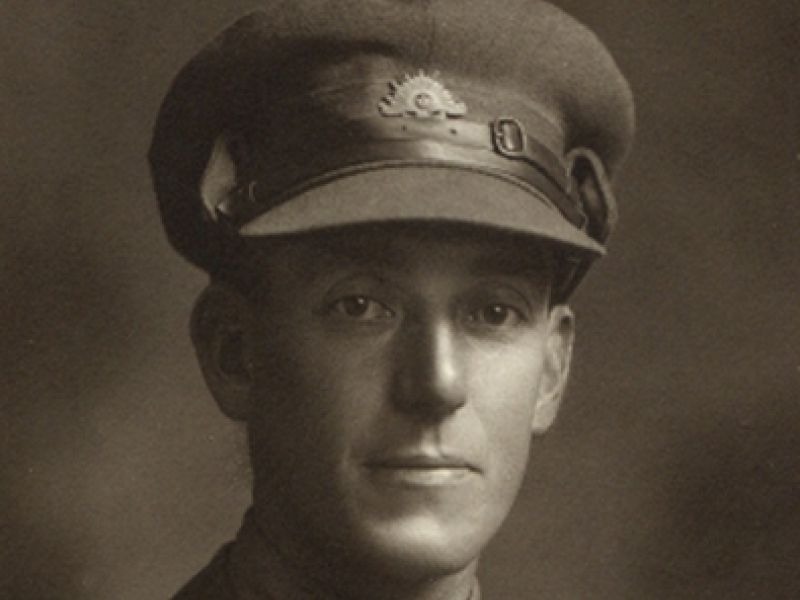
Captain John James Marshall, 55th Battalion, AIF
 Australian War Memorial
John Marshall was born on the 6th of November 1891 in Bexley, Sydney. He was the tenth child and youngest of William and Jane Marshall. John attended Kogarah High School and later, technical college. He sat the Junior Public Examination and the Public Service Examination and in September 1908, at age 16, joined the New South Wales Public Service as a junior clerk.
John was also keen on military service and worked his way up through the ranks of local militia units. After serving two years with Saint George’s English Rifle Regiment, in October 1912 he was appointed second lieutenant with the 39th Infantry, then was made adjutant of the 38th Infantry the following year. War broke out in August 1914.
On 30 January 1915 John Marshall applied for commission with the Australian Imperial Force. Appointed second lieutenant with the reinforcements for 3rd Australian Infantry Battalion, in mid-March he departed Sydney aboard the troopship Shropshire. Family lore has it that the night before he sailed, John’s father pleaded with him not to go, but to no avail.
At the beginning of July, John joined the Australians holding the Anzac position on Gallipoli. Having been there for several weeks as spring turned to summer, the troops were exhausted and now faced outbreaks of disease, spread by swarms of flies. Following a close shave when a bomb exploded right outside his dugout, by the end of July, Marshall had fallen ill and was evacuated to hospital. Five weeks later he had recovered and finally joined the 3rd Battalion in mid-September. By this time the battalion was on the island of Lemnos. Now barely 200-strong, they had been withdrawn to recover and take in new recruits after heavy losses fighting at Lone Pine. Returning to Gallipoli at the end of October, the battalion remained there until the entire force was withdrawn on the nights of 19 and 20 December.
In Egypt the Australian force was reorganised and expanded. Original battalions gave up roughly half their number to create new units. This was how John Marshall, now promoted to lieutenant, joined the newly-raised 55th Battalion on 13 February 1916. After a period of training in the desert and guarding the Suez Canal, the Australians were sent to the Western Front.
In July John was promoted to captain and sailed from Egypt at the end of the month. While the battalion went to the front lines in northern France, Marshall was sent to the 14th Training Battalion in England. There he remained for the next five months.
It was not until late January 1917 that John was sent over to France. Joining the 55th Battalion on 26 January, he found the Australians bogged down in front of the town of Bapaume. During February and March the Australians fought their way forward, up to the German Hindenburg Line. John missed the battalion’s attack at Doignies during April as he was attending Fifth Army School but had rejoined them in early May for the Battle of Bullecourt.
In September John led his company in bitter fighting in the Ypres Salient. The 55th’s main battle was at Polygon Wood. They captured their objectives but John had been wounded badly in the thigh. He was evacuated and admitted to the 1st London General Hospital three days later.
It took John a while to recover from the wound, and months later he was still only fit for light duties. Also being affected by poison gas, Marshall suffered shortness of breath and a racing heart. Yet by January 1918 he had been cleared fit. He joined his battalion in northern France on 13 February.
Just a few weeks later the Germans launched a massive attack on the Western Front, hoping to force a final decision. In places, British and French armies were sent into headlong retreat. The Australians were soon called in to help stem the tide. Writing to his mother at the end of March, John closed his final letter:
“Good-bye for the present, with love to all. Your loving son, John.”
Just days later the Australians were rushed down to the Somme, the 55th Battalion arriving in a fleet of double-decker busses. One soldier recalled:
“As we marched through the main street the inhabitants … came out from their houses to greet us. “Good Luck” and “God protect you Australians”. We marched across the river … and we were in Aubigny … shells were falling in the village pretty consistently. Gas shells lobbed now and again, the fumes lurked in corners.”
The German advance was halted. With both sides exhausted, they dug in opposite each other. But not for long. Commencing the evening of 23 April the enemy began a very heavy artillery bombardment, including gas. They attacked next morning and captured the key town of Villers-Bretonneux, but the Australians retook it that night.
The 55th Battalion came forward the night of the 26th to take over the front lines amid heavy shelling. Enemy artillery fire continued the following morning when around 9.00 am a shell hit the D Company command dugout. Captain John Marshall, Private Charles Partridge and Private George Hughes were all killed.
The battalion war diary made note of Marshall’s “keen sense of duty and splendid example and courage” which “always inspired those about. His death is deeply felt by all ranks”. Lieutenant Arthur Gardner said: “There is no doubt Captain Marshall was a very, very brave man and my brother officers and men feel his loss”.
John Marshall is buried in the Daours Communal Cemetery Extension in Picardie, France. He was 26 years old. The inscription on his headstone reads, “To live in the hearts of those we love is not to die.”
- Roll of Honour, Australian War Memorial https://www.awm.gov.au/collection/R1648896