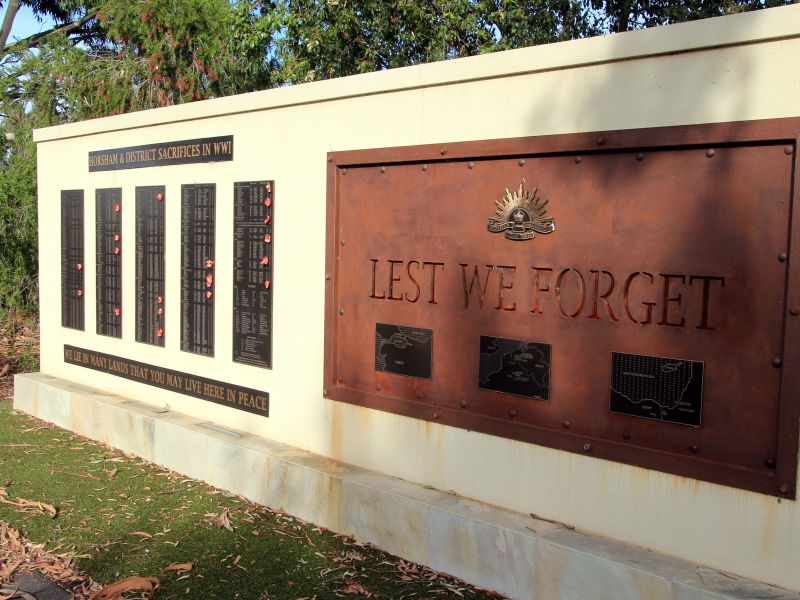
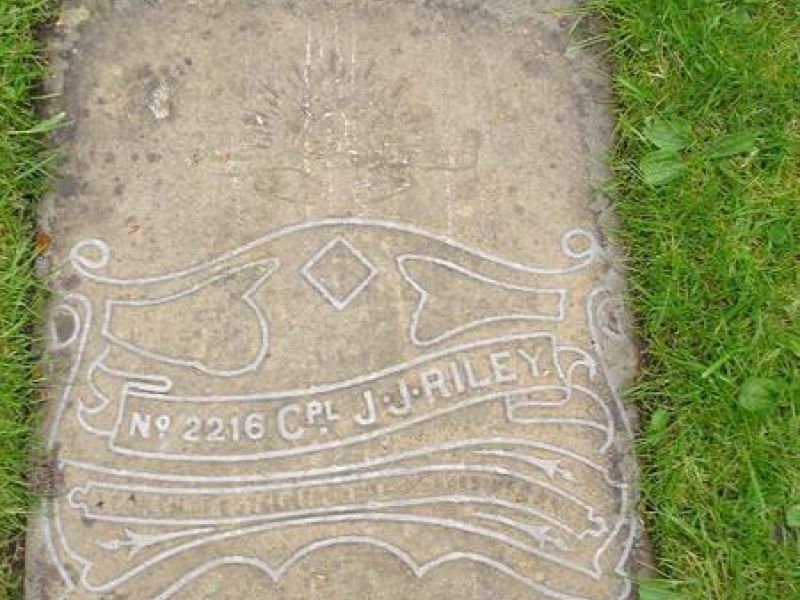
Corporal Joseph James Riley, Australian Machine Gun Corps
 Australian War Memorial
Joe Riley was born in Jeparit, Victoria, in 1895, the third son of Joseph and Harriet Riley’s seven children. When he was about three years old, Joe’s family moved to Horsham, where Joe was educated at the local state school. His father worked with steam engines around Horsham, including at a foundry and the hospital, and was in charge of the council’s steam roller. After completing school, Joe worked as a tailor for Mr Schwennesen in Horsham. His family was well known in town, and he was described as “a fine specimen of the clean-living youth.
Joe Riley and his brother, Will, enlisted in the Australian Imperial Force together in July 1915. The brothers completed their training together and left for overseas service with reinforcements to the 23rd Battalion in September 1915 on board the troopship Hororata. First sent to Egypt, in the new year Will wrote home to say, “Just a few lines to let you know that we are quite well, and hope all at home are the same.” The brothers were almost certainly too late to see service on Gallipoli, and remained with the 23rd Battalion throughout the period of training and reorganisation that the AIF underwent in Egypt in the early part of 1916.
The 23rd Battalion was sent to France to fight on the Western Front in March 1916, first entering the line in a quieter sector of the front around Armentieres. In July the battalion was sent south to take part in the fighting on the Somme. Private Riley’s first experience of a significant-sized operation came at Pozieres in late July 1916. Not long after entering the front line, he was shot in the face, and evacuated to hospital in England. Already a burgeoning collector of battlefield relics, Riley made sure to keep the shrapnel removed from his eye socket to send home to his parents.
By the time Private Joe Riley returned to his battalion in France, his brother Will, who had expressed an interest in machine-guns since reaching Egypt, had been transferred to the 2nd Machine Gun Battalion. Joe was also able to secure a transfer to the 6th Machine Gun Company in January 1917. Little is known of Joe’s service throughout 1917, but he clearly proved an able soldier, as by October he had been promoted to lance corporal, and had further temporary promotions to corporal the following year.
In July 1918 Private Joe Riley fell ill, and had to be evacuated to hospital in England once again, suffering from pneumonia. As his condition worsened, his heart began to fail. Nursing Sister Mary Macdonald wrote that Joe Riley “passed peacefully away at 5pm ,on the 12th of July 1918. Everything that was possible to help save his life was done, but I very much regret, without success.” Riley was buried in a cemetery in Clivedon, Buckinghamshire, with full military honours, with “a large number of officers, sisters and patients of the hospital being present.” Will Riley cabled home, and was the first to inform his parents of the death of his brother.
A friend later wrote to Joe’s parents to say, “It is only about two weeks since he left us, and to-day we learn to our great sorrow that he has passed away to the great unknown … his mates wish me to take this opportunity of expressing to you their deep appreciation of the gallant work done by Joe to help us all, and their deepest sympathy is with you all in your sad bereavement. I wish, Mrs Riley, that we could express to you our admiration of your son. He was an example to all for his cheerfulness in time of trouble, and for his cleanliness in living. Being very popular, he was sought by many, and always showed great strength of character. In him we lose one of the most popular lads in the company. Please accept our heartfelt sympathy, and try to bear the loss as bravely as he would have wished.”
Thirty-one men co-signed the letter. Today, Joe Riley’s headstone continues to remember his close relationship with his friends with the epitaph, “a token of esteem from his comrades in France.”
Joe’s brother, Private Will Riley returned safely to Australia, but more sorrow awaited him. His mother died of the Spanish flu two days before he reached home.
- Australian War Memorial Roll of Honour https://www.awm.gov.au/collection/R1664602