Flight Sergeant Michael John Hackett, No. 101 Squadron (RAF), Royal Australian Air Force
 Australian War Memorial
Michael Hackett was born in the Adelaide suburb of Largs Bay on the 6th of December 1923, the son of Francis Patrick and Mary Veronica Hackett.
After attending St John’s Secondary School and Port Pirie Technical School, he worked for three years as an apprentice carpenter with Broken Hill Associated Smelters in Port Pirie.
Michael Hackett enlisted in the Royal Australian Air Force reserve shortly after he turned 18, and when he was called up, he enlisted at Adelaide on the 10th of October 1942.
After initial training, he started training as an air gunner, attending wireless and gunnery school in Ballarat, and then bombing and gunnery school in West Sale.
In May 1943 Hackett made the journey from Adelaide to Sydney and then Brisbane, where he embarked for overseas service on the 15th of June 1943.
As part of the Empire Air Training Scheme, he was one of almost 27,500 RAAF pilots, navigators, wireless operators, gunners, and engineers who joined squadrons based in Britain throughout the course of the war.
Arriving in the United Kingdom in late July, after some additional training, Hackett joined No. 30 Operational Training Unit. Based at RAF Hixon, this unit trained night bomber crews.
On the 24th of February 1944, Hackett was transferred to No. 101 Squadron, RAF. Based at RAF Ludford Magna in Lincolnshire, the squadron flew Lancaster heavy bombers as part of Bomber Command.
In 1943, the squadron’s Lancasters had been equipped with a top secret radio jamming system codenamed “Airborne Cigar”. An additional crew member would operate the system, in a curtained-off area towards the rear of the aircraft – locating and jamming German fighter-controller broadcasts. The radio jammer would occasionally pose as controllers, to spread disinformation.
Breaking radio silence to do this, however, made the aircraft highly vulnerable to being tracked and attacked, which resulted in 101 Squadron having the highest casualty rate of any RAF squadron.
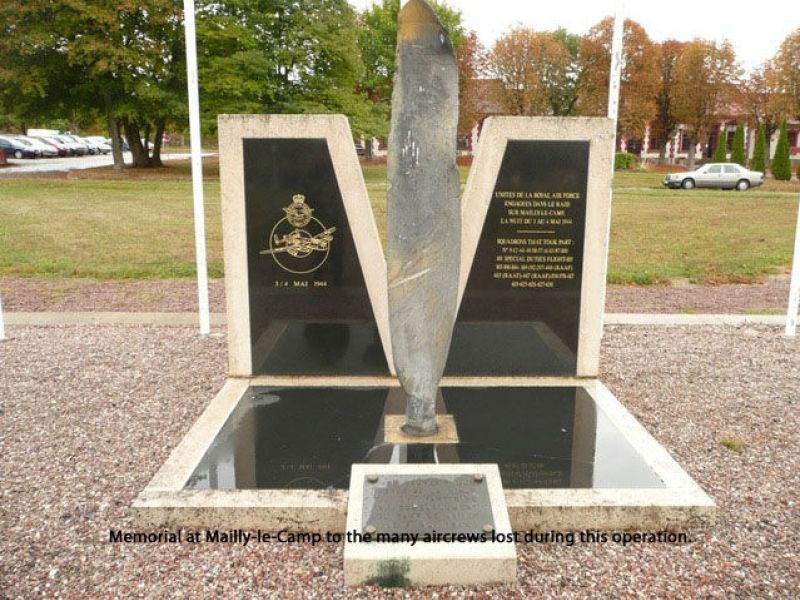
On the night of the 3rd of May 1944, Hackett was a crew member aboard a Lancaster detailed to carry out specialist radar-jamming duties over the target of military camp installations at Mailly-le-Camp in France.
Nothing was heard from Hackett’s aircraft after take-off, and it failed to return to base. With the crew declared missing, it would be nine months before Michael Hackett’s family learned of his fate.
It was later discovered that the aircraft had been hit by German anit-aircraft batteries in the north-east area of Mailly-le-Camp, it had crashed just south-west of Poivres, killing all aboard:
Flight Sergeant Sydney Ainsworth
Flying Officer George Baker
Pilot Officer George Blair
Sergeant David Cro
Warrant Officer Donald McNaught
Sergeant Arthur Ridgway
Flight Sergeant John Steward
And Flight Sergeant Michael Hackett, who was 21 years old.
Their remains were buried in Poivres [pron Poiv - ruh] Cemetery.
- AWM Roll of Honour https://www.awm.gov.au/collection/R1721943
- No. 1 Wireless Air Gunners School Ballarat 1940 -1945 Website https://www.1wags.org.au/memorial-roll/bomber-command-squadrons/display/434-mic…