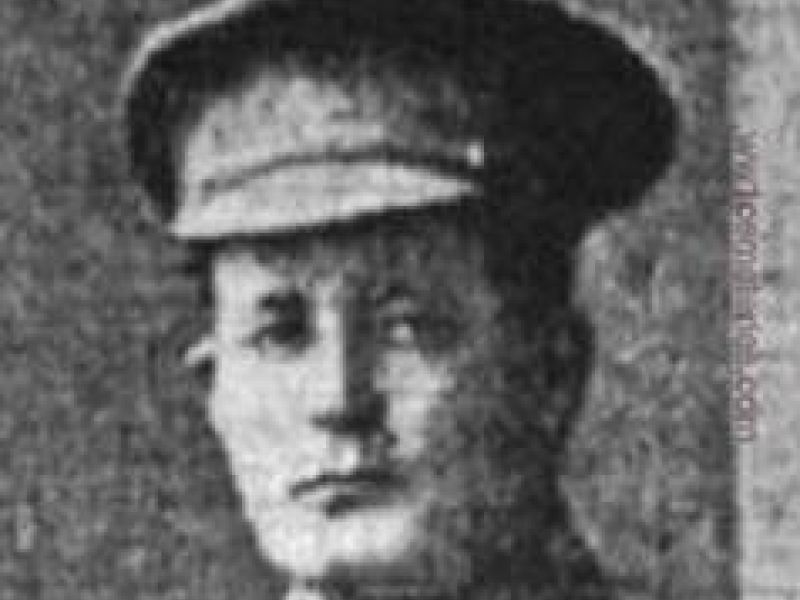
Private John Francis Hogan, 50th Australian Infantry Battalion
 Australian War Memorial
John Hogan was born in the Adelaide suburb of Norwood in 1882. Known as “Frank”, he was the fourth of seven children born to John Hogan and his wife Katherine. John senior had been born in Bombay, India, and served in the East India Company Bombay Artillery until he relocated to Australia with his family in the 1860s. By the time his children were born, John was working as a court bailiff in Adelaide and Port Augusta.
The family remained based in Port Augusta for most of Frank’s upbringing. He attended the Sisters of St Joseph School, before finding work as a chainman on the railway between South Australia and Western Australia.
Frank was also a well-known member of the local community, playing for the Port Augusta cricket team and joining the local rifle club. Frank’s father died in 1909, and he and his siblings helped to support their widowed mother.
Frank Hogan enlisted in the Australian Imperial Force on 16 July 1915. He was assigned to 11th reinforcements of the 10th Australian Infantry Battalion, and commenced his initial training outside Adelaide. Private Frank Hogan departed Adelaide in the troopship Benalla on 27 October 1915, bound for Egypt.
Soon after arriving in Egypt, Hogan fell ill. He was admitted to the No. 4 Auxiliary Hospital in Heliopolis suffering from mumps in mid-January 1916. Having recovered from his illness, Hogan was posted to a training battalion in early February, before being taken on strength of the newly-formed 50th Battalion at the end of the month.
While in camp with the 50th Battalion in April, Hogan again fell ill. He was treated for bronchitis, but returned to duty five days later.
Having spent the first half of 1916 in Egypt, the battalion departed for the Western Front in early June. Arriving in the south of France, the battalion was quickly introduced to the brutal realities of trench warfare, manning the front line outside Fleurbaix by early July.
Hogan was hospitalised for a third time in late July 1916, being admitted to a mobile hospital with influenza. He remained until early September, missing the 50th Battalion’s heavy casualties from their role in the battle at Mouquet Farm in mid-August.
Hogan spent a month preparing to return to active service He rejoined the 50th Battalion in northern France in early October, where the men were training and resting behind the lines. He was sick twice more over the bleak winter of 1916 and 1917, spending a week in hospital with influenza and bronchitis in late October, and six weeks recovering from trench feet at the end of 1916.
After a winter alternating between front-line duty and training and labouring behind the line, the battalion participated in the advance following the German retreat to the Hindenburg Line in spring 1917. To delay the allied troops, the Germans fortified numerous villages and towns on the approaches to the Hindenburg Line, which the advancing soldiers had to overcome.
One of these rearguard towns was the village of Noreuil, which the 50th and 51st Australian Infantry Battalions attacked on the morning of 2 April 1917.
Although the men of the 51st advanced quickly past the north of the village, the 50th Battalion advancing from the south encountered much heavier German opposition. Owing to the thin allied barrage, the German defenders were “able to open fire” on the men. By the time they reached the 51st Battalion, they had suffered heavy casualties: 360 men killed in action, wounded, or missing.
Among the 96 men known to have been killed in action was Private John Francis Hogan.
He was 34 years old.
Hogan’s sister Mary also served in the First World War, working as a nurse in London and on transport duty to Australia before being repatriated home in 1918.
Hogan’s remains were buried at Queant Road Cemetery in Buissy, France following his death. After the war, an Imperial War Graves headstone was erected over his grave, bearing the personal inscription selected by his grieving family back home: “His Duty Nobly Done, R.I.P.”
- Australian War Memorial Roll of Honour https://www.awm.gov.au/collection/R1631127