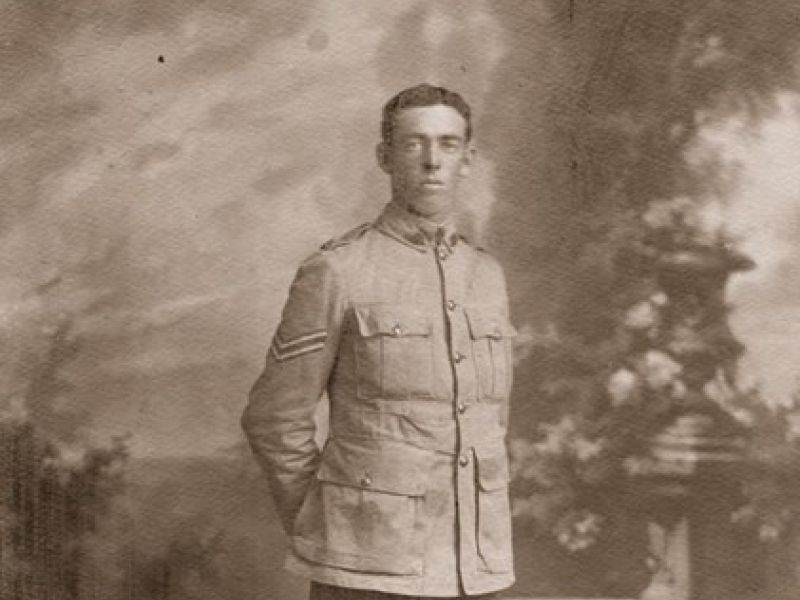
Trooper Phillip Anslem Madden, 7th Light Horse Regiment
 Australian War Memorial
Phillip Madden was born in the Sydney suburb of Petersham in April 1890, the eldest of eight children born to Frederick and Catherine Madden.
As a child, Phillip attended the District Brothers School in North Sydney, before training at a local technical college. After completing his education, he took on an apprenticeship with carpenter E.J. Smeal, which lasted for five years, and then continued to work as a carpenter and joiner in the northern Sydney area.
He was also an active member of the local militia, spending three years in the 1st Australian Infantry Regiment.
Phillip Madden enlisted in the Australian Imperial Force on 15 September 1915. He was allotted to reinforcements of the 7th Light Horse Regiment with the rank of trooper. After seven months of initial training, Trooper Phillip Madden departed Sydney in the troopship Port Macquarie on 26 April 1916, bound for Egypt. During the voyage, Madden was temporarily appointed acting corporal.
Madden arrived in Egypt in late June, and was taken on strength of the 7th Light Horse Regiment at Bir Et Maler. Over the next few months, Madden took part in the defence of the Suez Canal from the Ottoman advance across the Sinai Desert, including fighting at the battle of Romani in early August and attack at Katia the following day.
Madden was admitted to hospital on 15 August 1916 with a mild illness. He returned to the regiment the next day, and reverted back to his initial rank of trooper. From late August, the 7th Light Horse participated in the advance that followed the Ottoman’s flight across the Sinai Desert following their defeat at Romani and Katia.
Madden fell ill against in mid-September, and was admitted to the 31st General Hospital suffering from tonsillitis. This time, he remained in the hospital for nearly two months recovering, before being discharged to the Anzac Rest Camp in Port Said to regain his strength. After a brief stint with the 2nd Light Horse Training regiment, Madden returned to the 7th Light Horse Regiment at Hassaniya on 25 November 1916.
The regiment spent late 1916 and early 1917 engaged on patrol work until the British advance into Palestine stalled before the Ottoman bastion of Gaza. It was involved in the two abortive battles that attempted to capture Gaza directly in March and April 1917, with Madden emerging unscathed.
In late May 1917, Madden was admitted to hospital for a third time, suffering from faintness, headaches, pains in his chest, and a slight cough. Although no formal diagnosis was made, he remained at the 24th Stationary Hospital in Abbassia until mid-July, when he was again discharged to the 2nd Light Horse Training Regiment to regain his fighting strength.
Madden returned to the 7th Light Horse Regiment in early August 1917, just in time for the renewed offensive on Ottoman positions around Gaza. The regiment was involved in the attack on Beersheba on 31 October 1918, with a wide outflanking move leading to the crumbling of Ottoman defences at Gaza. Gaza fell in early November 1917, and the Ottoman forces began to retreat out of southern Palestine and into the Jordan valley.
In early November, the 7th Light Horse Regiment provided the advance guard for the Australians move to a new forward line. During the advance, the regiment came under heavy shell- and machine-gun fire, which continued throughout the day. During the shelling, Trooper Phillip Anslem Madden was killed in action.
He was 27 years old.
Madden ’s remains were buried along with the other men who had been killed during the shelling by Reverend J.B. McDonnell on the north side of a road outside a nearby village. Despite efforts to locate his grave after the end of the war, it was declared to have been lost.
Today Phillip Madden is commemorated on the Jerusalem Memorial in Jerusalem War Cemetery alongside the names of 3,300 Commonwealth servicemen who died during the First World War in operations in Egypt and Palestine and who have no known grave.
- Australian War Memorial Roll of Honour https://www.awm.gov.au/collection/R1649773
- Australian Virtual War Memorial https://vwma.org.au/explore/people/159372