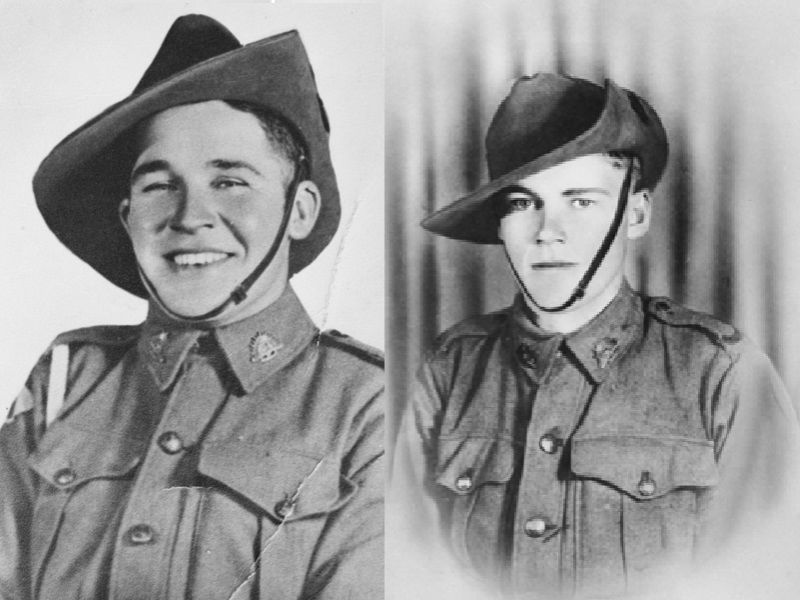
Brothers Private Dudley Lucas, 2/30th Battalion, Private Basil Albert Lucas, 2/3rd Battalion
 Australian War Memorial
Dudley and Basil were born in Bega, New South Wales, the ninth and twelfth of 15 children born to Alice Christina Boneham and her husband Henry Joseph Lucas. Known as “Dick”, Dudley was born on 9 October 1919, with Basil born give years later on 21 September 1924.
In March 1929, Alice died giving birth to her youngest son, Christopher. Shortly after her death, Henry moved with his 15 children from Bega to a disused dairy along the Brogo River. The family remained in the area throughout the 1930s, suffering again with the death of another brother, Harold, in 1933. The younger children attended the local Brogo North School, walking seven kilometres each way every day. Once their schooling was finished, most of the brothers, including Dudley and Basil, worked as rabbit trappers and bark strippers.
With the outbreak of the Second World War, Dudley and Basil were eager to enlist. By early 1941, Dudley had two failed enlistments under his belt, while Basil had been discharged following an enlistment attempt in 1940 after military authorities discovered he was only 15 years old.
Basil successfully enlisted in the Australian Army on 4 April 1941, signing his attestation papers in Sydney alongside his brother Cecil. He once again lied about his age, giving his date of birth as 1920. Enlistments accepted, Basil and Cecil travelled to Tamworth to join the 5th Training Battalion.
While Basil was training in Tamworth, Dudley managed to successfully enlist for service at Cooma on 30 May 1941. He joined the General Details Depot at Sydney on 27 June, the same day Basil and Cecil departed to join the 2/3rd Battalion in the Middle East.
While Basil made the trip to the Middle East, Dudley was allotted to the 2/30th Infantry Battalion at Bathurst, and after a few weeks of training left Australia on 29 July 1941. Rather than the Middle East, his battalion was bound for Singapore and the Malay Peninsula.
Basil and Cecil arrived in the Middle East at the end of July, and by September were serving with the 2/3rd Battalion on garrison duty in Syria. They remained in Syria for the rest of 1941, where Basil celebrated his 17th birthday.
Dudley arrived in Singapore in mid-August 1941, and spent the following months in and out of hospital getting treatment for a variety of illnesses. He was back with the 2/30th Battalion by early December. A few days later, Japanese forces landed in Thailand and northern Malaya. Over the next month, the 2/30th Battalion was involved in the wider British defence of the peninsula against the steadily advancing Japanese forces.
Shortly before 4 pm on 14 January 1942, B Company of the 2/30th Battalion ambushed the Japanese at Gemencheh Bridge in Malaya. The next day, the rest of the battalion attacked the remaining Japanese forces. It was the first time an Australian ground force had directly clashed with the Japanese Army. The battalion acted as a shock-absorber, inflicting as many casualties as possible before falling back. Japanese casualties numbered around 1,000, compared to 78 Australian. Of the Australians, 20 were killed or missing in action. Among the missing was Private Dudley Lucas.
The day after the ambush attack that left Dudley missing in action, Basil was detached from the 2/3rd Battalion in Syria to the 16th Australian Infantry Brigade Bren Carrier School for a fortnight. Upon returning to his battalion in February, he and Cecil ran into trouble with military authorities after they disappeared from camp for an evening.
The 2/3rd Battalion left the Middle East on 10 March 1942. Cecil remained behind in hospital, leaving Basil to sail to Ceylon alone. In Ceylon, the battalion garrisoned the island against a possible Japanese attack. Basil was given duty as the battalion’s cook, and was briefly hospitalised suffering from swollen glands around his neck and throat.
Basil and the rest of the 2/3rd Battalion left Ceylon on 8 July, and arrived in Australia in early August. They were home for a month, before embarking from Brisbane in mid-September to join the Australian forces fighting in the Pacific against the Japanese.
Basil celebrated his 18th birthday the day before the 2/3rd Battalion disembarked at Port Moresby in New Guinea. By mid-October, the battalion was based at Mayola Lake, training and working to preparing a landing area for aircraft.
On 15 October, Basil was evacuated to the 2/4th Field Ambulance at Mayola, suffering from a fever. Although he was discharged to a recovery camp to rest a few days later, his condition failed to improve. He was hospitalised again on 22 November, diagnosed with malaria.
On 25 November, Basil was evacuated to the 2/9th Australian General Hospital. He died later that day. While his service record reported that he had died of his illness, family lore states that he was killed when his position was strafed by Japanese aircraft fire.
Basil was 18 years old.
Private Basil Albert Lucas was buried at Bomana War Cemetery in Port Moresby. After the war, a Commonwealth War Graves headstone was erected over his grave, bearing the inscription selected by his grieving family back in Australia: “Loving memory of our darling son & brother who answered duty’s call”.
It took until 1946 for the Lucas family to receive confirmation of Dudley’s fate. In April 1946, it was determined that Private Dudley Lucas was officially presumed dead, his date of death set as 15 January 1942.
He was 22 years old.
With no known grave, he is commemorated on the Singapore Memorial, alongside more than 24,000 Commonwealth land and air forces who fought in Malaya and have no known grave.
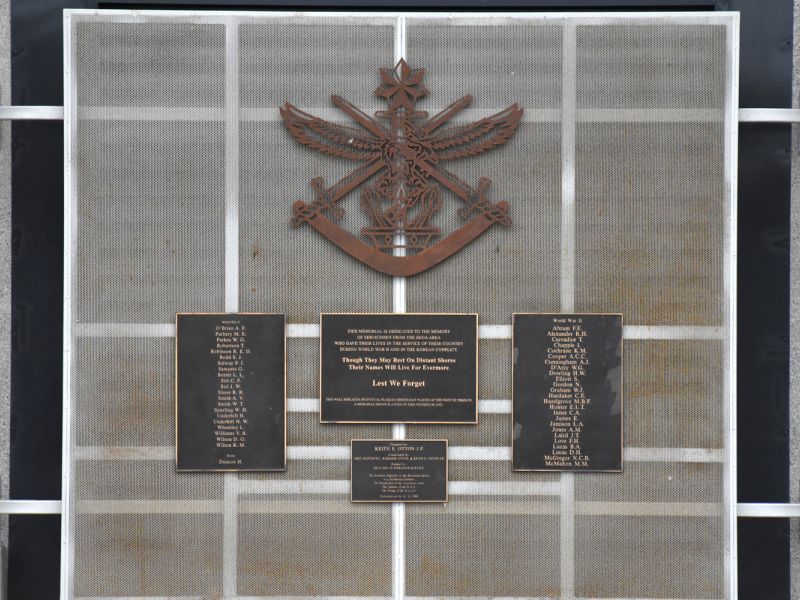
Nine of the ten Lucas brothers served in the Second World War, often enlisting multiple times until they were accepted for service. In 2017, a tribute plaque was dedicated in Bega in memory of Henry Lucas and his nine sons.
- AWM Roll of Honour https://www.awm.gov.au/collection/R1684332
- AWM Roll of Honour https://www.awm.gov.au/collection/R1684174