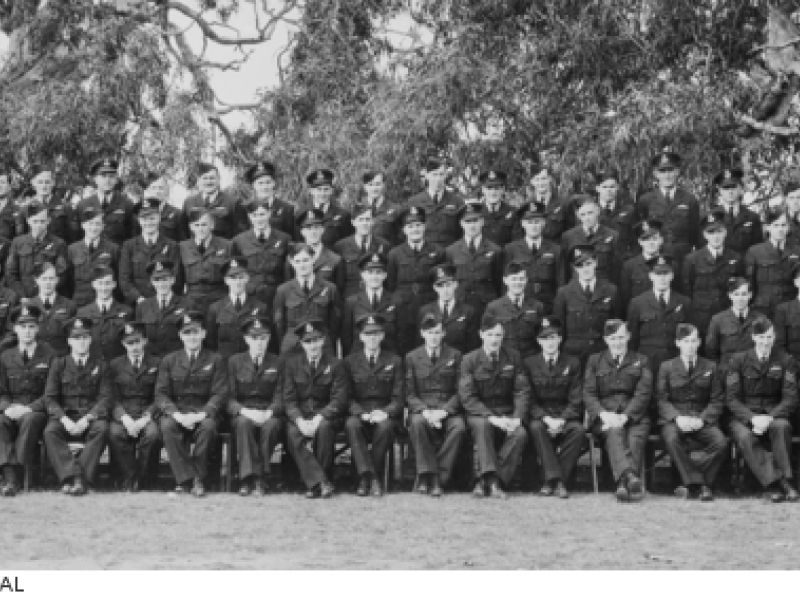
Flying Officer Robert Meath Hammond, 1 Operational Training East Sale, Royal Australian Air Force
 Australian War Memorial
Robert Hammond was born on 24 May 1913 in Carnarvon, Western Australia, the son of Cecil Henry and Ruby Hilda Hammond. His father was the Mayor of Carnarvon.
Robert was commonly known by his middle name, Meath. Young Meath grew up in Carnarvon, where he was involved in music, eventually attending Trinity College of Music. He went on to study at the University of Western Australia, and worked for the Union Bank. After six years at the Carnarvon branch, he was promoted and transferred to Wiluna.
On 26 November 1938, Hammond married Laurie Edith Gell. A daughter, Pauline, was born the following year, on 14 September. The young family lived in North Perth.
Robert Hammond enlisted in the Royal Australian Air Force on 1 March 1942, at the age of 28. After initial training, he began training as pilot, attending elementary flight training school at Cunderdin and service flight training school at Geraldton.
He was awarded his flying badge on 22 December 1942, and in April the following year he joined No. 1 Operational Training Unit. Based at East Sale, this unit trained aircrew for multi-engined aircraft operations. At its peak, it was operating over 130 aircraft, the most numerous being Bristol Beauforts – as well as conducting transport missions in New Guinea and maritime patrols in southern Australian waters.
In July, Hammond was posted to No. 7 Squadron, RAAF, based in Nowra, and then at the Ross River strip in Townsville. Equipped with Bristol Beaufort twin-engined torpedo bombers, this unit served as a bomber-reconnaissance squadron, attacking submarines and conducting patrols and escort duties between the Australian mainland and New Guinea.
In early 1944, the squadron moved to Higgins Field, close to the tip of Cape York Peninsula. Continuing with patrol duties, several aircraft attacked targets in southern Dutch New Guinea. By the end of October the unit had moved north to Tadji airfield near Aitape, beginning operations against Japanese positions in Niap and Wewak.
In June 1944, Hammond left No. 7 Squadron. After spending time at No. 13 Aircraft Repair Depot, in September he transferred to No. 1 Service flight training school, this time joining the unit as an instructor.
He continued in this role, transferring to Central Flying School at East Sale in September 1944. On 19 October that year, a son, Cecil, was born to the Hammonds.
In March 1945, Hammond transferred to No. 1 Operational Training Unit – the unit with which he had trained just two years earlier – as an instructor.
On 30 July, Flying Officer Hammond was the instructor pilot in Beaufort A9-143, overseeing pilot Flying Officer Melville Castle on a low-flying non-operational exercise. Also on board was wireless operator Flight Sergeant Stanley Lloyd.
At 8:15 am, the aircraft struck the ground in a nose-down attitude during a steep turn, crashing about six kilometres from Paynesville in Victoria. The crew of three were killed instantly on impact.
Survived by his widow and two young children, Robert Hammond was 32 years old.
Today, his remains lie buried in Sale War Cemetery.
- Roll of Honour, Australian War Memorial https://www.awm.gov.au/collection/R1719988