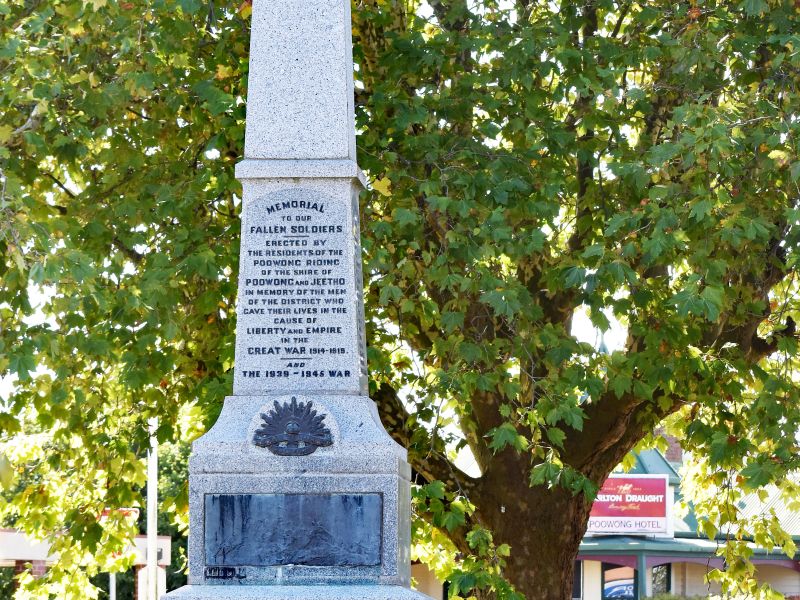
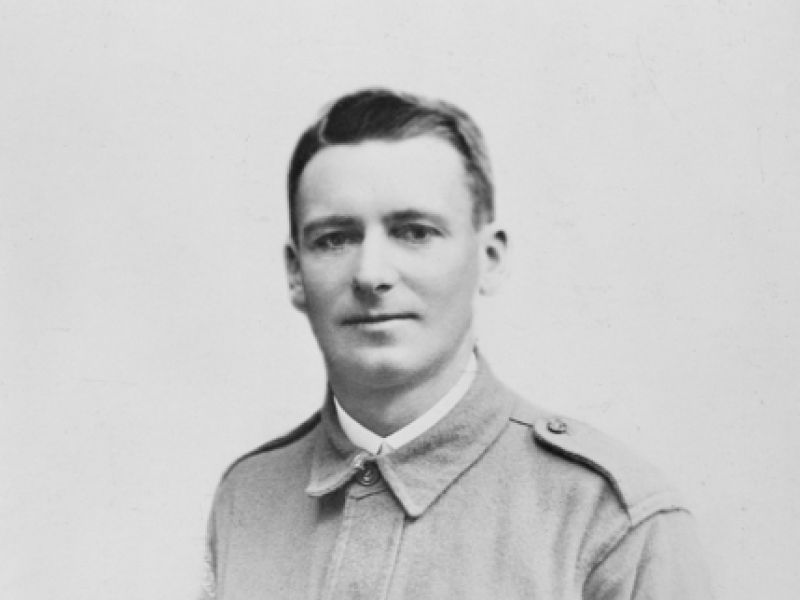
Private Herbert Alexander Mouat, 6th Australian Infantry Battalion
 Australian War Memorial
Herbert Mouat was born on 27 August 1888 in Cowwarr, Victoria, one of four children born to Thomas and Hannah Mouat. Known as “Bert”, he grew up in the suburbs of Melbourne and received his education at Essendon State School where he was a member of the school cadets. Having finished his schooling, he moved to Gippsland, settling in the small town of Poowong, where he worked as a labourer and became captain of the town’s football team. His first child, Ivan, was born in 1910 to Robena Kerr. Robena and Bert married the following year and had a daughter named Joyce in 1913 and another son, Archibald, in 1915.&
Shortly after the birth of his third child, Bert Mouat enlisted in the Australian Imperial Force. He joined on the 27th of August 1915, and was allocated to the 14th Reinforcements of the 6th Battalion with the rank of private. After a short period of training in Australia, he embarked for active service from Melbourne on the 28th of January 1916, on board the troopship Themistocles. His fourth child, Herbert Verdun, was born while Private Mouat was en route to France.
Private Mouat disembarked in Egypt in late February. He soon became ill and was sent to hospital in Cairo. He re-joined his unit in March and was transferred to the newly-formed 57th Battalion a month later. He embarked for the Western Front but was transferred to his old unit, the 6th Battalion, in late July.
He took part in his first major battle of the war near the French village of Pozieres just days after his arrival at the front. The allies made 19 separate attacks there over 42 days in an attempt to capture the village and the high ground at a cost of more than 23,000 casualties. Ralph Donaldson, a signaller who was also in the fighting at Pozieres, recalled the horror of the battle in a letter home to his brother, saying:
“Fritz had been shelling us all night, four of our officers had been killed and others had been wounded … the day after our last scrap up there when our division took the ridge beyond Pozieres, a fellow came to me crying like a little child, and if there was ever such a thing as heartbreak, I saw it then. This man for three days and three nights had been fighting in the trenches … after, he with some others volunteered to do stretcher bearing and when he came to me he had been going all day from early morning, carrying in the wounded under heavy shell fire … He had worked till he could work no longer and it was breaking his heart to know there were still more to be brought in and he could not do it.”
Mouat’s unit was sent to a quieter section of the front in Belgium, where they spent time manning the trenches and training behind the lines.
Mouat became ill again and was sent to hospital to recover. He re-joined the 6th Battalion in November when it returned to France, just in time to spend a bitterly cold winter in the trenches. Like many others, Mouat contracted diphtheria in February 1917. He was evacuated to England until late September, when he re-joined his unit on the Ypres Salient in Belgium. By October 1917, he was thrust back into the fighting under horrendous muddy conditions, assailed by gas and shells.
On 28 October, the 6th Battalion was attacking enemy positions at Passchendaele, when Mouat was hit by enemy gunfire. The bullet penetrated his spine, paralysing him instantly. He was sent to hospital behind the lines for treatment, and then evacuated to England. Medical staff were unable to do anything to improve his condition, and his wife was told that he would be unable to return to Australia. He remained in hospital for almost a year, when he died on 28 September 1918.
Bert Mouat was buried at Brookwood Military Cemetery in Surrey, where he lies today beneath the simple inscription, “For ever with the Lord”
He was 30 years old.
- Roll of Honour, Australian War Memorial https://www.awm.gov.au/collection/R1644643