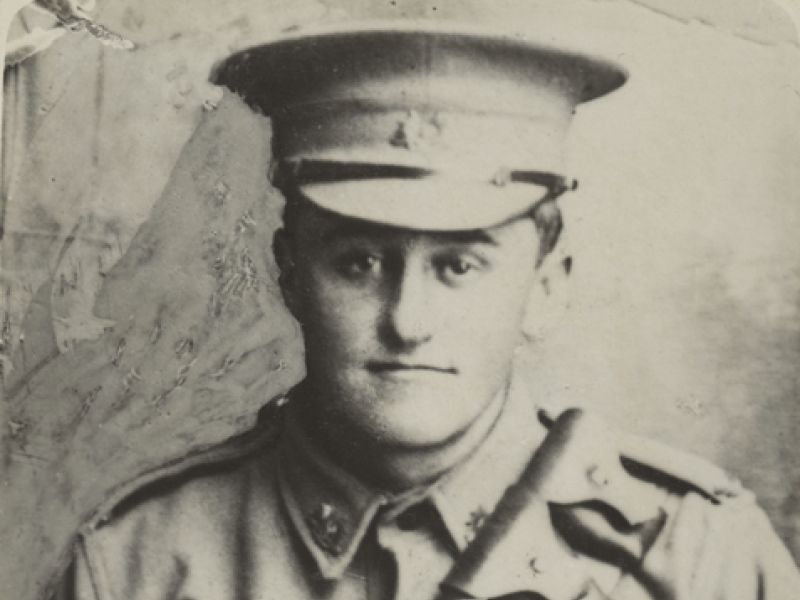
Trooper Joseph James Power, 8th Light Horse Regiment
 Australian War Memorial
Joe Power was born in 1893, the second son of Patrick and Catherine Power of Euroa, Victoria. Born into a large family, he probably grew up on Brook Street, although little of his early life is known. His childhood was certainly not without hardship. Just before Christmas 1903 his brother Leo, just a year younger, died. Three years later, while the family were away, their house burned to the ground. The effect these events had on the family were mostly kept private, however. Joe Power went on to work as a groom, and was described as “a general favorite in Euroa”.
Power enlisted in the Australian Imperial Force within weeks of the outbreak of war in 1914. His experience with horses saw him posted to the second reinforcements of the 8th Light Horse Regiment. After a period of training in Australia, he left for Egypt in February 1915 on board the troopship Armadale.
On 18 March 1915, Trooper Power and his group of reinforcements boarded a train to take them from the Egyptian port of Alexandria to Cairo to begin training in the desert. Power was looking for something to eat, and had heard food was available at the end of the train, so he started moving through carriages. As he got to the end of one carriage, he paused to light a cigarette before moving onto the next. But instead of stepping over the gap between the two train carriages, he misstepped and slipped down between them. The man following him leapt forward but only just touched his coat before Power was gone.
The troop train’s commanding officer, Lieutenant Anderson, tried to stop the train, but the guard refused. When they reached Beira, three miles on from the scene of the accident, Anderson reported the incident, and an ambulance was dispatched. Nothing could be done for Joe Power, however, as he had gone directly under the wheels of the train.
Many of Power’s friends from Euroa commented on his death in letters home. William Saxon wrote, “We … were very sorry to hear of Joe Power’s death at Cairo in April. I think it was on the day we left, so we were much surprised to hear of it.” Albert Bunting wrote home of another man hurt passing from one carriage to another, adding “this is almost the same kind of accident that was responsible for Joe Power’s death. It is the simplest thing in the world for anyone to be caught in this way while the carriages are moving.” William Pezet wrote, “I was very sorry to hear about poor Joe Power. Awful bad luck to get this far and then killed in an accident.”
An enquiry was carried out by military police, which determined that there was no blame to be attached for the accident. Lieutenant Anderson wrote to Power’s parents to say, “you have my deepest sympathy… and, although Joe was not permitted to do any fighting, you have the satisfaction of knowing that he laid down his life for his country in honourable cause, and that his death was without suffering.”
This sentiment was echoed by the Euroa Gazette, which, in delivering the news of Joe’s death, wrote “Although not killed in the fighting line, it must be a comfort to his parents to know that the has given his life for his country just as much as if he were at the front among the bullets, as any services rendered in the preparation, or in the going to the front are part and parcel of the risks of war.”
Private Joe Power was buried on 20 March 1915 with full military honours, one month and five days before the landing at Gallipoli. Today he lies in the Cairo War Memorial Cemetery. He was 22 years old.
- AWM Roll of Honour https://www.awm.gov.au/collection/R1655289