Private Arthur George Power, 28th Australian Infantry Battalion, AIF
 Australian War Memorial
Arthur Power was born in Brentford, England on 18 September 1891, one of 13 children born to engineer Harry Power and his wife Francis, nine of whom survived beyond the age of ten.
Arthur spent five years as an apprentice with the engineering company G.W. Beldam & Company in Brentford.
In September 1911, Arthur left Liverpool with his mother and his five younger siblings on the steamship Belgie, bound for Fremantle in Western Australia. His father stayed behind in England, but eventually joined the family in Australia.
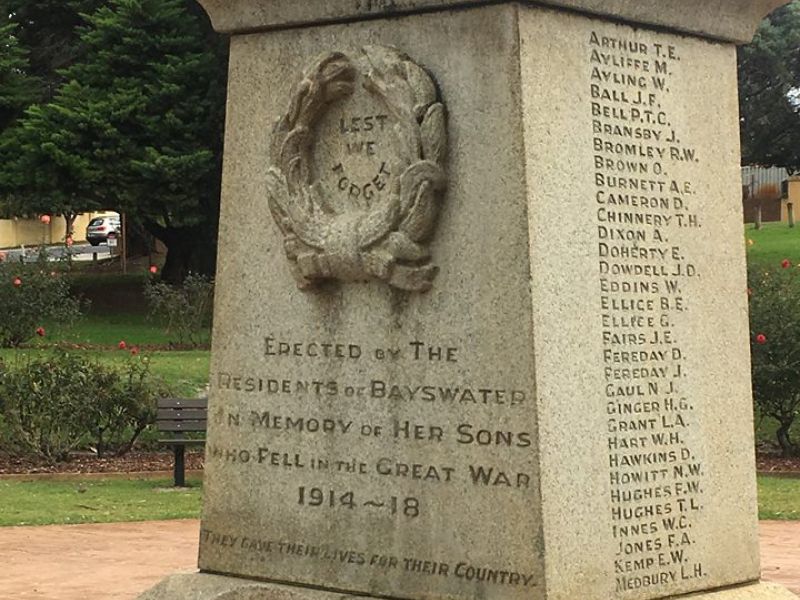
The Power family settled in the Perth suburb of Bayswater. Arthur joined the Western Australian Government Railways and Tramways, and by 1914 was working as a labourer and pattern maker at the Midland Railway workshops.
In December 1915, Arthur married Annie Elizabeth Batey, a fellow English immigrant and a daughter, Ruby, was later born to the couple.
On 13 March 1916, Arthur was granted leave from the Railways to serve with the Australian Imperial Force. He enlisted two days later, was allotted to reinforcements of the 28th Battalion, and began training in camp outside Perth.
Private Arthur Power departed Fremantle in the troopship Seang Bee on 18 July 1916, bound for England. During the voyage, Power found himself on the wrong side of military authorities. He was awarded 168 hours detention for an unspecified reason and confined to quarters from 8 August.
The remainder of the journey to England passed without excitement. Power arrived at Plymouth on 9 September 1916, and joined a training battalion.
Power proceeded overseas to France in November, joining the 28th Battalion at Flesselles in the Somme Valley in early December.
Power passed the bitter winter of 1916 and 1917 in the Somme Valley with the 28th Battalion, moving between the front line and reserve trenches. In mid-February, he was detached to the 7th Australian Machine Gun Company. There is some confusion in his service record over when he returned to the 28th Battalion, or if he remained with the Machine Gun Company for the remainder of his service.
Power was based in the Somme Valley in late May 1917, when he was admitted to hospital suffering from influenza and nephritis – the swelling of the cells in his kidneys. He remained in hospital at Etaples until early August, and spent another month at the Australian Base Depot full recovering his strength.
Power returned to his unit on 13 September 1917, shortly before its transfer into the Ypres sector of Belgium.
On 20 September, members of the 7th Brigade – including the 28th Battalion and the 7th Machine Gun Battalion – were involved in an attack on German positions along the Ypres–Menin Road. While leading a party of men along duckboards towards the front line, Power was hit by the fragments of an enemy shell. An eyewitness observed that the shrapnel had “wounded him very badly”, with wounds to his right leg and right hand.
He was immediately evacuated to the 2nd Casualty Clearing Station, where it appears his right leg was amputated as a result of his wounds. He was transferred to England in late September, and admitted to a Military Hospital in Dover in a critical condition.
Private Arthur George Power ultimately succumbed to his wounds, dying in hospital on 25 September 1916.
He was 26 years old.
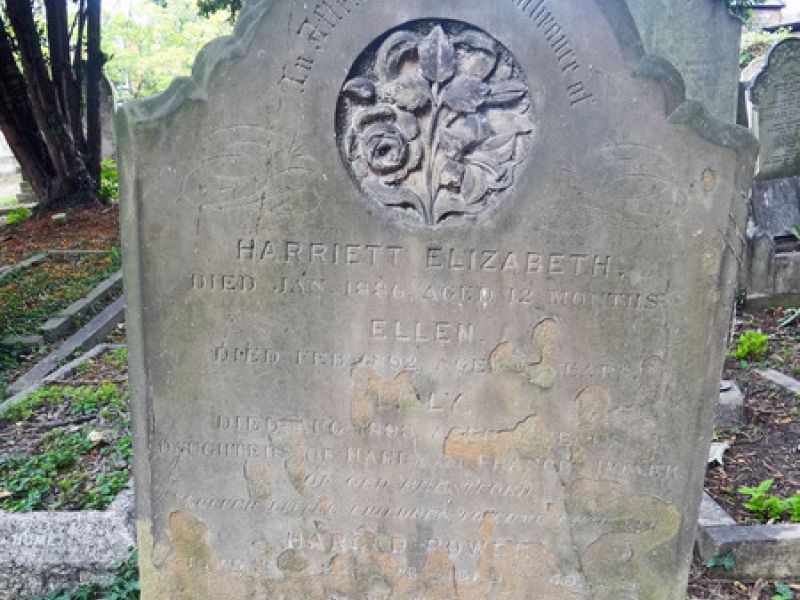
Arthur Power was buried in the South Ealing Cemetery on 28 September, three days after his death. He was given a full military funeral, including a firing party and gun carriage supplied by the Australian command in London. His father was present for the funeral, as was his older brother Private Ernest Charles, who had enlisted in March 1917 and was training in England at the time of Arthur’s death. Wreaths were laid on behalf of Arthur’s mother and siblings, family friends, and the munition workers at Kingston on Thames. An oak cross was erected over his grave by the Australian Imperial Force, which after the war was replaced by a stone Imperial War Graves headstone.
In Australia, tributes continued to pour into the local newspapers long after his death. In 1925, the railway workers at the Midland workshops unveiled a soldiers’ memorial in honour of the employees who had died during the war, including Private Arthur Power
On the second anniversary of his death, Arthur’s wife, family, and friends inserted commemorative poems in The West Australian. The poem inserted by his mother and siblings spoke of their continuing grief, exacerbated by the death of Arthur’s father in June that year:
Never can our hearts forget
The sorrows of the past.
When grief has left so deep a wound
The pain must always last.
His name is listed on the Roll of Honour at the Australian War Memorial among almost 62,000 Australians who died while serving in the First World War.
This is but one of the many stories of service and sacrifice told at the Australian War Memorial. We now remember Private Arthur George Power, who gave his life for us, for our freedoms, and in the hope of a better world.
- AWM Roll of Honour https://www.awm.gov.au/collection/P11072310
- Virtual war memorial https://vwma.org.au/explore/people/199778