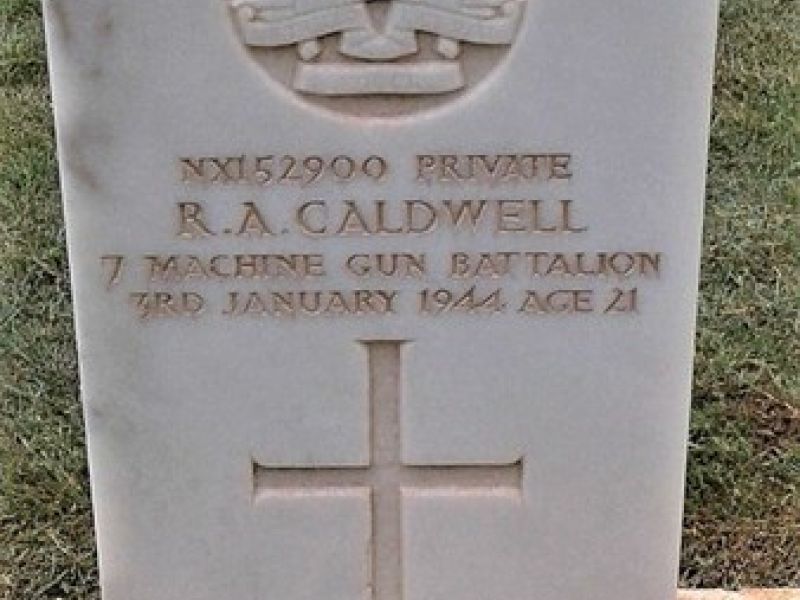
Private Raymond Alexander Caldwell, 7th Machine Gun Battalion
 Australian War Memorial
Raymond Caldwell was born on 24 August 1922 in Nimmitabel, New South Wales, the son of John and Isabella Caldwell.
He grew up in the Bega Valley Shire alongside his siblings – Doris, John, Irene, Alma, and Edith – and attended Cobargo public school, before going on to work as a lorry driver’s assistant.
With the advent of the Second World War, in January 1940, the compulsory military training scheme which had been suspended since 1929 was reintroduced, and militia units were called up for periods of full-time training.
Caldwell, who had joined the Citizens Military Forces in early December 1941, came to join the 3rd Battalion, then based in Canberra.
After the Japanese attacks on Pearl Harbor and British territories in Malaya, the threat to Australia became more immediate, and militia units were mobilised and sent to New Guinea for defensive duties.
In January 1942, the 3rd Battalion was brought up to its wartime establishment with drafts of national servicemen recruited from regional New South Wales and the Australian Capital Territory. By the end of May the men arrived in Port Moresby.
The conditions in New Guinea were difficult. Dense jungles, rugged terrain, intense heat, and tropical disease made service highly dangerous. Caldwell succumbed to an episode of dengue in June. Though he returned to service in July, his health would never completely recover, and he would be plagued by problems until his death.
Detached to the 36th Battalion in September, on his return to duty in November, he joined the newly established 7th Machine Gun Battalion. Raised in Port Moresby as the “New Guinea Force Machine Gun Battalion”, the battalion was formed by bringing together the machine-gun companies of the six infantry battalions already deployed in New Guinea. The men were initially employed to defend the beaches around Port Moresby against a possible Japanese landing.
While this new unit was a militia unit, Caldwell enlisted in the Second Australian Imperial Force regardless, doing so on 7 March 1943. Two months later he was again plagued by illness, and was taken for medical care before returning to duty.
Upon his return, in July he was graded signaller, and conveyed his delight upon this accomplishment so strongly that he was later remembered in newspapers near his home town as “signalman Caldwell”.
In Port Moresby, Caldwell continued training, undertaking defensive duties and working to improve defences. In August, the 7th Machine Gun Battalion was relieved, and Caldwell and his comrades embarked for Australia aboard the troopship Duntroon.
As the battalion began preparing for its next deployment, practising amphibious landings around Trinity Beach in Queensland, the decision was made to disband the unit, and use its personnel to reinforce other units. The process of disbanding the unit would be completed by the end of April 1944.
Caldwell, however, would not live to see this occur. Early in 1944, he was taken to hospital in a dangerously ill state, suffering from intestinal obstruction and abdominal pain believed to be the result of disease.
His condition deteriorated rapidly, and he died on 3 January 1944. He was buried five days later, on 8 January, at Atherton War Cemetery in Queensland, where his remains lie today.
He was 21 years old.
- Australian War Memorial Roll of Honour https://www.awm.gov.au/collection/R1693377