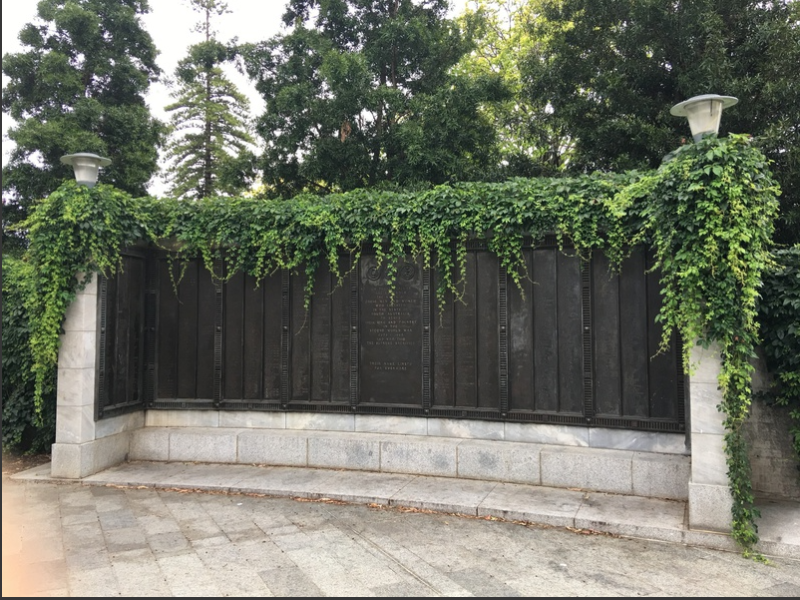
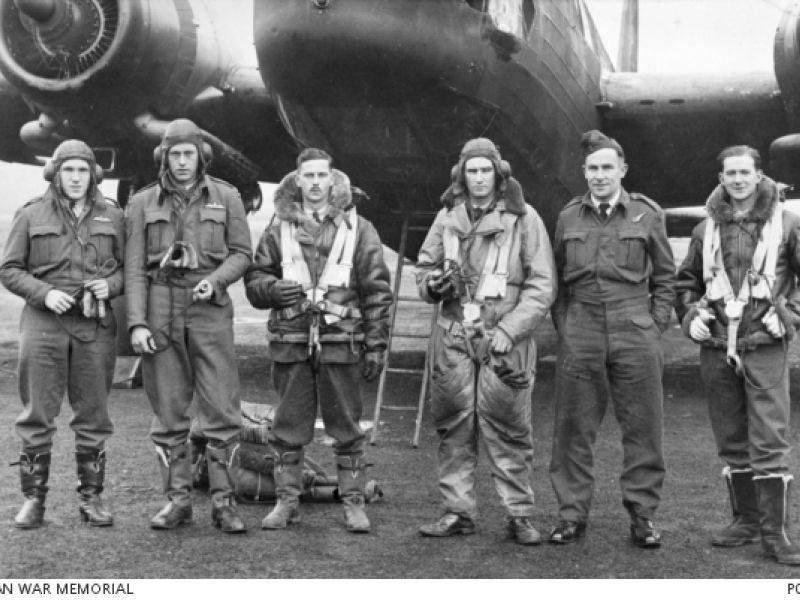
Flying Officer Robert McKerlie Croft, No. 463 Squadron, Royal Australian Air Force
 Australian War Memorial
Robert Croft was born on 16 December 1916 at Evandale, Adelaide, to Margaret and William Croft. William had served with the 4th Imperial Bushmen in the Boer War.
Robert Croft worked as a gardener and a driver, and on 1 June 1940 enrolled in the Royal Australian Air Force reserve, aged 23. The next month he enlisted and began basic training; after that he trained as an air gunner at Ballarat.
On 9 April 1941, Croft embarked from Sydney for overseas service, arriving in England four months later. As part of the Empire Air Training Scheme, he was one of almost 27,500 RAAF pilots, navigators, wireless operators, air gunners, and flight engineers who, throughout the course of the war, joined Royal Air Force squadrons or Australian squadrons based in Britain.
After undergoing more training in England, Croft served in the Middle East with No. 458 Squadron, Royal Australian Air Force, and in North Africa with No. 108 Squadron of the Royal Air Force. Back in England in 1943 he completed a gunnery leader’s course, and that October was promoted to Flying Officer. On 22 April 1944 he was posted to No. 463 Squadron, Royal Australian Air Force.
On the night of 10 May, 31 Lancaster bombers from Nos 463 and 467 Squadrons, RAAF, took off as part of a major Royal Air Force raid from Waddington, England. Their target was the heavily defended railway yards at Lille in France. Flying Officer Croft was the mid-upper gunner.
Sometime before dawn his aircraft was shot down by a Luftwaffe pilot. The bomber crashed into the clay pit of the brickworks just outside the Belgian village of Langemarck, some 30 kilometres north-west of Lille. It was later determined that the aircraft had probably exploded mid-air, and all aboard had died instantly. Twelve Lancasters were lost on the raid, and 50 airmen were recorded as casualties of the mission.
Flying Officer Croft was 28 years old. He was remembered as “a most popular officer … greatly missed”.
The villagers at Langemarck held a memorial service for the crew, and the remains were buried in a nearby cemetery. In 1946 the bodies were exhumed, and the body of Flying Officer Croft was identified. He was reinterred at the Wevelgem Communal Cemetery in Belgium, under the inscription, “His duty nobly done.”
He was mourned by his parents, who placed an in memoriam notice in the newspaper that read:
“We have you in our memory; God has you in His care.”
- AWM Roll of Honour https://www.awm.gov.au/collection/R1706822
- AWM photo collection item https://www.awm.gov.au/collection/C1193549