
Flight Sergeant John Eyre Brown, No. 467 Squadron, Royal Australian Air Force
 Australian War Memorial
John Brown was born on 23 July 1922 in the town of Quorn, South Australia, to Ellis and Elsie Brown. He grew up in company with his younger brother, Robert. Their father was a painter, and the family later lived in Peterborough in South Australia.
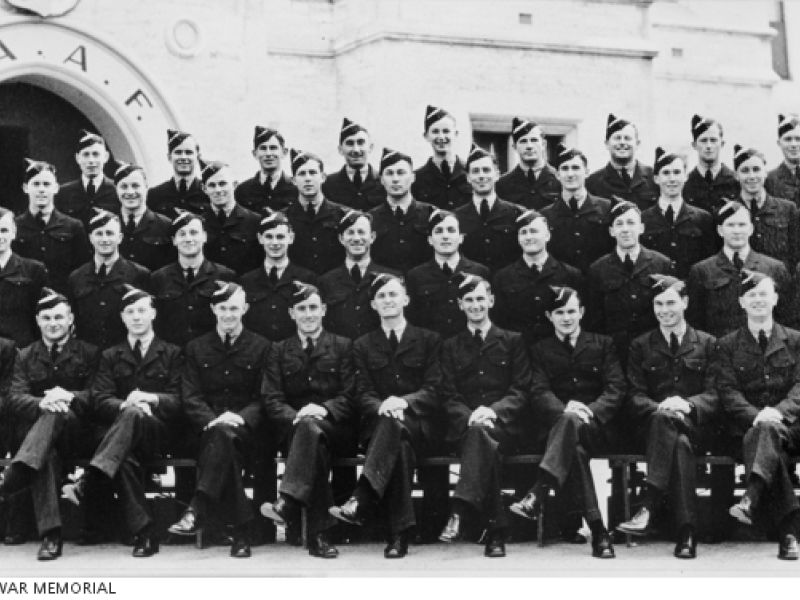
John Brown enlisted in the Royal Australian Air Force on 18 July 1942, just before his 20th birthday. He was trained as an air gunner, and embarked for overseas service on 5 May 1943. As part of the Empire Air Training Scheme, he was one of almost 27,500 RAAF pilots, navigators, wireless operators, air gunners, and flight engineers who, throughout the course of the war, joined Royal Air Force squadrons or Australian squadrons based in Britain.
While in England Brown met Hilda Sharratt, and they married in the Peak District of rural Derbyshire in 1943.
Further specialist training followed, and eventually Brown was posted to No. 467 Squadron, RAAF, as a flight sergeant. As part of Bomber Command, the squadron flew the four-engined Avro Lancaster heavy bomber.
On the night of 20 April 1944, Bomber Command launched a major bombing raid on the marshalling yards at La Chappelle in Paris. Flight Sergeant Brown was the rear air gunner aboard Lancaster “PO-Y”, which took off shortly after 11 pm. No. 467 Squadron committed 19 aircraft to the mission, and PO-Y was the only one that failed to return to base.
After the war it was determined that the aircraft had been hit by anti-aircraft fire, and crashed in an outer suburb of Paris in the early hours of 21 April. There were no survivors. Those killed with Flight Sergeant John Brown were Australians Pilot Officer Kenneth Feeney, Flying Officer James Cameron and Flight Sergeants Maurice Cutmore, Max Francis, and Simon Emery, along with British Sergeant Richard Lundy.
After the war the remains of Commonwealth servicemen buried in Europe were examined and identified where possible. Brown’s body could not be identified, and he was buried in a communal grave with his crewmates in the Clichy Northern Cemetery in Paris. He rests under the inscription: “Among the chosen few, the very brave, the very true.”
He was 21 years old.
John Brown is commemorated on the roll of honour at St Peter’s Church in Buxton, Derbyshire.
- AWM Roll of Honour https://www.awm.gov.au/collection/R1703500
