Flight Lieutenant Rex Victor Skinner, No. 24 Squadron, Royal Australian Air Force
 Australian War Memorial
Rex Skinner was born on 12 September 1918 at Broken Hill, New South Wales. He was the only son of Phillip Skinner, a bootmaker, and his wife Elsie. Rex grew up around Adelaide and received his education at Salisbury Public School and later at Adelaide High School. On completion, he began working as a shipping clerk for a wheat exporter. Rex was involved in his local community, and served in the local militia. He was also a member of the Port Lincoln Aero Club, where he developed an interest in flying.
Rex enlisted in the Royal Australian Air Force Reserve on 17 April 1940. He was soon accepted for pilot training and joined the Royal Australian Air Force in July. He undertook his initial training in Somers, Victoria, before travelling to Parafield for elementary training. In late 1940, Skinner continued his training in Wagga Wagga and Bradfield Park, before embarking for training in Canada on 22 February 1941.
In Edmonton, Alberta, he began training to become an air observer. Skinner was awarded his air observer’s badge in August 1941, and embarked for England the following month. As part of the Empire Air Training Scheme, he was one of almost 27,500 RAAF pilots, navigators, wireless operators, gunners, and engineers who joined squadrons based in Britain throughout the course of the war.
In England, Skinner began training at the Royal Air Force base at Pershore where he learned to fly Wellington bombers. In March 1942 he joined No. 70 Squadron and was transferred to the Middle East. There, he flew during the battle of El Alamein before joining No. 37 Squadron, another Wellington unit based in the Middle East. He served with 37 Squadron in Malta, Libya and Egypt, attacking enemy supply lines as well as vital ports, including those at Tripoli and Tobruk. As the Allies advanced, during 1943 the squadron was based in Tunisia, then Foggia in southern Italy. Skinner remained with this squadron until late 1944, when he returned to Australia. Back in Adelaide, he married his sweetheart Lorna McDougall at St Peters Church in Glenelg on 27 September 1944.
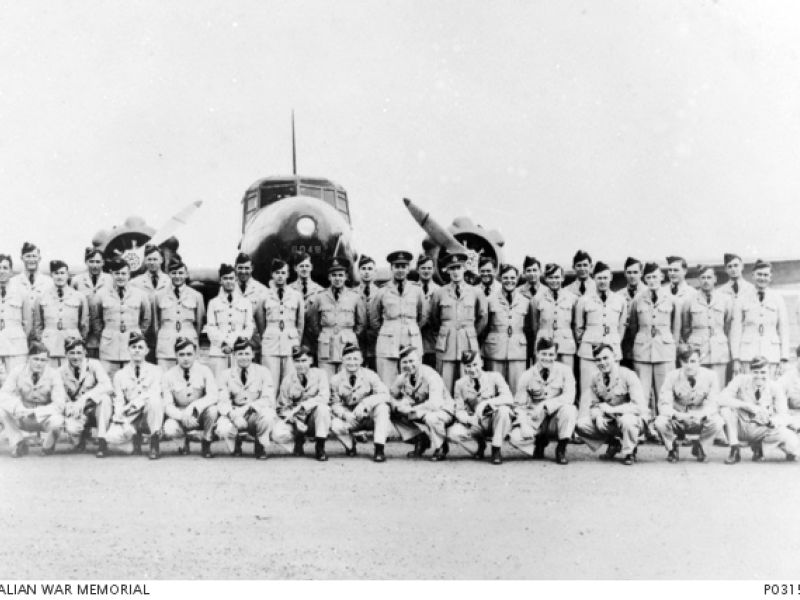
In April 1945, Skinner joined No. 24 Squadron, Royal Australian Air Force, and became involved in bombing raids against targets in the Netherlands East Indies. Based at Morotai, the squadron flew Liberator heavy bombers, which were notorious death traps, known among aircrew as Flying Coffins. These raids in the Pacific formed part of Allied attempts to liberate Java, which had been in Japanese hands since 1942.
Skinner’s first major action with No. 24 Squadron came just three months into his new posting, during the Allied landings at Balikpapan in Borneo. Here, the squadron was responsible for covering the landings of more than 33,000 Allied troops attempting to capture the port and secure the region’s oilfields. Skinner was supporting these attacks on 5 July 1945 when his aircraft was hit by fire from enemy anti-aircraft guns. His Liberator crashed into the side of a nearby hill. It was later located by army patrols who were unable to recover the bodies. A letter written in Malay was attached to the wreckage stating that there were no survivors.
Just over a month later, Japanese forces surrendered and the war in the Pacific was over.
The remains of Skinner and his crew were recovered after the war and buried at Labuan War Cemetery in Malaysia, where he lies today beneath the inscription:
“In his supreme sacrifice we shelter. Glorious memories forever.”
Flight Lieutenant Rex Skinner was 26 years old.
- Roll of Honour, Australian War Memorial https://www.awm.gov.au/collection/R1719193